Molder and Hatcher discuss positions on renewable energy, nuclear power ahead of November election
Sep 14, 2026 | 6:01 am ET
Description
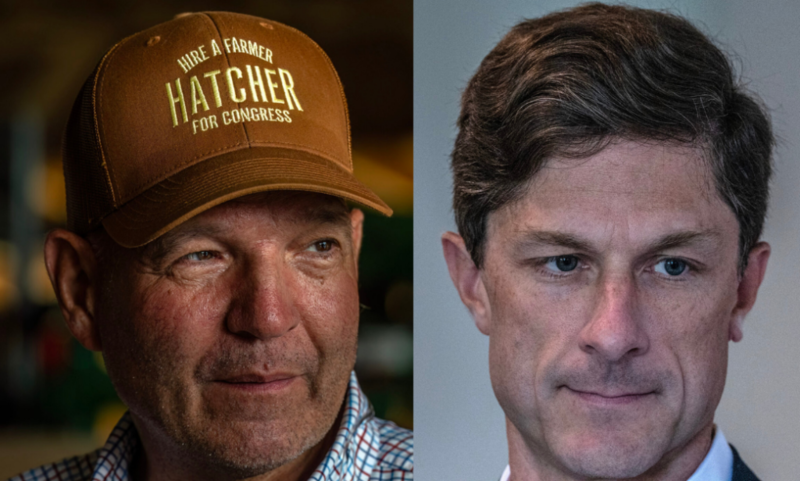
Charlie Hatcher, left, and Chaz Molder, right, are campaigning to serve Tennessee's 5th Congressional District. (Photos: John Partipilo)
District 5 candidates Charlie Hatcher, a Republican farmer and former Tennessee agriculture commissioner, and Chaz Molder, the Democratic mayor of Columbia, share pride in Tennessee’s nuclear energy work and see renewable energy sources as tools for powering the state’s future.
But they take different approaches on federal government involvement and dealing with nuclear waste.
The contenders are vying for a district that spans some of the state’s most and least populated areas, including counties where local economies have ties to renewable energy sources.
The majority of the 54 solar farms in Tennessee are concentrated in West Tennessee. The 5th Congressional District includes several solar farms, including the state’s largest in rural Lake County.
The district is also home to some of Tennessee’s top agricultural counties, where corn and soybeans remain among the leading commodity crops. About 46% of Tennessee’s corn yield is used to make ethanol fuel, according to Tennessee Corn, a coalition of farmer-funded corn promotion groups. The majority of Tennessee’s soybean yield is used for animal feed, but oil extracted from the beans is also used to make biodiesel fuel.
Here’s what Molder and Hatcher told the Lookout about their positions on renewable and nuclear energy.
Federal involvement
Hatcher’s primary election campaign saw a boost from outside spending by the Invest in Tomorrow Coalition, a political action committee funded by renewable energy investors that spent $2 million opposing incumbent U.S. Rep. Andy Ogles for his actions against renewable energy development. After Ogles’ defeat, President Donald Trump endorsed Hatcher to win the general election.
But what does Hatcher think of federal support for renewable projects?
Federal subsidies or grants can and should be used to help fledgling industries get off the ground, he said, but these should be limited in time frame.
“The federal government doesn’t need to create an artificial demand for a certain renewable energy,” Hatcher said. “It’s just not sustainable, and that’s where you get into (being) not good use of taxpayer money. If you have to subsidize renewable energy for a long period of time, I don’t like that.”
Hatcher points to agricultural subsidies as an example.
“Commonly, the USDA gives grants for value-added products, and they’re grants, but the expectation is once that project or that industry gets off the ground, then that’s … termed out,” he said.
The federal government doesn’t need to create an artificial demand for a certain renewable energy. It’s just not sustainable, and that’s where you get into (being) not good use of taxpayer money.
Hatcher also acknowledged the agriculture industry’s positive relationship with renewable fuels, which provide another use case and revenue stream for the country’s most prominent row crops.
“I’m for all forms of energy that make sense,” he said. “They have to stand alone themselves once they get off the ground.”
Molder said federal incentives for renewable energy need to be consistent, referring to the Trump administration’s abrupt reversal of Biden-era tax credits and other federal support for renewable energy programs.
“Federal policies need to be consistent and steady enough for utilities and businesses, small businesses particularly, to plan around it,” Molder said. “Constantly creating these incentives and then turning around and abruptly eliminating them makes it harder and harder for businesses to really participate in these types of renewable energy options, and frankly, make it more expensive to build and more expensive to borrow for.”
Solar power and other renewable energy can help lower costs and strengthen the grid long-term, Molder said.
Gov predicts Tennessee will be a finalist for nuclear campus
“This is an opportunity where government can be put to work to do good by incentivizing the private sector to be innovative with respect to renewable energy opportunities instead of creating inconsistencies and causing confusion,” he said.
Going nuclear
The U.S. Department of Energy announced in early August that Tennessee is one of five states under consideration for a federal nuclear energy partnership. The state has a long history in nuclear research at the Oak Ridge National Laboratory, and Gov. Bill Lee created a $70 million investment fund for nuclear projects and a nuclear advisory council.
The federal government is proposing a $50 billion investment in a nuclear campus involving both production and nuclear waste storage. The announcement stirred concern over where and how nuclear waste might be stored in Tennessee if the state is selected for the project.
We’ve got to make sure we understand what we’re doing in our own state relative to nuclear energy and waste that’s being produced in our own state before we start becoming a storage site for other states’ waste.
“Nuclear energy is already our state’s biggest source of electricity,” Molder said. “We should be proud that Tennessee is leading the nation in this regard.”
Molder emphasized the growing need for electricity and said “having reliable, low-carbon power around the clock is important,” and nuclear energy will be a part of meeting that demand.
But he’s concerned about the possibility of Tennessee becoming a storage site for other states’ nuclear waste.
“We’ve got to make sure we understand what we’re doing in our own state relative to nuclear energy and waste that’s being produced in our own state before we start becoming a storage site for other states’ waste,” Molder said. “And I think, you know, being a mayor, having local control on these issues is very important for me.”
Hatcher said he’s proud of Tennessee “leading the country on nuclear energy,” including Lee’s focus on the industry. Lee appointed Hatcher to his position in the state’s agriculture department, and endorsed Hatcher’s campaign to represent the 5th District.
Regarding nuclear waste, Hatcher said he would “just let the experts deal with that.”
“We’ve had nuclear waste in the past. I expect, as technology advances, there will be less nuclear waste and a better way to store it,” he said.
Nashville, TN