Oregon on track for historic midterm voter turnout, secretary of state says
Nov 03, 2026 | 4:12 pm ET
Description
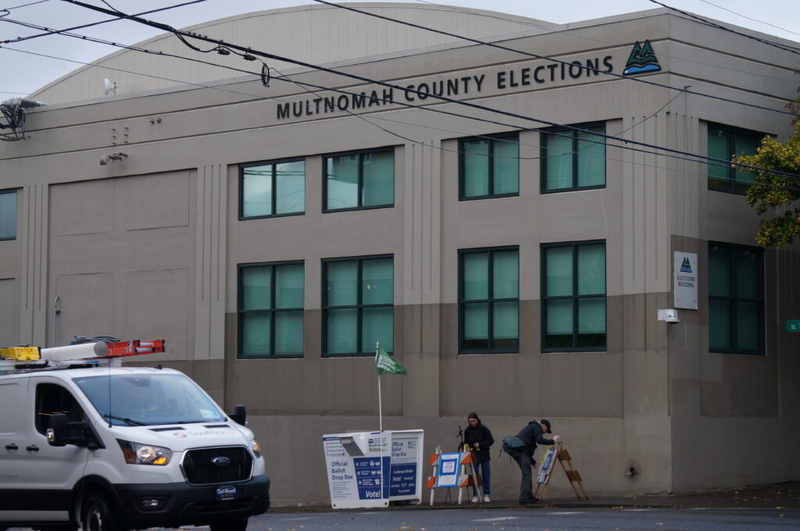
Voters drop their ballots in a ballot box outside of a Multnomah County elections office on Monday, Oct. 28, 2024 in southeast Portland. (Photo by Alex Baumhardt/Oregon Capital Chronicle)
PORTLAND —Voter turnout for Oregon’s midterm election could be on track to reach historic highs, according to Secretary of State Tobias Read.
As of Tuesday morning, more than 1.5 million eligible Oregon voters had already cast their ballots, and Read said overall turnout is expected to surpass recent years’ midterms with average turnout in the high 60% of registered voters.
While the total number of votes cast in Oregon continues to climb, overall turnout percentages decreased slightly after 2016, when the pool of registered voters expanded due to the implementation of a state law that automatically registers Oregon drivers to vote in the license registration and renewal process. Turnout is also generally higher in presidential election years than in midterms.
The turnout numbers were among election updates Read and other Democratic state leaders, including U.S. Sen. Ron Wyden and Attorney General Dan Rayfield, shared at a news conference at Portland State University on Tuesday.
PSU President Ann Cudd also joined the elected officials to praise Read’s Campus Voting Challenge launched this fall, meant to boost college student voter participation.
Read, Rayfield and Wyden reiterated messages they’ve shared for months about election integrity and the importance of getting ballots into boxes today by 8 p.m.
Ballot box access and voter intimidation at drop sites has not been an issue so far, Read said. President Donald Trump and the U.S. Department of Justice for the first time in history has sent election monitors to all 50 states.
In Oregon, 10 were sent to Multnomah County, Read said, including some who are Oregonians. The Multnomah County Elections Division has also sent out observers to monitor the federal monitors, according to Read.
He urged voters to ensure they’ve signed their envelopes and that it matches the signature on file at their local elections office. Some 15,000 ballots were challenged during the May primary because of signature issues. Read said in that situation, the voter will get a letter from their elections official with instructions, and they’ll have 21 days after election day to get the issue fixed so that the ballot will count. He encouraged all Oregonians to track their ballots at oregonvotes.gov/track, available to voters in all 36 counties for the first time.
Wyden and Rayfield said they are already in discussion with local county election officials and attorneys general from across the country to prepare for the possibility of unlawful intervention or Trump and his administration’ refusal to accept election results.
Trump and federal Department of Justice officials have sought to preemptively disqualify outcomes and voters in Alaska and California, and Trump for years has sought to cast doubt on U.S. elections integrity and the outcome of the 2020 election, when he lost to former President Joe Biden.
Rayfield said he and other state attorneys general have been planning for worst-case-scenario election denial from the president for the last two years.
“We’ve held multiple gatherings, some where Secretary Read’s team has joined, and other secretary of states, planning for all the eventualities that could occur prior to election day, “ Rayfield said.
He described planning for “phase one,” which was the possibility Trump could try and manipulate results before Election Day. He described “phase two” as everything after Election Day, and the possible choices Trump could make if the Republican party experiences major losses.
“These are the types of things that you have dedicated public servants and Departments of Justice across this country that are preparing for those eventualities,” he said.
Zach Stancik, a member of PSU’s student government, asked Read what he would tell voters inclined to not fill out the full ballot, or who just vote in the highest-profile statewide races. Read enumerated that since 2018, 600 contests have been decided by less than 10 votes.
One of the most notable examples was former Gov. Kate Brown, who won her first election to the Oregon House of Representatives by seven votes in 1992.
“So if just four people had done something different, we might not be referring to her as Governor Brown,” Read said.
Salem, OR