Mock funeral mourns death of academic freedom before UT System updates rule on cutting programs
May 20, 2026 | 6:59 pm ET
Description
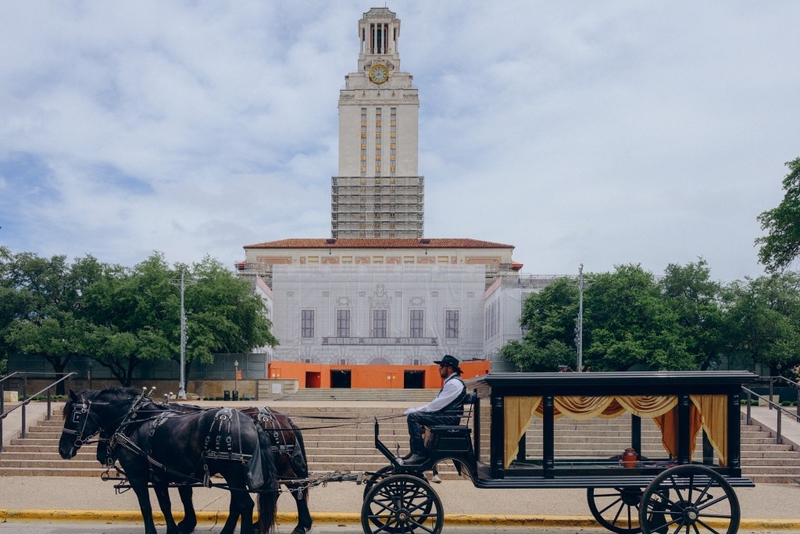
A horse-drawn hearse at the University of Texas at Austin Tower during the UT Funeral protest on May 20, 2026. (Manoo Sirivelu/The Texas Tribune)
University of Texas System regents approved a rule change Thursday, giving campus presidents more power to cut academic programs and faculty jobs.
Their vote came one day after critics marched a horse-drawn hearse through downtown Austin to the system headquarters to mourn the death of academic freedom at Texas colleges.
Critics say UT System’s new policy strips protections as universities face political pressure over what can be taught and studied.
“I come bearing terrible news,” graduate student Cameron Samuels told the crowd through a megaphone on Wednesday. “The University of Texas is dead. Yes, you heard that right.”
Samuels, co-founder of Students Engaged in Advancing Texas, said the university and “its spirit of academic freedom” had fallen to “a death by a thousand cuts.”
Until Thursday, faculty at system schools had a formal role in reviewing academic programs and some jobs before they are cut. The new rule gives administrators more control and bars professors from appealing a president’s decision to eliminate an entire academic program and the jobs tied to it.
The move aims to streamline the process while preserving faculty input and due process, according to UT System agenda materials. Regents approved it Thursday without discussion as part of a broader package of personnel rule changes.

Some UT schools are consolidating race, ethnicity and gender programs. At Wednesday’s meeting, several speakers urged regents to slow down or reverse those decisions.
Board Chair Kevin Eltife defended the direction of the UT System. The system has record enrollment, philanthropy and alumni support, and 95,000 students applied to UT-Austin this year for 9,000 spots, he told attendees.
“Whatever we’re doing, we’re not perfect, but we’re damn sure headed in the right direction,” Eltife said during Wednesday’s meeting. “We respectfully agree to disagree.”
UT-Austin officials announced in February plans to merge several race, ethnic and gender studies departments by September 2027. Faculty were later told the consolidation would be completed by this fall. University of Texas at San Antonio officials, meanwhile, said they would combine the university’s bicultural-bilingual studies department with its race, ethnicity, gender and sexuality studies department by Sept. 1.
In records obtained by The Texas Tribune through public information requests, UTSA cited declining enrollment, financial pressures and an “uncertain policy landscape” among the reasons for its move. UT-Austin officials reviewed data comparing faculty and undergraduate major counts in several departments slated for consolidation with much larger departments, according to the records. For example, data show women’s, gender and sexuality studies had 13 faculty members and 24 undergraduate majors, compared with 53 faculty members and 2,927 undergraduate majors in economics last fall.
Teaching about race, gender or sexuality is not against state or federal law. But leaders at both levels of government are increasingly pressuring colleges over those subjects.
Last year, for example, President Donald Trump and Gov. Greg Abbott issued executive orders directing the federal and state governments to recognize only two sexes. UT-Austin was among the schools offered a Trump administration compact that would have given signatories priority for federal grants and other benefits if they agreed to campus policy changes. Eltife initially praised the proposal as an opportunity for reform, but UT-Austin leaders did not sign it.
Students and faculty dressed in funeral attire marched nearly 2 miles from the UT Tower on campus to system headquarters downtown, retracing a route organizers linked to student protests after former UT-Austin President Homer Price Rainey was fired in the 1940s amid conflict with regents over academic freedom.
The funeral was organized by Students Engaged in Advancing Texas, a youth-led advocacy group that held a similar mock funeral for academic freedom at a Texas Tech University System Board of Regents meeting on May 7. The group plans another demonstration Thursday at the University of North Texas System’s regents meeting.
Samuels urged alumni and supporters to withhold donations until UT leaders take steps to protect academic freedom as well as students and faculty members’ rights. In an interview Tuesday, Samuels said about 20 people had signed the pledge to withhold their donations over the past week, though not all listed an amount. Samuels said those who did list amounts had pledged to withhold about $30,000. That total does not include Pamela Ribon, a UT-Austin alumna with an endowed scholarship in the theatre and dance department.
Ribon, who spoke at the College of Fine Arts commencement in 2019, confirmed she will not add to that endowment or contribute to the Annual Fund, which she has done nearly every year since graduating in 1997.
“This is heartbreaking to me,” Ribon said in an email to The Tribune.

Karma Chávez, chair of UT-Austin’s Mexican American and Latina/o studies department and president of the campus chapter of the American Association of University Professors, told regents before Thursday’s vote that her department will be eliminated Aug. 15.
“I’ve seen firsthand how a well-functioning and thriving department … can be put on the chopping block without anyone doing the chopping having even a remote idea of what we do in the classroom,” Chávez said.
Chavez was the only person who testified on the rule before Thursday’s vote. A day earlier, others framed UT schools’ consolidations of ethnic and gender studies programs as part of a statewide fight over whose history students learn.
Alicia Perez-Hodge, representing HABLA Hispanic Advocates and Business Leaders of Austin and the Coalition for Excellence in Higher Education, said she wished she had learned about South American independence leader Simón Bolívar at the same time she learned about George Washington.
“But in South Texas, they taught us about Robert E. Lee,” Perez-Hodge said. “You talk about indoctrination? The man was a traitor to the United States of America, yet we were taught to honor him.”
Under the old policy, tenured faculty in a program under consideration for closure was allowed to contribute to a review through a committee made up of faculty and administrators.
The new rule shifts more of that review into administrators’ hands. The president will direct the review and decide what to consider, including cost, enrollment, student demand, completion rates and whether the program fits within the university’s mission. The provost will conduct the review and recommend a decision to the president.
Faculty can still submit information, and a review panel made up mostly of faculty members will consider it before making recommendations to the provost.
The policy now narrows some appeals. Faculty can no longer appeal a president’s decision to eliminate an academic program and the jobs tied to it. They could appeal only when some positions are cut within a program that remains open and only to challenge whether university leaders acted arbitrarily in choosing one professor over another. The rule cuts that appeal window from 30 days to 15 days.
Presidents can fast-track program closures in rare, time-sensitive cases involving state or federal regulations, including when delays could threaten compliance or students’ eligibility for federal aid. The adopted policy does not outline how quickly that process could move but notes that financial pressure or enrollment declines alone would not qualify.
Randa Safady, UT System’s vice chancellor for external relations, communications and advancement services, responded to The Tribune’s questions about the proposed changes saying they are part of a broader effort by regents to streamline rules and “make each section work more efficiently.”
The academic program elimination rule was created more than two decades ago and has had little modification since, leaving it to operate under “old language and definitions,” Safady wrote in her response.
Safady said drafts of rule changes are sent to university presidents, faculty representatives, members of the employee and student advisory councils and others for review. She did not say whether the proposed rule could apply to ongoing consolidations at campuses.
The program-cutting rule was not the only change to faculty governance regents approved Thursday.
The broader package also revised UT System’s faculty advisory body rule, creating a systemwide faculty advisory body made up of one faculty member from each institution selected by campus presidents from president-controlled campus advisory groups.
Unlike faculty senates reconstituted under Senate Bill 37, those advisory bodies do not appear to carry the same public meeting requirements.
The Texas Tribune partners with Open Campus on higher education coverage.
Disclosure: Texas Tech University System, University of Texas System and University of Texas at San Antonio have been financial supporters of The Texas Tribune, a nonprofit, nonpartisan news organization that is funded in part by donations from members, foundations and corporate sponsors. Financial supporters play no role in the Tribune’s journalism. Find a complete list of them here.

Austin, TX