‘Not the place to commit financial crimes’: Utah aims to better fight complex scams
Aug 31, 2026 | 6:38 pm ET
Description
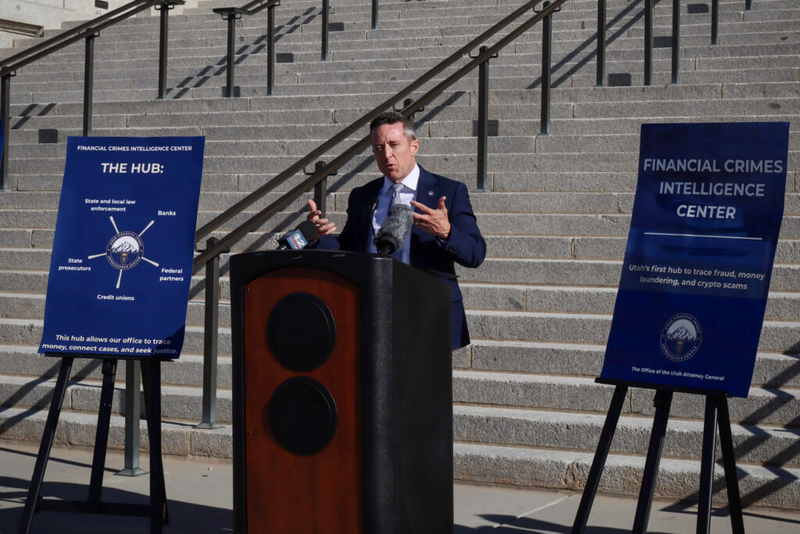
Utah Attorney General Derek Brown speaks at a news conference announcing the state's new Financial Crimes Intelligence Center on Aug. 31, 2026. (Annie Knox/Utah News Dispatch)
Utah is stepping up its efforts to investigate scams and connect the dots between them with a new hub that’s the second of its kind in the nation, state leaders said Monday.
They want the Financial Crimes Intelligence Center in the Utah attorney general’s office to form a new line of defense against increasingly sophisticated operations, including those using artificial intelligence to multiply their reach, said Utah Attorney General Derek Brown.
The problem is growing, he told reporters, with Utahns losing $108 million to financial crimes last year and almost $60 million so far this year. Once someone’s been scammed, Brown noted a bank typically flags the problem, a police department will open a case and a hotline will field a call from the victim seeking help.
“But ultimately, none of these organizations are talking with each other,” Brown said. “So it’s hard to know if they’re part of a larger, organized crime ring. There’s a gap. And today the FCIC is filling that gap.”
Utah lawmakers this year gave their support to the center, committing to $1.7 million in yearly funding. Senate Majority Leader Kirk Cullimore, who sponsored the budget request, said it fits with the Legislature’s recent move to protect digital identity and sends a strong message.

“I think this will signal that we are not the place to commit financial crimes,” Cullimore, R-Sandy, said during Monday’s news conference at the state Capitol.
As they pieced together the plan for the center, state officials met with law enforcers in Texas to learn about a state fraud intelligence center there, Brown said after the news conference. The Utah team’s goal is to bring in enough information to recognize patterns, he told Utah News Dispatch.
“And frankly, AI is going to help us do that as well,” Brown said, adding that component is still taking shape. “You know, we can use the same tools that they use — to benefit us.”
He’ll measure the success of the program in part by how much money is returned to victims after judges order restitution, Brown said. But it will be more difficult to know how many people never fall victim because of prevention and heightened awareness, he added.
To fight elder fraud, a top Utah law enforcer is meeting with seniors around the state
The center’s employees include two prosecutors, two investigators, a forensic accountant, an analyst and a paralegal. They report to a division director in the attorney general’s office overseeing mortgage and financial fraud cases, Brown said.
Surrounded by representatives from banking and credit union associations at the news conference, Brown and Cullimore said Utahns who fall victim to fraud should not feel ashamed.
Cullimore said within the last week, someone in his household accidentally gave credit card information to a fake website. And Brown recounted how an attorney friend lost millions to a sophisticated real estate scam.
“I just want you to reach out, I want you to report it, because a $30,000 fraud that takes place in Cache County and a $30,000 fraud taking place in Washington County may actually be connected,” Brown said. “Our job is to identify that connection.”
Howard Headlee, president of the Utah Bankers Association, added it’s important to file a report right away so investigators can get to work.
“In these cases, time is of the essence. Time is critical,” Headlee said.
To report fraud to the center, visit its website at fraud.agutah.gov.
Salt Lake City, UT