Prop. 317 would call drug cartels terrorists. Critics fear who else it could catch.
Aug 31, 2026 | 6:56 pm ET
Description
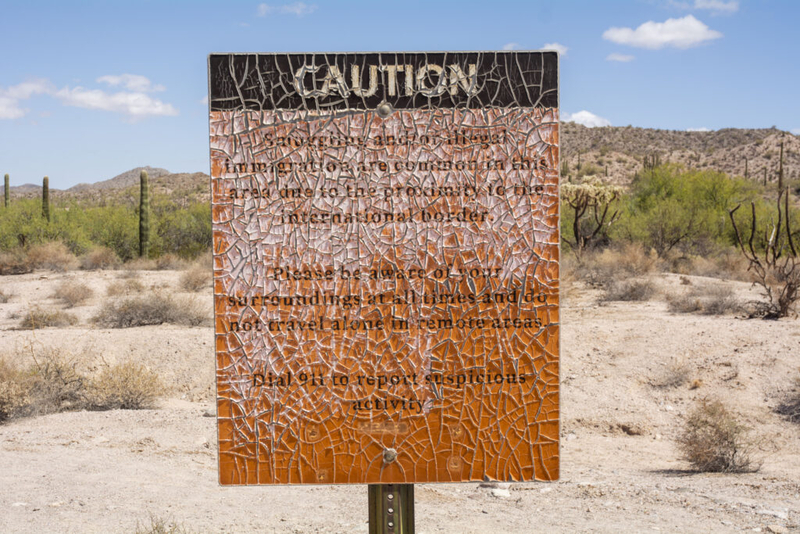
A worn out sign at the trailhead for Quitobaquito Springs warns visitors that they may encounter smugglers or migrants in the area and says to call 911 if they see suspicious activity. (Photo by Jerod MacDonald-Evoy/Arizona Mirror)
Later this year, voters will decide whether Mexican drug cartels should be labeled terrorist organizations under Arizona law, a classification that critics say will, at best, do nothing and, at worst, be used by a future governor to justify sending military forces to the border.
Proposition 317 would declare drug cartels equivalent to terrorist organizations and order the Arizona Department of Homeland Security to do everything within its power to “address the threat posed by drug cartels.” Putting the law on the books has been a multi-year effort for Republican Steve Montenegro, the speaker of the Arizona House of Representatives, who has sought to set himself apart as a vocal immigration hawk among a party that is increasingly focused on the issue.
In 2023, Gov. Katie Hobbs vetoed the Goodyear Republican’s first iteration of the drug-cartels-are-terrorists bill, prompting Montenegro to turn to voters to avoid future rejections. But the Republican-controlled legislature decided not to advance a ballot measure version in 2024.
It wasn’t until 2025, after President Donald Trump issued an executive order designating drug cartels terrorist organizations at the federal level — which was quickly weaponized to ship immigrants with tattoos to a Salvadoran mega prison, where they were subsequently tortured — that Arizona Republicans greenlit the move to ask voters to order state officials to go after drug cartels.
Joel Edman, a spokesman for Progress Arizona, called the proposal “pure, dumb symbolism” and said it amounts to nothing more than Republican lawmakers seeking to bolster Trump’s policy goals.
“This is clearly trying to support and signal the local legislative Republicans’ loyalty to Trump’s agenda,” he said.
But Edman acknowledged that the language in the proposal could potentially be used by a future Republican governor to send Arizona National Guard soldiers to the southern border, under the guise of protecting against an “invasion” of undocumented immigrants and drug smugglers, which Republican lawmakers have long fought to declare.
“(Prop. 317) is part of this broader effort to continue to militarize the border,” Edman said.
Darrell Hill, the spokesman for the Arizona chapter of the American Civil Liberties Union, echoed that concern, though he emphasized that using Prop. 317 as the basis for declaring an “invasion” would ultimately be legally indefensible.
“It has very loaded language that could lead to the deployment of law enforcement or other resources at the border in excess of what is necessary, but I don’t think the state has the power to declare an invasion,” he said.
Once an extreme position staked out by the most xenophobic Republicans, characterizing human trafficking and drug smuggling at Arizona’s southern border as an “invasion” has now become a common sentiment in the Republican Party under Trump.
In 2022, then-Arizona Attorney General Mark Brnovich, facing plummeting public opinion in a crowded U.S. Senate primary, published a legal opinion claiming that the governor has the right to invoke war powers under the U.S. Constitution’s definition of an invasion. Legal scholars have refuted that argument, noting that the Constitution leaves the decision about how to respond to an invasion to federal officials.
But Republicans have pushed forward with the theory. And Prop. 317 appears to have been born, at least in part, in a nod to that argument. During a February meeting of the House Judiciary Committee, Montenegro touted the legislation as a critical tool for law enforcement officers and a necessary defense against criminals at the Arizona-Mexico border.
“(Prop. 317) underscores the urgency of the Arizona Department of Homeland Security to utilize its authority to address the invasion of traffickers at Arizona’s southern border,” he said.
Hill pointed out that, while the proposal threatens to lead to an overly militarized border, the more immediate concern is who could be classified a terrorist. The definitions in the initiative about what constitutes a drug cartel are too broad, Hill said, and they risk labeling Arizona residents or asylum-seekers as terrorists instead of people who are actually involved in drug trafficking.
Prop. 317 defines a drug cartel as an “ongoing formal or informal association of persons” whose members either individually or cooperatively participate in human smuggling, drug trafficking for profit or terrorism. That, Hill said, could sweep in low-level drug offenders, people with substance abuse issues or immigrants traveling with paid guides.
“Arizona residents who are engaged in buying and selling low amounts of drugs may find themselves designated as terrorists simply because they have a substance abuse disorder or are a low-level part of the drug economy,” he said.
A similar concern was raised during that House Judiciary hearing. Rep. Lupe Contreras, D-Laveen, pressed Montenegro on whether the legislation could lead to migrants being forced to carry drugs while crossing the border under threat of violence also being designated terrorists. Montenegro waved away that concern, saying that the Department of Homeland Security has processes in place to determine who is really at fault.
“The Department of Homeland Security has different processes and different definitions as to how they deal with terrorist organizations. It has to do with the transnational criminal aspects of the organization, it has to do with their activity,” Montenegro said. “If they’re going to be terrorizing people, that’s different than carrying a backpack.”
It’s unclear how the ballot measure will fare in November, but Arizonans have demonstrated a willingness to support proposals that take an aggressive stance against border-related crimes. Two years ago, 61% of voters approved of Proposition 314, which made it a state crime punishable with a minimum of 6 months in jail for people to cross the state’s southern border without authorization anywhere but at an official port of entry.
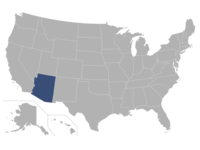
Phoenix, AZ