Michigan lawmakers still don’t have a budget deal, scuttling likelihood of a vote before midnight
Jul 02, 2026 | 3:53 pm ET
Description
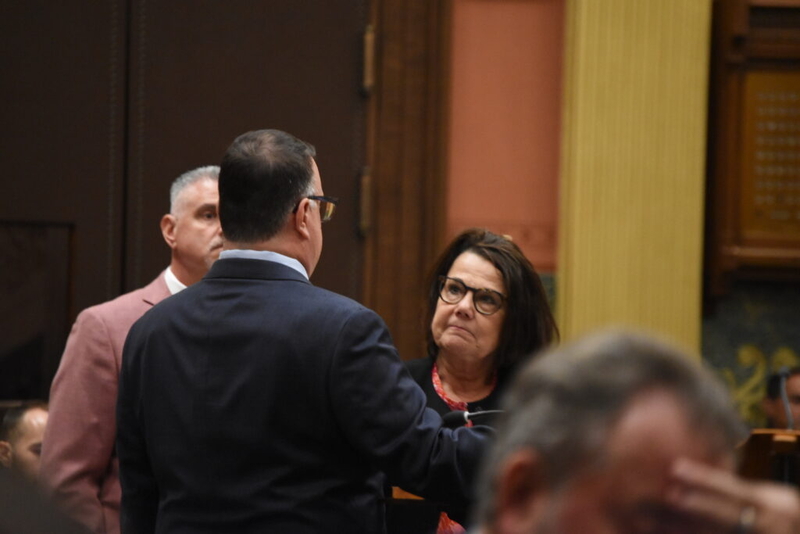
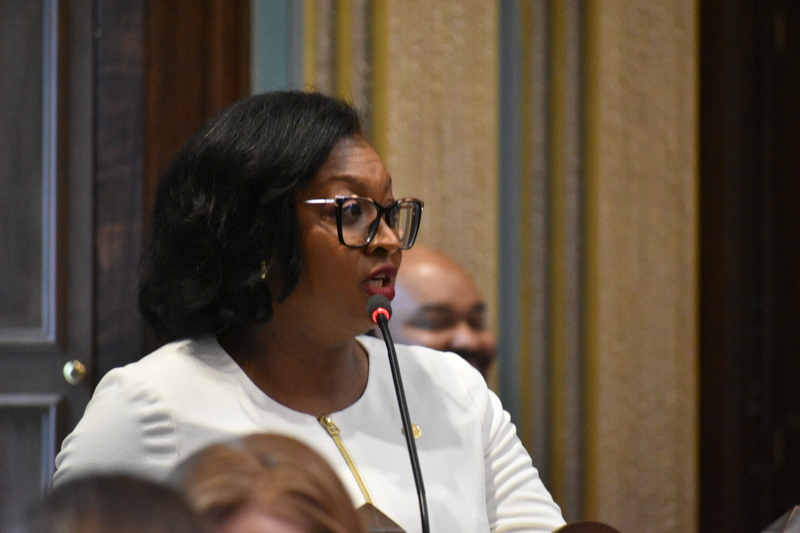
House Speaker Matt Hall and House Appropriations Chair Rep. Ann Bollin speak on the House Floor amid debates on the Fiscal Year 2027 budget. July 1, 2026 | Photo by Katherine Dailey/Michigan Advance
After working late on Wednesday to send 2026-27 fiscal year budget negotiations to the respective leaders of the state House, Senate and Gov. Gretchen Whitmer’s office, lawmakers on Thursday said they were no closer to a deal than they were the previous evening.
House and Senate Conference committees — which is the final negotiating and development stage of the state’s budget process — were scheduled to meet Thursday around 1 p.m. Both committees, however, gaveled in and immediately went at ease.
On the House side, state Rep. Ann Bollin (R-Brighton Township), chair of the House Appropriations Committee, immediately left the House’s appropriations meeting room on the Capitol’s third floor without addressing why the committee was at ease. The committee was meant to meet to discuss and then vote out the House K-12 and higher education omnibus bill, House Bill 5630.
Across the hall, in the Senate appropriations room on the same floor, state Sen. Sarah Anthony (D-Lansing), chair of the Senate Appropriations Committee, similarly gaveled in the meeting only to send it at ease. Anthony’s committee was meant to discuss and vote out Senate Bill 878, the omnibus package funding the whole state government and its agencies.
Anthony did speak with reporters following the meeting. She said that the parties were still negotiating and that a final agreement has not been reached as of 1:30 p.m. Thursday. When asked what the hold up was — policy related bills to make the deal work, funding items within the budget, or disagreements on boilerplate language — Anthony said, “everything.”
“Nothing has been finalized yet, but what we do know is that many of these pieces that we’ve been discussing, the big pieces, things related to Medicaid, things related to our education budget, those areas are still being negotiated now,” Anthony said. “Because we’re in the middle of those negotiations, I can’t say too much. What I can say is that budgets are a statement of values, and I think we don’t all have shared values in this building.”
Either way, the situation led the Legislature to once again not meet its July 1 statutory budget obligation to have a spending plan agreed to, passed and signed by the governor. The hold up has been a point of contention and uncertainty for Michigan’s K-12 schools, which are building their budgets before the start of the fall semester.
Anthony did not say whether lawmakers expected to vote on a final budget before midnight Friday, potentially leading to either an all-night session deep into Friday morning, or potentially an adjournment late Thursday evening with the Legislature coming back into an unscheduled session day on Friday to finish up.
That timeline also assumes a final budget deal is reached. If one is still elusive by Friday morning, it is possible that the Legislature resumes its budget battle next week. Friday is also a state and national observed holiday, as Independence Day is on Saturday and is observed on Friday.
Anthony was asked if lawmakers would find themselves in the position of having to vote on a budget, which is presumed to be an at least $80 billion spending plan based on the Senate’s and the House’s budget proposals passed in the spring, at 3 a.m. on Friday without really knowing what’s in the final package.
The senator said that was not the preference, as she would prefer to give her chamber and the House enough time to read through the proposals. That is not entirely in Anthony’s and Bollin’s control. The Michigan Legislative Services Bureau, or LSB, still has to draft the bills and the respective House and Senate fiscal agencies need to develop analysis documents so lawmakers can better understand the final package. That could take many hours. If a deal is reached even by Thursday evening, the work to draft the bills could push the day’s legislative sessions into Friday morning.
“LSB has to do their job to make sure that there’s not technical mistakes, but we will be briefing our caucus members,” Anthony said. “I’m assuming that everyone else will be doing the same in this building throughout the day.”
When asked if she had a ballpark when the chambers might vote, Anthony said the bills were not yet drafted, excluding the fact that a deal hadn’t even been reached.
There were rumblings throughout the week that the chambers and the governor could potentially get the education budget done this week and take off for the summer to campaign, because the July 1 deadline mostly is there to help fund schools in a timely manner. Other aspects of the budget funding the whole of government don’t need to be fully realized until the Oct. 1 constitutional deadline, which is the start of the new fiscal year. If at least a school budget is signed this week, it would give lawmakers more time to hash out how to fund the other state agencies.
Although Bollin did not address reporters following the break in the House conference committee, state Rep. John Roth (R-Interlochen) did tell reporters that no House member, including in the Republican caucus that leads the chamber, wanted to leave for the summer without at least a school aid budget in place.
Roth also mentioned that although schools do need to know soon about what state money they have to actually budget for the year, not all of them are up in arms.
“I talked to most of my schools. They’re not upset,” Roth said. “Sure, they would have loved to have it by June 30, but if it’s done this week, they’re fine.”
Asked if he thought that statutory July 1 deadline was worthless, Roth said he did.
“If we could do it, let’s change our actual fiscal year,” he said. “Make it July 1, our fiscal year, then that’s a whole different game. Right now, the only reason we have it is to be done with school aid. My first year here, we got school aid done and then we did the omnibus in September.”
As of 3:30 p.m. Thursday, the chambers were still in recess and the conference committees remained at ease.
Michigan Advance Reporter Kyle Davidson contributed to this story.
Lansing, MI