Michigan lawmakers discuss new classroom cell phone ban with students
Apr 07, 2026 | 3:28 pm ET

Description
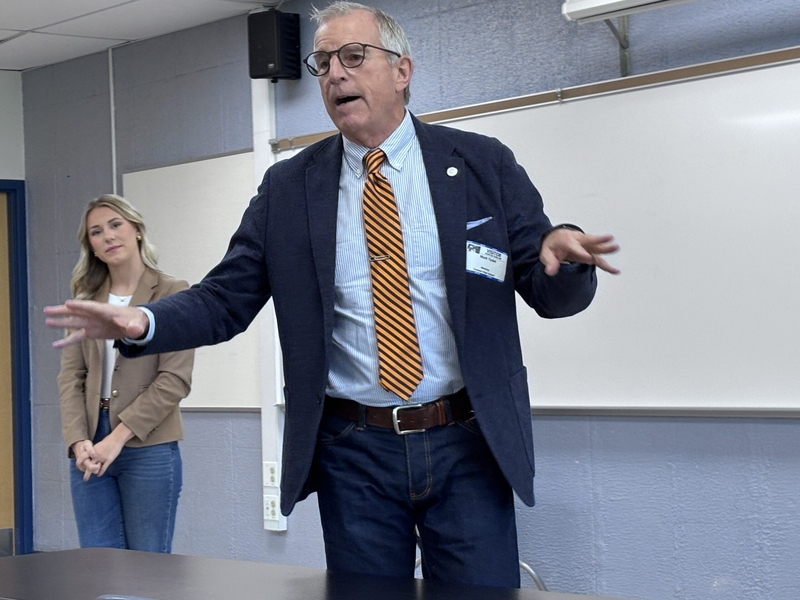
Representatives Mark Tisdel (R-Rochester Hills) and Rylee Linting (R-Wyandotte) talk about the recently-passed school cell phone ban limiting their use with students at Trenton High School on Tuesday, April 7, 2026. | Photo by Martin Slagter/Michigan Advance
Students in Nick Scott’s AP Government class at Trenton High School were given a rundown on how a piece of state legislation that impacts their daily education came to pass, courtesy of a visit Tuesday from a pair of state representatives.
Representatives Mark Tisdel (R-Rochester Hills) and Rylee Linting (R-Wyandotte) took students through the process of how a set of bills banning cell phones during instruction time in Michigan classrooms became a law, from Tisdel’s drafting of the bill in June 2023 to Gov. Gretchen Whitmer’s signing of the bipartisan legislation in February.
Tisdel and Linting walked students through the thought process on why the need to bring a bill forward was necessary, backed by studies that supported banning cell phone use during class time, to the compromises that took place in crafting legislation that went from a “bell to bell” ban to one that limited cell phone use during instruction time only.
The two GOP representatives also described the pushback they say the proposed bills received from Democrats before public pressure and support for the ban ultimately led to overwhelming support from both sides of the political aisle. Tisdel said the discussion ultimately was aimed at showing students how lawmakers work to improve education outcomes.
“This is a distraction,” Tisdel said, holding up his own iPhone 14. “Even if you have it in your pocket and you feel it vibrate, you know it’s there. Inherently you’re thinking, ‘I wonder what that was?.’ With that distraction alone, research will say, it can take you up to 15 minutes to get back on task.”
“We got this information that was built around, ‘gosh maybe it’s not such a great idea to make teachers like Mr. Scott have to compete against the world’s most powerful entertainment medium,” Tisdel said.
Like many Michigan schools, Trenton High School already has its own policy limiting cell phone use in school. The school has gone through different versions of the policy over the past few years, with its current rule allowing students to have a cell phone on their person, but to have it out of sight and off during class.
The state’s bills, which go into effect next school year, require school districts to develop and adopt a policy banning the use of cell phones during instructional time and to set protocol for how and when students are allowed to use their phones during an emergency.
Linting, the youngest lawmaker in the Legislature, said she saw the bills as an effective measure to help students concentrate better during class and help improve declining standardized test scores, noting her own experience attending middle and high school during a time when cell phone use was allowed and prevalent.
“As Michigan’s youngest product of public education, I can bring a different perspective,” said Linting, who graduated from Grosse Ile High School in 2020. “I had an iPhone, not just in high school, but also middle school.”
Polehanki: There was no deal with House GOP on competing school cell phone bans
“When you get to the state House and you’re looking at the amount of money that we’re directing toward schools, if students are distracted by phones, we’re not getting the bang for our buck that is coming from our taxpayer dollars,” Linting continued. “When we’re investing in our schools, we want to see results and I think if students are focusing a little bit more during instructional time across the state, that will improve results.”
Developed by Tisdel in the Republican-led Michigan House last July, the vote initially failed without support from House Democrats, Tisdel said, although several members of the House Republican caucus were either absent or voted against the bill. However, public outcry and indications of widespread support from educators and constituents led to a revival of the bill this past winter with the House voting 99-10 to send Tisdel’s bill to the Senate for further consideration alongside Sen. Dayna Polehanki’s (D-Livonia) Senate bill. Eventually, the Senate passed both Tisdel and Polehanki’s bills by identical 34-1 margins.
Tisdel explained that the bill’s initial failure actually was beneficial in building a groundswell of public support for a ban, with a survey from the National Education Association indicating 90% of its members polled were in favor of a cell phone ban.
He also pointed to Democrats and Republicans gathering more input from school officials throughout the state in crafting bills that made the most sense to bring back to the Legislature this past winter, demonstrating the power of involving a wide swath of stakeholders.
“After it was voted down in July, from July to January I had been interviewed for radio, TV and newspapers over 100 times,” he said. “Having it voted down was actually the best thing that happened to me relative to getting that bill passed.”

Trenton High School senior Annalise Unwin said different policies have been implemented at Trenton during her time in school, with enforcement of the policy varying depending on the time of year and the leniency of different teachers.
Ultimately, she feels that the policy has had a positive impact on student learning.
“I feel like not being able to have your phone on you is going to help you pay more attention in class, but it really just depends on the teacher,” she said. “When I’m told I’m not allowed to have my phone in class, I do learn more, personally.”
Unwin said since the policy was implemented, teachers have been encouraged to be more strict in seeking compliance.
Scott said Trenton’s most recent iteration of its cell phone policy that allows students to have phones on them but not out during class has been the most beneficial to student learning. He pointed to the implementation of the policy a few years ago helping set expectations that cell phones aren’t to be used during instruction in helping enforce it more recently.
Having Tisdel and Linting explain their rationale in bringing the bills to the Legislature helps students understand concepts they’re taught in the classroom and how they impact their lives, Scott said.
“Pretty much everything that could have happened did happen, so they’re able to see those roadblocks with a specific example,” Scott said. “We talk about all of those things during class — committees; at the federal level we talk about filibuster, cloture, compromising. I think it was a great example to apply something that we always talk about in class with a real world example.”
Lansing, MI