Meet John Kittredge, SC’s next chief justice
Mar 06, 2024 | 6:00 am ET
Description
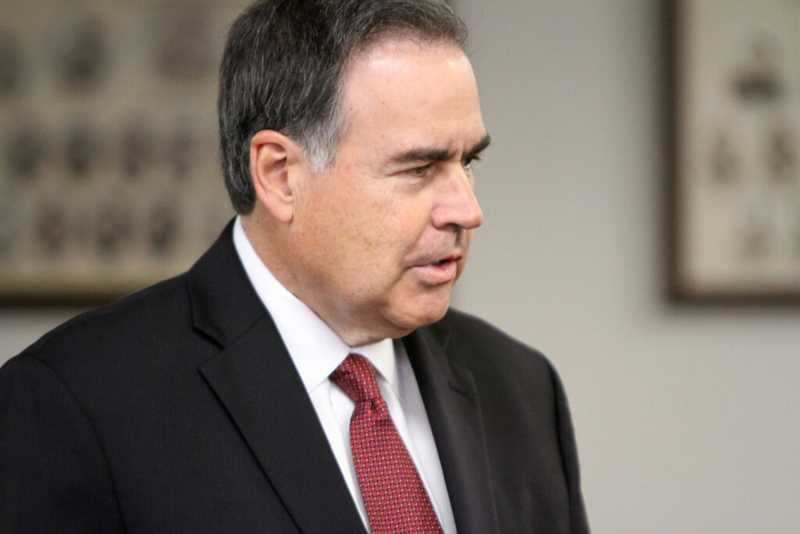
South Carolina Supreme court Justice John Kittredge arrives for his screening by the Judicial Merit Selection Commission on Monday, Nov. 6, 2023, in Columbia, S.C.(Mary Ann Chastain/Special to the SC Daily Gazette)
COLUMBIA — If South Carolina Supreme Court Justice John Kittredge attends a gathering of the state’s trial lawyers, he also accepts the invitation of the defense lawyers’ group. Most of the time, he tries to avoid the events all together.
This is just one of the lengths to which the 67-year-old jurist goes to appear even-handed, friends and colleagues told the SC Daily Gazette.
“He’s always thinking about stuff like that and he’s always thinking about the right thing to do,” said Frank Eppes, a defense attorney who has argued before Kittredge in his home town of Greenville.
Amid national political polarization, this ideal of impartiality runs to the core of the Greenville native slated to lead the state’s judicial branch through 2028, when he’ll be forced to retire under South Carolina’s age limit for judges.
Kittredge has more than three decades of experience on the bench, starting with his 1991 election to family court. Sixteen years after first taking his seat on the state’s highest court, he is set to replace retiring Chief Justice Don Beatty of Spartanburg, whose term ends after he turns 72, the mandatory retirement age.
Lawmakers unanimously elected Kittredge, the lone candidate for chief justice, on Wednesday — at a time when the court is under increased scrutiny.
He will head the only state high court in the nation without a single female justice.
The U.S. Supreme Court ruling in 2022 that overthrew Roe v. Wade and left the state high court to decide the legality of South Carolina’s abortion laws politicized last year’s replacement of retiring Justice Kaye Hearn, bringing intense scrutiny to an election normally based on personal relationships and geography.
The two female judges running to replace her ultimately dropped out before the Legislature elected the male judge who had the votes. Six months later, the all-male court upheld the latest version of a so-called “fetal heartbeat” law that bans abortions once an ultrasound detects cardiac activity — around six weeks into pregnancy.
Meanwhile, the Senate is debating changes to how the Legislature vets and selects judges, with reformists arguing the process gives legislators too much power over judges.
House, Senate GOP trade insults as reform fight stalls judicial elections
A judge, not a politician
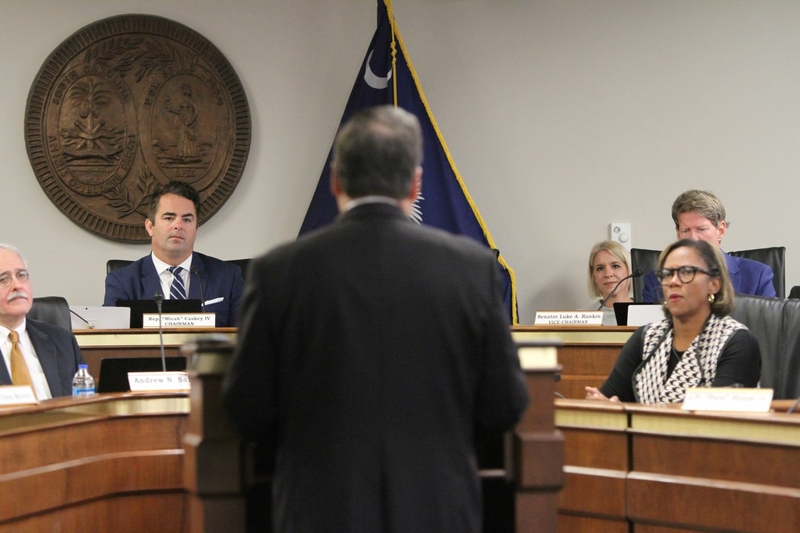
With all of this swirling, Kittredge made it a point last November to tell the panel conducting his job interview for chief justice that he wants to see more diversity among the state’s judiciary and has no political leanings, even when one of the criticisms lobbed at him was fear he was too conservative.
“I am apolitical, and I believe that with every fiber of my being,” he told the screening panel.
If he came off as conservative, he said, it’s because the laws he’s basing his judgements on were penned by the Legislature’s conservative majority.
Kittredge did not respond to questions or interview requests from the SC Daily Gazette, but those who know him say that’s not an empty line.
“There are judges that are politicians and there are judges that are judges,” said Eppes, who is a self-avowed Democrat. “Justice Kittredge is a judge. He’s not a politician. He has no agenda. He has no axe to grind.”
Politically charged
It’s not the first time Kittredge has found himself in a politically-charged situation. It was a near-miss eight years ago when politics threatened to enter the process as Beatty ascended to chief justice, The State newspaper reported.
It’s been long-standing tradition, when a former chief justice retires, the next most-senior associate justice runs unopposed for the vacancy. And in 2016, Beatty was up for the top position.
But some prominent Republican lawmakers openly criticized a pair of opinions — one Beatty authored and the other he signed for a 3-2 majority— as “judicial overreach” and indicated they might oppose his candidacy. Beatty was a Democrat in the S.C. House for five years before his colleagues elected him to the circuit court bench in 1995.
The Republicans sought a chief justice whose decisions were more likely to reflect their views. Kittredge was floated as a potential candidate. He even picked up an application.
It was enough to prompt retiring Chief Justice Costa Pleicones, in his first and only speech to the Legislature, to urge lawmakers to respect the independence of the judicial branch and avoid only electing those “who may simply pass an ideological purity test.”
Kittredge ultimately never challenged Beatty. But now it’s his turn at the helm.
‘Strict constructionist’
High intellect, high character and a stringent adherence to the separation of government branches set out in the U.S. Constitution, as well as empathy and humanity, have been the benchmarks of Kittredge’s judicial career and will continue to be as chief justice, said Chuck Simmons, Kittredge’s close friend and fellow judge.
When it comes to past rulings, Kittredge was in the minority of the two Beatty opinions Republicans openly criticized.
The most contentious decision involved a decades-old lawsuit from poor, rural school districts.
In 2014, Beatty joined Hearn and then-Chief Justice Jean Toal in ruling that legislators had failed to provide students the opportunity to succeed. The trio ordered legislators to correct the inadequacies and report back to the court, without telling them what to do or by when. Toal penned that opinion shortly before retiring herself.
The dissent Kittredge authored is among those he considers his most significant, according to documents submitted when he applied for chief justice.
In the minority opinion, Kittredge said as a father and a citizen he would find “much to cheer about” in the majority’s decision pushing to improve education. But he chastised the means, saying the court was acting as a “super-legislature.”
(Three years later, Kittredge wrote the 3-2 order that ended the court’s oversight and closed the 24-year-old case for good.)
“Based on my view of the rule of law, especially the principle of separation of powers, I believe the Court has overstepped its bounds,” he wrote in 2014.
“I acknowledge that to some courts and judges, the concept of ‘the rule of law’ has expanded over time from adjudicating to legislating. In some circles, the constitution has been reduced to nothing more than a vending machine that allows a person to select constitutional ‘rights’ that mirror personal preferences,” he continued. “That is not my view of the rule of law or the United States Constitution or South Carolina Constitution.”
It’s that type of language that labeled Kittredge a “strict constructionist” — meaning he interprets the literal meaning of statute when it was written.
It’s the same thing some Republicans cited when they elected Justice Gary Hill. Before Hill’s election, Hearn wrote the 3-2 ruling that threw out the Legislature’s 2021 version of the “fetal heartbeat” law as violating the state constitution’s guarantee from unreasonable violations of privacy. That law temporarily took effect after the U.S. Supreme Court ruling, before the state high court suspended, then dispensed with it.
GOP lawmakers condemned the ruling as “judicial activism” on a “privacy” guarantee that had nothing to do with abortion when it was inserted in the constitution. So Hill’s judicial theory, which Kittredge shares, was of key importance when legislators were selecting Hearn’s replacement.
Legislators ultimately passed a slightly different version of the six-week ban, which the court upheld last August in a 4-1 decision that Kittredge authored. And though it’s probably the opinion he’s currently most known for, it wasn’t among those he highlighted in his application process.
Family Court to Supreme Court
Instead, it was a case that harkens back to Kittredge’s experience on the family court bench.
“Many lawyers that practice in family court view it as the most important court,” Greenville attorney Reid Sherard wrote in an email. “We seek solutions to both the calculable (division of assets, alimony, child support) and the incalculable (the trajectories of lives, and the impact on generations of families).”
That helps explain why a rare divorce case Sherard argued before the state Supreme Court rose to the top of Kittredge’s list of rulings that he considers his most significant.
The 2015 case involved a husband-and-wife-owned business and how to value its worth and divide potentially millions of dollars in their divorce. Kittredge’s opinion ultimately set a precedent, giving lawyers a formula for determining how much the reputation and work done by each spouse personally factored into the success of a company, splitting the value accordingly.
A family case appealed to the U.S. Supreme Court also made Kittredge’s list. Adoptive Couple v. Baby Girl challenged the adoption of a Native American child by a South Carolina couple, contending it violated federal law meant to protect the break-up of American Indian families.
Ultimately, the nation’s top justices sided with Kittredge, who wrote in a 2012 dissent that the biological father “purposely abandoned this child and no amount of revisionist history can change that truth.”
Opportunity to help
Simmons, the Greenville County master-in-equity, met Kittredge in law school at the University of South Carolina. The two bonded over their mutual love of Greenville and the Atlanta Braves. An avid baseball fan, Kittredge rode his bike as a child on summer evenings to Meadowbrook Park to watch Greenville’s former minor league team, the Mets.
After law school, Kittredge helped Simmons get a job at the Wilkins family law practice in Greenville, then headed up by David Wilkins, South Carolina’s former House speaker and, during the second Bush administration, the U.S. ambassador to Canada.
“John was a client’s dream lawyer because he was very committed,” Simmons said. “He’s very bright and if 100% was good, John would put in 200%.”
When a seat on the family court bench opened in 1991, Kittredge jumped at the chance.
“John saw the opportunity to be involved in and help people through a crisis situation,” Simmons said.
It’s Kittredge’s thoughtful, caring nature that has endeared him to many — like when he hand-delivered a note to Eppes on the day his father, a former circuit court judge in Greenville, died and when he compiled a scrapbook of letters from patrons of the Ham House, a meat-and-three staple in Greenville, for the restaurant’s owner when it closed.
Despite striking a stoic tone on the bench, friends of the veteran justice also say he has “a wicked sense of humor,” one that has the father of three veering into the dad-joke realm.
A favorite bit of his is about a camping trip with Simmons. When a bear appeared in their campsite and Kittredge began lacing up his sneakers, Simmons told him he wouldn’t be able to outrun a bear.
“Chuck, I don’t have to outrun a bear,” the line goes. “I just have to outrun you.”
Law enforcement to lawyer
True to his ideals surrounding judicial demeanor, Kittredge also rarely loses his temper on the bench. But he also didn’t let suspects slide. People appearing in his courtroom who didn’t stop for police better have a good excuse, Eppes said of Kittredge’s Circuit Court tenure.
“He thought that shows a disregard for law enforcement, put people’s lives in danger and put law enforcement lives in danger,” Eppes said.
It’s something that may tie back to Kittredge’s early career aspirations in law enforcement.
Kittredge, who Billy Wilkins affectionately refers to as “Johnny,” grew up a couple doors down from the former U.S. district judge.
Wilkins was solicitor when Kittredge told him he wanted to go into law enforcement. Wilkins set him up with an internship at the city police department. But Wilkins said he saw Kittredge had an analytical mind. He talked the young Kittredge into setting his sights on law school, which could lead to a career in the FBI.
But Kittredge fell in love with the law somewhere along the way.
When Wilkins became U.S. district judge, Kittredge came on as one of his first law clerks.
“He really is one of those people that was kind of born to be a judge,” Eppes said.

Columbia