Harford County residents fight back against battery storage proposal
Jul 30, 2026 | 10:25 pm ET
Description
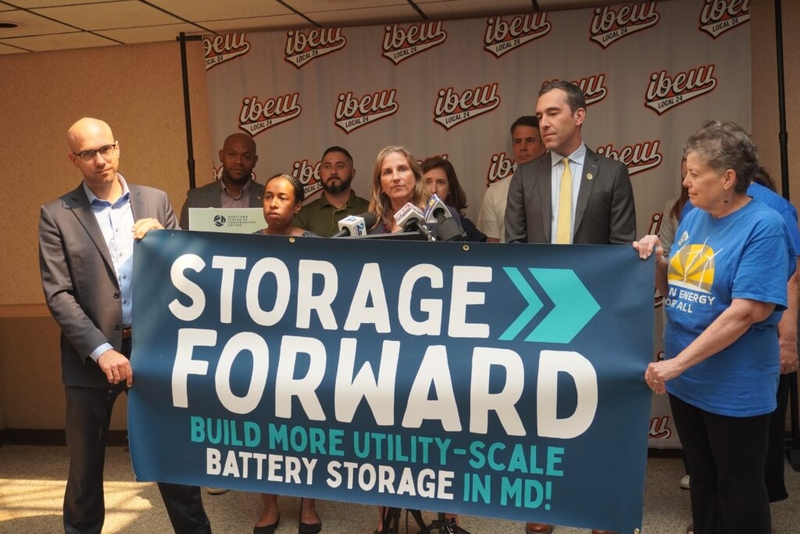
Del. Lorig Charkoudian (D-Montgomery) speaks during a news conference Thursday encouraging the state to advance battery storage projects. (Photo by Christine Condon/Maryland Matters)
Harford County officials and residents say they’re concerned by a proposal to add a utility-scale battery storage facility to a hillside along the “pristine” Deer Creek, a tributary to the Susquehanna River.
Their testimony came Thursday as regulators at the Maryland Public Service Commission reviewed four battery storage projects for eligibility for a new credit, created by state lawmakers in 2025. The other projects are planned on the site of a solar project near Westernport in Garrett County, at the Chalk Point power plant in Prince George’s County and at the former Dickerson coal-fired power station in Montgomery County.
But only the Harford project, a 500-megawatt proposal called the Oystercatcher Energy Storage Project, drew opposition Thursday, with critics citing concerns about fire risk and related environmental contamination.
“Environmentally, you would struggle to find a worse site for this project,” said Jennifer Wilson, a resident who said her children attend the nearby Norrisville Elementary School.
The mostly forested site already hosts Baltimore Gas & Electric’s Conastone Substation, located in the northwestern corner of Harford County. A representative from Tenaska, the company developing the project, said Thursday that the facility would be located at least 600 feet from the waterway, and that most of the 70 acres would remain forested.
Harford County Executive Bob Cassilly (R) also opposes the project, he said in an interview with Maryland Matters, particularly given that the beloved creek — a favorite kayaking spot for him and his family — is located downhill. He worried that firefighters would have trouble fighting any blazes at the site nestled behind the substation, and that any chemicals used for firefighting, or contained within the battery facility itself, would flow down into the river.
“If anything goes wrong with this thing, it goes right down into the Deer Creek,” Cassilly said in an interview. “This is a cherished waterway that feeds the water supply.”
In testimony to the commission, Matthew Kropp, director of Harford County’s planning and zoning department, expressed worries that “toxic heavy metals and chemicals” in the battery infrastructure could leach into the soil or water, and that local fire departments lacked “the training, knowledge and resources to deal with a potential emergency.” He worried that the proposal did not contain sufficient measures to contain a fire or other emergency.
A representative for Del. Lauren Arikan (R-Harford) also said at Thursday’s hearing that her office has gathered 1,300 signatures opposing the project near Deer Creek.
Lee Hine, who lives about a half mile from the proposed project, said he was surprised by its location, given the hilly terrain in a prized natural area.
“The watershed is a prime aspect of why we all moved to this area. It’s a natural preserve here,” Hine said. “I’m trying to understand why we’re not looking for ‘brown ground’ facility areas — or at least flatter areas. This is a mountain. We live on a mountain.”
Keith Latham, who leads battery storage development at Tenaska, said the company plans to use lithium-ion-phosphate batteries, a safer alternative to lithium-ion batteries, and house them in purpose-built enclosures complete with cooling systems.
“Additionally, code standards and best practices have also greatly reduced risk of issues in newer battery storage projects. As we move forward through the development process, we’ll also collaborate with local fire departments and the fire marshal. We’ll work with the first responders on an emergency response plan,” Latham said.
But residents also questioned the project’s cost-effectiveness. A study performed for the PSC found that the Oystercatcher project, the largest by megawatts, did not produce quite enough ratepayer benefit to equal the cost, using two different estimation models.
“I ask the commission to reject this project based on the fact that it doesn’t provide economic relief to BGE ratepayers, and it’s certainly going to put the ecosystem of Harford County at great risk,” Patti Hankins said at the meeting.
Even if one of the projects considered Thursday receives the credits, it still must receive construction approvals from the commission, according to a news release from the commission.
The PSC hearing came hours after a Baltimore news conference, during which environmental groups, unions and a few Democratic politicians extolled the benefits of battery storage technology, which can store extra power for four hours or more and release it to the grid later on. They argued, too, that some safety concerns may be overstated.

Adam Dubitsky, state director for the Maryland Land & Liberty coalition, a conservative nonprofit supporting renewable energy development, said much of the opposition is based on “outdated information about these systems.”
“They are safe when done right, and when firefighters know how to fight these fires — which is very possible — in the rare times when there is an incident,” Dubitsky said.
Del. Lorig Charkoudian (D-Montgomery) said any approved project must adhere to the National Fire Protection Association standards, which require separation between battery units to prevent fires from spreading between batteries.
“I understand that when new technology is coming to communities, people are asking questions — totally appropriate for folks to do that,” Charkoudian said during Thursday’s news conference. “It’s just really important that we don’t add to fear-mongering, and we make sure people have the accurate information about the things that keep batteries 100% safe.”
During Thursday’s PSC hearing, John Walser, a fire protection consultant at Fire & Risk Alliance, argued that fires at battery energy sites have become increasingly rare as safety standards have improved.
“This reduction is due to the lessons learned from early failures,” he said, including fires at other battery storage facilities.
At Thursday’s news conference, environmentalists largely focused on the overall benefits of battery storage. It’s particularly important now, they said, as residents face high power bills and the grid faces high demand from data centers and electrification, amid reductions in supply due to the retirement of some fossil fuel generators.
“For most of the history of the electrical grid, if someone flipped on a light switch, a power plant somewhere had to produce those electrons at virtually the same time. But battery storage is changing that,” said Rico Albacarys, political director for the International Brotherhood of Electrical Workers Local 24. “It allows us to store electricity when it’s plentiful and the costs are less, and then deliver it back to the grid when demand is highest.”
Maryland possesses very little utility-scale, battery storage connected to the transmission grid, Charkoudian said. That’s why the General Assembly stepped in last year with the Next Generation Energy Act, requiring the PSC to open a battery storage procurement for up to 1,600 megawatts. This year, the legislature extended the megawatt limit, as long as cost effectiveness requirements are met.
The facilities can also reduce emissions during high-demand situations, by avoiding the need for fossil fuel “peaker” plants to come online, said Rebecca Rehr of the Maryland League of Conservation Voters.
“Storage reduces reliance on the most expensive, most polluting, and harmful peaker plants that run only during the periods of highest demand,” Rehr said.
Still, the risks concern residents of Norrisville, the small town closest to the Oystercatcher project. Nancy Gladden, who said Thursday she moved to the “blink and you miss it” town in 1984, is concerned that battery projects are unproven, and their safety for the community “highly questionable.”
“We are surrounded by hills and beautiful rolling cornfields and meadows,” Gladden said. “It’s an idyllic place full of homes, happy kids, and wonderful outdoors for them to explore and grow up in. I’m commenting tonight because I’m concerned for the community — for my community.”

Annapolis, MD