Measles, whooping cough spike amid low vaccination rates
May 29, 2026 | 2:58 pm ET
Description
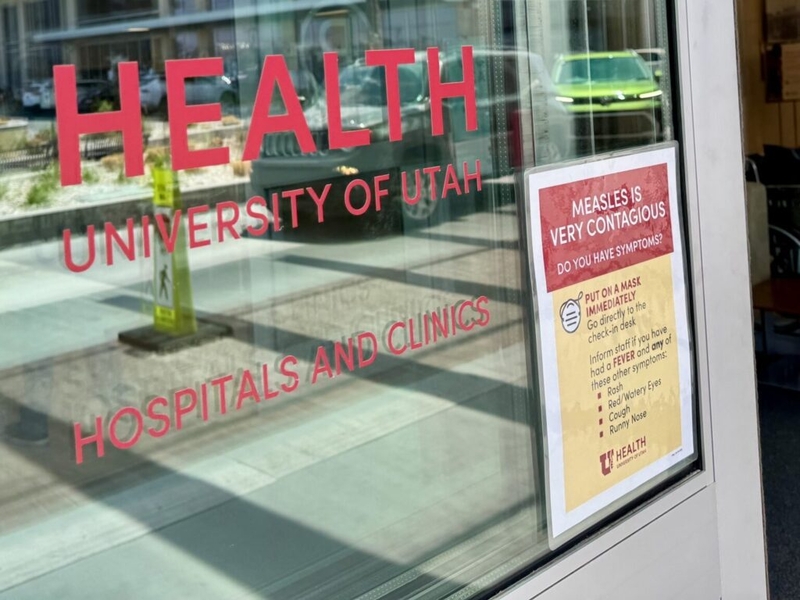
A University of Utah clinic in Salt Lake City displays a sign warning about measles last year. Utah is among the states that already has more measles cases in 2026 than in all of 2025, when cases reached the highest annual level since 1991. (Photo by McKenzie Romero/Utah News Dispatch)
Vaccine hesitancy fed by misinformation is causing new surges of measles and whooping cough, while COVID-19 hotspots persist in some states and a new threat looms from an Ebola outbreak in central Africa.
Nationally there have been 1,983 measles cases this year, nearly the 2,288 total for all of 2025, which in itself was the worst year since 1991, the federal Centers for Disease Control and Prevention reported Friday.
Halfway through the year, 12 states and the District of Columbia already have more measles cases than they did for a full year in 2025. That’s true for South Carolina and Utah, where cases are already more than double last year, and also for states such as Florida, which has 139 cases so far compared with eight in 2025, and Virginia, which already has 63 compared with six in all of 2025.
States that once led in child vaccination fall as they expand exemptions
South Carolina, the state with the highest number of cases this year at 669, declared an end in April to an outbreak that was the nation’s largest in 35 years. The outbreak in the northwestern part of the state was centered in Spartanburg County, where religious exemptions to vaccination have spiked.
The Utah outbreak, which began in the Short Creek area on the Utah/Arizona border, where vaccination rates are low, has generated 484 cases this year and is now slowing, said Dr. Andrew Pavia, a pediatrician and professor at the University of Utah, speaking at a May 26 briefing for the Infectious Diseases Society of America.
Dozens of measles patients have been hospitalized with serious symptoms such as brain inflammation or pneumonia, he said, and one baby developed life-threatening congenital measles during pregnancy but survived, he said.
The national increases signal that the U.S. will certainly lose the measles elimination status it gained in 2000, Pavia said, in a determination due this fall.
“Most state public health departments are stretched very, very thin, limiting their ability to contain measles. Anti-vaccine rhetoric has made this all the more difficult,” Pavia said. He referred to $11 billion in federal funding cuts to local public health last year that were delayed by a restraining order when states sued. The case is in settlement negotiations, according to court records.
The Trump administration cited a “non-existent pandemic that Americans moved on from years ago” in the funding cuts, but COVID-19 is still causing more than 1,000 deaths a month and wastewater surveillance still shows hotspots in the Appalachian region and some other states, including Michigan.
Whooping cough is also on the rise with Ohio and Florida most affected. Deaths last year were at the highest level, 22, since 2010, according to the latest CDC WONDER provisional statistics.
“The rising number of deaths from whooping cough, including among infants, is a reminder of the vital importance of vaccination,” said Dr. Joshua Sharfstein, a pediatrician and professor at Johns Hopkins Bloomberg School of Public Health in Baltimore who follows whooping cough trends.
“Families who follow public health guidance on vaccination and other precautions can avoid a needless tragedy,” Sharfstein said.
Louisiana was accused of unusual delays in reporting a whooping cough outbreak last year that claimed at least two lives. Shortly after the deaths were reported, the state ended promotion of vaccines and vaccination events. At least three babies died in Kentucky last year along with at least one in Oregon.
Unvaccinated people are like fuel for the wildfire of disease outbreaks, said Pavia, of the University of Utah, in his remarks.
“Until we can restore faith in vaccines and restore funding for our public health agencies and increase measles vaccine coverage, we have to anticipate that there will be many more outbreaks, and some of these may blow up into very large conflagrations,” Pavia said.
Meanwhile the Trump administration announced a new quarantine center in Kenya opening Friday, May 29, for Americans exposed to the Ebola virus in the Democratic Republic of the Congo. The move was criticized by the Infectious Diseases Society of America in a statement, saying the decision to send exposed Americans to Kenya “raises serious questions about resources, timing and the level of care Americans sent there will receive.”
On Ebola, a May 22 CDC directive prohibited United States entry of non-citizens who had been in the Democratic Republic of the Congo, or nearby Uganda or South Sudan, in the previous 21 days. The disease has killed 224 people in that region, and there are more than 900 suspected cases.
Stateline reporter Tim Henderson can be reached at [email protected].