Maryland joins 24 states suing White House over refusal to release $6.8 billion in school funds
Jul 15, 2025 | 12:47 am ET
Description
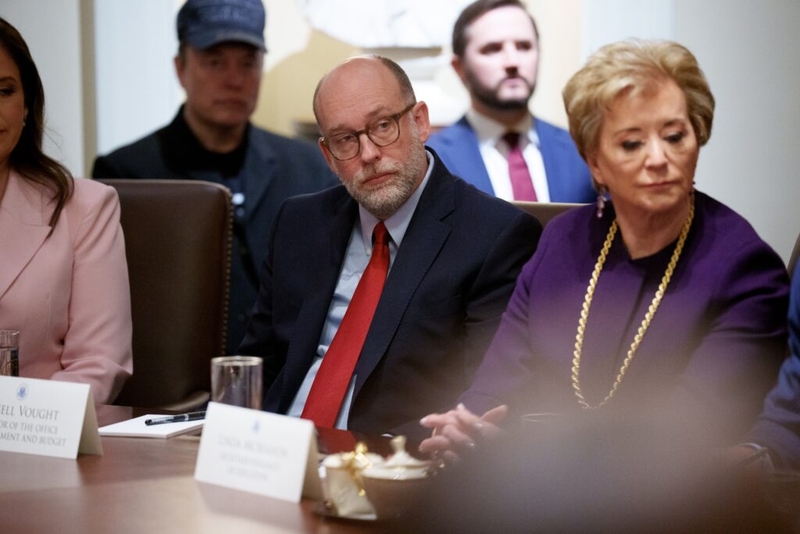
Office of Management and Budget Director Russ Vought, center, and Education Secretary Linda McMahon are targets of the states' lawsuit over the administration's decision to freeze $6.8 billion in schools funds at the last minute. (Photo by Andrew Harnik/Getty Images)
Maryland joined 23 other states and the District of Columbia Monday in a lawsuit against the Trump administration, two weeks after the U.S. Department of Education abruptly froze $6.8 billion in funds for summer programs, adult learning and more.
The lawsuit was filed Monday in U.S. District Court for the District of Rhode Island against the Education Department, the Office of Management and Budget and President Donald Trump. It was sparked by a three-sentence June 30 email to states that said previously approved federal funds, due to be released the next day, were instead being held for review to ensure that they align with “the President’s priorities and the Department’s statutory responsibilities.”
The attorneys general argue that the funding freeze violates an assortment of federal laws and constitutional principles — both recurring themes in the arguments they made in dozens of similar multistate lawsuits brought to court since Trump took office in January.
They also say it comes at the worst possible time for school systems.
“This reckless funding freeze is directly harming Maryland’s students by taking more than $110 million from Maryland K–12 schools and adult education programs, which has jeopardized teacher training, thrown essential special needs services into chaos, and left families scrambling to find child care before the start of a new school year,” Maryland Attorney General Anthony Brown said in a statement on the suit.
“Maryland’s students are not pawns in political games over government spending — they need and deserve the educational resources that the Trump administration is threatening to cancel,” Brown said.
A quarter of the grant money typically arrives in state education coffers on July 1, the start of a new fiscal year, so local education departments can plan for the year ahead. But the expected payments were paused on June 30, the last day of fiscal 2025.
Federal freeze on funds could cost Maryland schools $125 million this year
The timing leaves state-level education officials in precarious positions as they plan for the year ahead, Rhode Island Attorney General Peter Neronha said during a virtual news conference Monday with the attorneys general of California, Colorado, and ksuit.
“It is impossible for states to effectively budget for an upcoming school year … when the president takes the football away from us like Lucy in a Charlie Brown cartoon,” Neronha said.
The funds supported after-school and summertime programming for kids, as well as adult education, and teacher training. It also funded education for English-language learners and subsidized education for children of migrant workers.
Other states on the lawsuit are Arizona, Connecticut, Delaware, Hawaii, Illinois, Kentucky, Maine, Michigan, Minnesota, Nevada, New Jersey, New Mexico, New York, North Carolina, Oregon, Pennsylvania, Vermont, Washington and Wisconsin, along with the District of Columbia.
The U.S. Department of Education did not immediately respond to a request for comment Monday. A July 9 statement from the Office of Management and Budget shared with Rhode Island Current noted that the funds were paused after some school districts had allegedly used previous grant money “to subsidize a radical left-wing agenda.”
California Attorney General Rob Bonta, who hosted Monday’s news conference, described the lawsuit as the latest defensive move against what he called the Trump administration’s “little regard for the law.”
“In fact, out of the 31 lawsuits I and many of my colleagues have now filed against the Trump administration in the last 25 weeks, eight of them challenge unlawful attacks on education,” Bonta said.
The coalition of attorneys general wants a federal judge to rule that the funding freeze is illegal, as well as order the federal government to release the money. A pair of court filings seeking both outcomes comprises over 180 pages, and describe the freeze as “contrary to law, arbitrary and capricious, and unconstitutional.”
Neronha told reporters that, in Rhode Island’s case, the funding freeze comes at an especially inopportune time, with the state’s part-time legislature having just wrapped up its legislative session three weeks prior.
“It was a very difficult budget year,” Neronha said, with lawmakers forced to make tough fiscal decisions amid the state’s many money troubles, including an ailing health care infrastructure.
Supreme Court clears the way for sweeping cuts at Education Department
But Neronha said he hoped that the issue would be resolved “far, far, far before” legislators return for a new legislative session in January.
Rhode Island Department of Education Commissioner Angélica Infante-Green, who denounced the funding freeze at a July 9 news conference, said Monday that the funding freeze “harms Rhode Island’s students, families, and teachers.” The loss of $29 million in congressionally approved aid means “there will be cuts” to before- and after-school programs, STEM learning, multilingual education, and professional development for teachers, Infante-Green said.
“Rhode Island students have been making significant strides in education progress, post-pandemic,” Infante-Green wrote in her statement. “Delays and cuts in federal funds put progress and momentum in every district in Rhode Island at risk.”
Taking legal action against the Trump administration is now routine for Democratic attorneys general. Neronha’s office has co-led or joined 26 lawsuits against the Trump administration since March. Maryland also has a hand in 26 suits, according to Brown’s office.
Asked by reporters about the likelihood of success in the present funding case, Neronha declined to predict an outcome.
“I don’t want to get ahead of ourselves and I don’t obviously want to speak for the court,” he said. “We have to make our points there as well. But based on the track record … we’ve seen this story before. We’ve been in the ring before with these sorts of cases and we’ve had great success because the violations of the law are so obvious.”
– Thi story originally appeared in Rhode Island Current, which is part of States Newsroom, a nonprofit news network supported by grants and a coalition of donors as a 501c(3) public charity. Rhode Island Current maintains editorial independence. Contact Editor Janine L. Weisman for questions: [email protected].
Annapolis, MD