Michigan’s Democratic U.S. Senate primary too close to call
Aug 05, 2026 | 1:33 am ET
Description
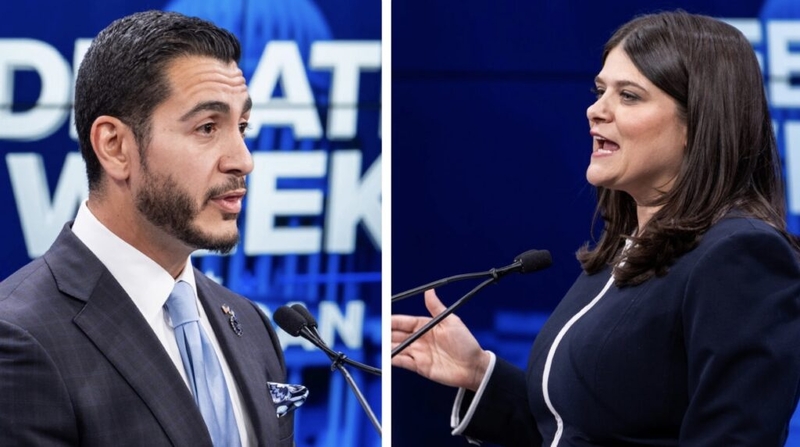
Abdul El-Sayed and U.S. Rep. Haley Stevens (D-Birmingham) during a televised debate on WOOD TV8 in Grand Rapids. July 7, 2026 | Photo by Bryan Esler/WOOD TV8
DETROIT — As of 1:25 a.m. Wednesday, Michigan’s Democratic U.S. Senate primary is currently too close to call, with former Wayne County health official Abdul El-Sayed and U.S. Rep. Haley Stevens (D-Birmingham) currently neck and neck with a few key counties left to report unofficial results.
Unofficial election results show that with 91% of the votes counted, El-Sayed was slightly ahead of Stevens, 48.9% to 47.1%, respectively, per the Associated Press as of 2:07 a.m. Wednesday. A winner in the race has not yet been declared.
Results were being reported from all of Michigan’s Lower Peninsula counties, but to varying degrees. Kent County’s returns were 99% in as of midnight, as were Oakland County’s unofficial results. El-Sayed was winning in Kent but Stevens was winning in Oakland. With just over 50% of the vote tabulated, Ingham County was reporting El-Sayed with a sizable lead. He also had a 10 percentage point lead on Stevens in Macomb County, but less than 50% of unofficial returns were tallied in the county at midnight.
Stevens appeared to be outperforming her expectations in rural Michigan, while also holding strong in Wayne County and Detroit, where she expected to perform well. El-Sayed was also outperforming his expectations around the state, including in West Michigan.
Stevens spoke to her supporters around 1 a.m. and said they were in it until the end.
One area to watch is Marquette County, in Michigan’s Upper Peninsula, which does have a large student population, which tends to be younger and more liberal. Marquette was not reporting any returns as of midnight Wednesday.
With a large portion of Wayne County’s unofficial results still out there, the race could potentially swing toward Stevens as the night trails on, but at this point, the race is too close to call.
Both Stevens’ and El-Sayed’s campaigns are holding their election night watch parties in Detroit, which will prove to be a key battleground in the race.
El-Sayed addressed his supporters at around 1 a.m. at his watch party at the Majestic Theater.
“Know that the billionaires, corporations, and the special interests-they weren’t going to give up light. We all knew they were going to spend their money,” El-Sayed said. “We didn’t know they were going to spend $70 million of their money. We didn’t know that they were going to outspend us $11 to $1. And yet we’re still standing.”
El-Sayed also said that it has been said that, “Here in Michigan, we’re a purple state, that somehow everybody walks around wondering, ‘I wonder where I stand on the left-right spectrum.’”
“When really, up and down the state, what you hear is, ‘I wonder how I can afford my rent. I wonder how I can afford my groceries. I don’t know what’ll happen if I get sick because I can’t afford my deduction,’” he said. “We are not a purple state. We are a state in need of a movement, and despite their strength, despite their lies, old and ad after ad after ad after ad on TV, were walking into the rest of this evening with a three-point lead.”
As Craig Mauger of The Detroit News noted on social media, Detroit election officials typically grab absentee ballots from city drop boxes after polls in the city are closed, then tabulate those results, which is a laborious and time consuming process.
For those who are new to Michigan elections, Detroit election officials have to pick up absentee ballots from all of the drop boxes in the city after polls close and then, process and count those ballots.
It can take hours, and there could possibly be thousands of ballots.
— Craig Mauger (@CraigDMauger) August 5, 2026
Videos are courtesy of a partnership with C-SPAN. This story will be updated as more results come in or if the race is called for either El-Sayed or Stevens.
Lansing, MI