Maine lawmakers want polluters to pay, but opted first to study how much
Mar 31, 2026 | 3:23 pm ET
Description
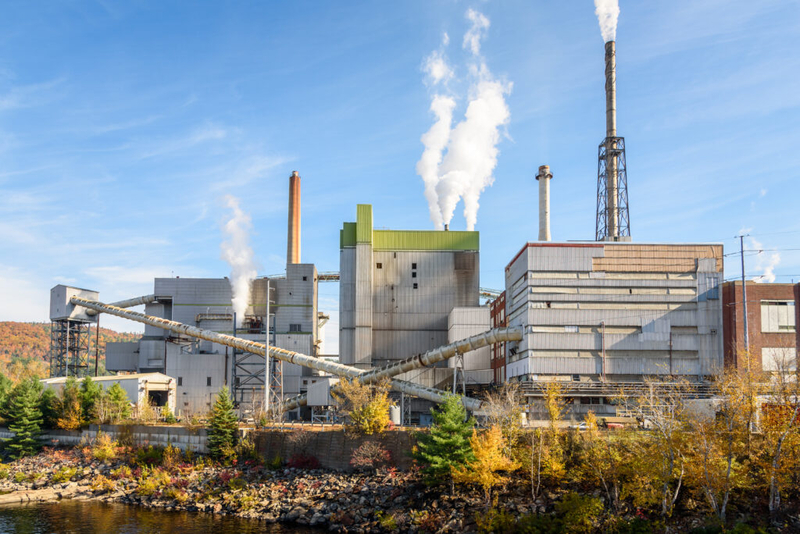
The Rumford Mill, now known as ND Paper- Rumford, is a major paper and pulp mill that sits on the shores of the Androscoggin River. (Photo by AlbertPego/ Getty Images)
Maine lawmakers have given initial approval to a bill to study the costs of climate change in the state, amending a prior proposal that would have launched a program to get polluters to pay for those damages.
The Senate advanced LD 1870 with a first vote of 19-13 Monday followed by an initial vote of 75-72 in the House of Representatives Tuesday. The votes were mostly along party lines, with Rep. Tiffany Roberts (D-South Berwick) joining Republicans in opposition. The bill will need enactment votes in both chambers before it heads to Gov. Janet Mills for her signature.
LD 1870 directs the Maine Department of Environmental Protection to assess how much money greenhouse gas emissions have cost the state.
Bill sponsor Sen. Stacy Brenner (D-Cumberland) said the bill is an essential first step.
“So yes, this bill is not the final step, but it’s a necessary one, because if we’re serious about making polluters pay, we must begin to understand exactly what they owe,” Brenner said.
Rep. Vicki Doudera (D-Camden) said Maine people are already paying for the consequences of climate change.
“Here in Maine, we believe that if you make a mess, you clean it up, and that should be no different for one of the biggest messes that we have seen in a long time, which is climate change,” Doudera said.
The bill was initially introduced last session as an effort to hold polluters accountable by establishing a superfund for large fossil fuel companies to pay into that could be used for repairs and resilience efforts.
But states that have already passed superfund legislation —Vermont, New York, Hawaii and Michigan — are being sued for those policies, including by the U.S. Department of Justice. The Justice Department said the lawsuits are also meant to advance an executive order from President Donald Trump that targets state and local policies involving climate change, environmental justice and carbon emissions reductions.
A federal judge in Vermont heard arguments Monday in that lawsuit, the first legal challenge in the country to a climate superfund law. Vermont has been sued by the United States, the American Petroleum Institute, the U.S. Chamber of Commerce, and a coalition of 24 Republican-led states’ attorneys general.
“Fossil fuel companies and their allies are trying to avoid responsibility, challenging a law that will make them pay their fair share of costs to adapt to a changing climate,” said Kate Sinding Daly, senior vice president for law and policy at Conservation Law Foundation.
Maine lawmakers said that the amended version of LD 1870 will allow the state watch how those lawsuits play out, while studying the costs to the state.
“It directs the State of Maine to assess the cost of climate damage to our state, including in the areas of agriculture, the tourism economy, infrastructure and our natural resources,” said Sen. Denise Tepler (D-Sagadahoc) said during debate Monday. “We need to have this information to determine the damages owed to Maine by climate polluters, some of the biggest companies and the most profitable companies in the world.”
Sen. Joseph Martin (R-Oxford) said he opposed the bill because it spends $600,000 with no direct policy outcomes or guarantee of actionable results.
“This bill prioritizes process over results, creating an expensive report instead of delivering tangible benefits to Maine people,” he said. “The Senate should reject this unnecessary expenditure and focus on efficient outcome driven policies that justify their cost.
The bill’s price tag means it will need to be funded — either through the supplemental budget or through the budget committee’s discretionary spending — in order to take effect.
Rep. Michael Soboleski (R-Phillips) said the bill still risks pulling Maine into the legal battles other states are facing, and dictates how the next Legislature and governor approach this issue.
Maine advances climate superfund bill that would ask fossil fuel companies to pay
“This amendment is not a compromise,” Soboleski said. “It is not a reset. It is a strategic deferral of the consequences. It delays action while still steering the future. It avoids responsibility while shaping the next administration’s agenda.”
Maine Conservation Voters legislative director Sarah Woodbury said Maine residents are already paying the price for climate change.
“Whether it be drought, extreme weather, or sea level rise, climate change is costing Maine a fortune,” Woodbury said. “LD 1870 is the financially prudent and responsible first step the state can take to assess the damage climate change is costing the hardworking people of this state.”
Rep. Cheryl Golek (D-Harpswell) called the bill thoughtful and practical, and said it would help Maine communities prepare for the future.
“This is about giving our communities the tools they need to adapt and stay resilient,” Golek said. “And let me be clear, this is also about protecting our taxpayers at a time when we are all working to balance tight budgets. This bill helps ensure that those who cause the damage help pay for it, instead of shifting the burden on everyday maintenance.”
Brenner said that fossil fuel companies have known about the effects of climate change for decades, but chose to protect their business model instead of the public.
“And that matters because it means that the costs we’re facing today are not just the result of unintended consequences,” Brenner said. “These … are the result of informed decisions by fossil fuel companies to continue to make untoward profit at the expense of our way of life here in Maine, our security and our financial well being.”
The bill was proposed last year, but lawmakers on the Environment and Natural Resources committee held off, wanting to see what progress would be made in the court cases in other states.
We are often told that climate action is too expensive. I believe this assessment will show that it is inaction that we cannot afford.
The committee returned to the issue in January, holding a public hearing and voting 8-4 in support of a proposal that would have established a superfund for large fossil fuel companies to pay for infrastructure repairs, resiliency efforts and other costs, particularly in the rural and low-income communities disproportionately affected by flooding and other disasters.
But after the bill was not taken up by the full Legislature for over a month, the committee reconsidered it, ultimately voting in favor of an amendment to instead direct the Department of Environmental Protection to conduct a study.
On the Senate floor Monday, Tepler said the amended bill is modeled off of legislation passed in Maryland, which has not seen lawsuits like the ones in Vermont and New York.
“We are often told that climate action is too expensive,” Tepler said. “I believe this assessment will show that it is inaction that we cannot afford.”
In January, Melanie Loyzim, commissioner of the Maine Department of Environmental Protection, estimated that the state has spent $100 million in the past few years for storm recovery and implementing resiliency efforts.
Augusta, ME