Maine asks court to throw out DOJ lawsuit seeking access to sensitive voter data
Dec 15, 2025 | 3:15 pm ET
Description
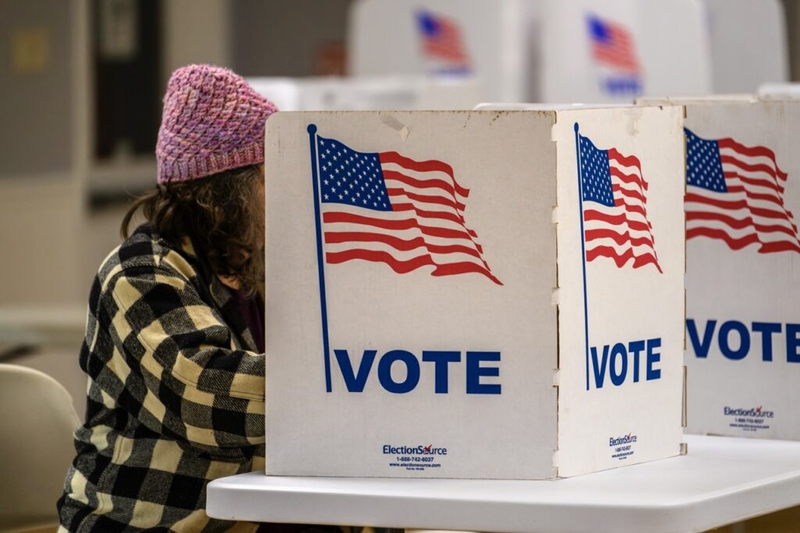
Mainers cast votes at the Durham Amvets Post No. 13 on Election Day 2025. (Photo by Jim Neuger/ Maine Morning Star)
Maine asked the district court to throw out the lawsuit from President Donald Trump’s Department of Justice over the state refusing to turn over sensitive voter data.
The motion to dismiss, filed in the U.S. District Court of Maine by Attorney General Aaron Frey on Dec. 12 on behalf of the state, argues that the lawsuit should be discharged in its entirety because the DOJ failed to support a valid legal case as to why it is justified to such information, and that its information requests violate federal privacy law.
Maine Secretary of State Shenna Bellows, a Democrat who is running for governor in 2026, has twice rejected these requests, which have demanded Maine’s full voter registration list — including all fields, such as driver’s license numbers, partial social security numbers and full dates of birth — along with names of officials who handle the list’s maintenance, the number of ineligible voters the state identified due to noncitizenship and voter registration applications from specific time periods, among other information.
In September, the DOJ sued Maine and Oregon for not turning over the information and has since launched lawsuits against roughly half a dozen other states.
As the Trump administration requested this data, federal officials acknowledged that the Department of Justice shared voter roll information with Homeland Security to search it for noncitizens. Bellows and other secretaries of state have raised concern about the federal government using voter records for citizenship probes.
“Maine elections are free, safe and secure,” Bellows said in a statement Monday, “and we will continue to fight the gross federal overreach so that they remain so.”
According to the DOJ, the lawsuit against Maine alleges the state and Bellows violated the National Voter Registration Act, the Help America Vote Act and the Civil Rights Act of 1960 by refusing to provide “data regarding the removal of ineligible individuals and to produce an unredacted, computerized state voter registration list.”
In the motion to dismiss, the state of Maine claims the DOJ misused those acts in its arguments, adding, “Were this not enough (and it is), DOJ’s demand also blatantly violates the federal Privacy Act of 1974, the post-Watergate law enacted to prevent precisely the sort of secret compilation of data on Americans’ First Amendment activities that DOJ appears to be attempting here.”
Voter registration databases contain information about people’s choice of political party and in which elections they chose to vote, which are activities protected by the First Amendment, the motion points out.
Voter registration databases contain information about people’s choice of political party and in which elections they chose to vote, which are activities protected by the First Amendment, the motion points out.
On Friday, the court allowed the League of Women Voters of Maine to intervene as a defendant in the lawsuit.
“The League is committed to safeguarding the private data of our fellow Mainers,” said Jill Ward, the organization’s president, “and we will continue defending Maine voters against intrusions that run counter to the highest democratic principles and values.”
The League is represented by Campaign Legal Center, the Brennan Center for Justice, and Johnson & Webbert, a Maine civil rights firm specializing in cases against governmental abuses of power.
On Monday, the District Court of Maine accepted an amicus curiae, or friend of the court, brief in this case from American Civil Liberties Union of Maine and the ACLU Voting Rights Project.
These groups joined Bellows in fighting the lawsuit, specifically arguing in their brief that the federal government’s demand for the sensitive voter information violates the language and purpose of federal voting law and state privacy law and that the request should therefore be denied and the lawsuit dismissed.
“Maine voters have shared this sensitive information so they can exercise their right to vote, but they never agreed to let the federal government access that information and ignore the law,” Zach Heiden, chief counsel at the ACLU of Maine, said in a statement.
Heiden said these federal requests undermine data privacy and voter trust, which can depress turnout and serve “as the basis for patently false and dangerous claims.”
- December 16, 20259:24 amThis story was updated to include information about the League of Women Voters' intervention in the lawsuit.
Augusta, ME