Louisiana weighs big changes in zombie deer disease containment. But what do the scientists think?
May 01, 2026 | 4:00 am ET
Description
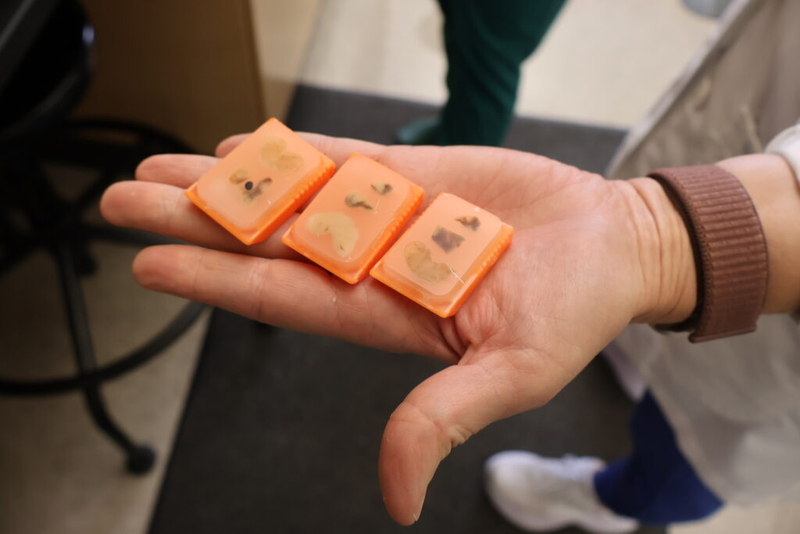
Samples to be tested for chronic wasting disease at the Louisiana Animal Disease Diagnostic Lab in Baton Rouge. (Elise Plunk/Louisiana Illuminator)
There’s a disease spreading amongst deer in the United States, including northern parishes of Louisiana, that has no cure. The state implemented measures to contain the spread, but those could soon be dialed back at the will of state legislators, worrying scientists who study the disease and its expansion.
Chronic wasting disease, colloquially known as zombie deer disease, has spread into 36 states and five Canadian provinces since it was first detected in the wild in the 1980s. It has also been detected in deer farm herds in South Korea and among wild reindeer, moose and red deer in Scandinavia.
Deer, elk and other cervids infected with this contagious illness looked starved, disoriented and drool excessively, excreting the proteins that cause the disease, known as prions, into the environment. Healthy deer that come into contact with infected deer or prions in the environment are likely to catch the disease as well. There is no cure, and it always results in death.
“It’s a misfolded protein that the cell machinery cannot turn over,” said Mariano Carrossino, a pathologist at the LSU School of Veterinary Medicine. “The cell starts to malfunction, and this is how the disease develops,” he said.
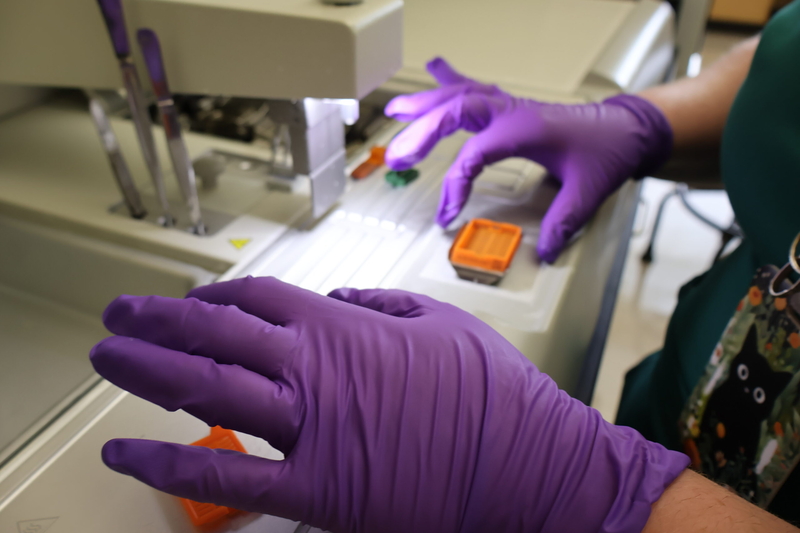
Detecting the disease is essential for containment efforts. Carrossino works in the diagnostic lab to test for cases of the illness in individual deer, where he and the lab technicians select samples of brain stem and lymph nodes donated by hunters.
The samples are encased in wax before being thinly sliced and colored with ink. Under a microscope, Carrossino and the lab techs can tell whether the deer was diseased, alerted to the problem by little pink dots visible on their computer monitor.

When a case comes up positive, it spurs agency action to try and contain the spread.
In Louisiana, anywhere marked as an “enhanced mitigation zone” doesn’t allow baiting or feeding, to prevent healthy deer from being drawn to infected areas. On land adjacent to the control areas where no disease has yet been detected, marked as “buffer zones,” baiting and feeding is restricted.
But this could soon change.
House Concurrent Resolution 4 would suspend restrictions on baiting and feeding within management zones for 18 months. Another resolution in the Senate would change control areas to be based more on disease prevalence percentages instead of area.
The first case of chronic wasting disease was detected in Louisiana in 2022. Since then, it has slowly but steadily crept across the state, with just over 50 cases detected in five other parishes in the northern part of the state.
The Louisiana Department of Wildlife and Fisheries is in charge of controlling the spread of the illness chronic wasting disease. So far, they’ve done so by marking zones where baiting and feeding deer, which is a legal practice in Louisiana, isn’t allowed.
“Prions concentrate in the saliva, which is one of the more infectious bodily fluids, so bait piles can quickly become hotspots for transmission,” said Noelle Thompson, wildlife health specialist and chronic wasting disease researcher.
Thompson said prions also remain infectious in the soil for years, if not decades, so even if bait piles and foot plots are removed, that area can still pass on disease to healthy creatures for a long time.
“Once you do detect an animal, the landscape has probably been contaminated for at least many months, more likely years, and you’re just now playing catch up,” said Mark Zabel, a professor with the Colorado State University College of Veterinary Medicine and Biomedical Sciences.
How to handle the spread of this disease could also be further complicated by another bill that would allow wildlife rehabs to take in White Tailed Deer that are found sick or injured.
One of the legislative proposals that alarms experts originally just allowed people to possess certain wildlife like opossum, rabbits, raccoons and squirrels. Now the bill, sponsored by Rep. Lauren Ventrella, R-Greenwell Springs focuses solely on allowing wildlife rehabilitators to treat white tailed deer.
Ventrella spoke in defense of her bill alongside Greensburg resident Kimberly Graham with a story of a fawn seized by Louisiana Department of Wildlife and Fisheries officials and euthanized in accordance with law and internal policy against keeping white tailed deer in captivity.
“Right now, as it stands, if you find an orphan fawn in the wild, the department essentially has to euthanize it,” said Ventrella during a House Natural Resources Committee meeting in April.
Graham said she kept a fawn she named Baby Bell and lamented the lack of consideration for abandoned baby deer in the law regulating wildlife rehab centers. “When the baby was thriving under my care, wildlife agents came to me, confiscated and killed her,” she said during the meeting. “It broke my heart, and this just can’t continue.”
The bill also includes specific provisions to try and protect against the spread of chronic wasting disease, bringing the Louisiana Department of Wildlife and Fisheries tentatively on board with the legislation.
But, when paired with the potential for large changes to the way chronic wasting disease is contained, experts are concerned about rehabilitation programs.
Thompson said that allowing the rehabilitation of white tailed deer “will certainly increase geographic spread of chronic wasting disease” and goes against best management practices for containing the disease, like those published in 2018 by the Association of Fish and Wildlife Agencies.
“It is just harder to detect the disease in fawns,” said Thompson, adding that there are more studies emerging to show that mother deer can more commonly pass Chronic Wasting Disease to their babies than previously thought.
Zabel went on to say that deer with the disease have an increased likelihood of being hit by cars or being injured as well, “because they get disoriented,” casting uncertainty around if an orphaned fawn has the disease.
“You could have that fawn be positive but not showing any symptoms,” said Zabel, “It’s highly likely that, even if they are infected, they’re not going to show any signs” for up to one year.
In the rehabilitation bill, deer suspected of having chronic wasting disease would need to be reported, euthanized and sent for testing. In the case of a positive, any other deer being rehabilitated at the same facility would also need to be put down, with the rehab unable to take on any deer cases in the future.
“It’s likely that it’s OK that you’re rehabilitating these animals, especially orphaned animals, but if there’s any way to do at least some kind of testing before they’re released, that would be good,” said Zabel.
He added that he would recommend urine, blood or feces sampling that are less official than a lymph node or brain test but at least act as some sort of mechanism to prevent the disease from spreading.
“These are all considerations everybody across the country dealing with CWD has to consider,” he said, adding that the attempt at a compromise between economic concerns from the hunting industry and wanting to help fawns isn’t unfounded. But the disease won’t stop spreading because of compromise.
“If they implement this, in five or 10 years, they’re gonna look back and say, ‘Oh man. Yeah, this didn’t work’,” he said.
Baton Rouge, LA