Louisiana lawmakers pass bill that could vacate a colleague’s ethics fine
Jun 04, 2026 | 6:32 pm ET

Description
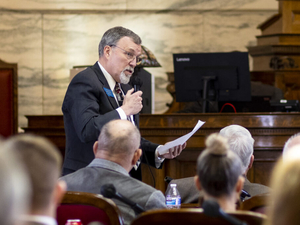
A bill passed by the Louisiana Legislature could help state Rep. Steven Jackson, D-Shreveport, get out of a $1,000 ethics fine. (Photo by Allison Allsop/LAI)
The Louisiana Legislature unanimously approved a bill last month that could allow at least one of its members to dodge a state ethics fine.
The Senate quietly inserted language into House Bill 250 that changes an existing law dictating when political candidates have to file public personal financial disclosure forms with the state. The initial law went into effect Aug. 1, 2024, but the Senate change would make it retroactive to Jan. 1, 2023.
That earlier date could get state Rep. Steven Jackson, D-Shreveport, out of having to pay a late fee of at least $1,000 for failing to file his own personal financial disclosure form, according to Louisiana Ethics Administrator David Bordelon.
“The amended version of this bill could potentially affect the status of one of Rep. Jackson’s outstanding late fees in connection with the 2023 candidate disclosure report,” Bordelon wrote in an email in response to a reporter’s questions. “The Board had previously issued a $2,500 late fee, which was reduced to $1,000, with the remaining $1,500 suspended based on future compliance [by Jackson].”
Jackson told a reporter via text Monday to send written questions about this amendment to an “Elect Steven Jackson” email account. A spokesperson for Jackson named Ashley Crawford responded to the reporter’s email Tuesday, saying a handful of other bills lawmakers passed this year also made previous state laws retroactive.
“The use of retroactive language is neither novel nor unusual when the Legislature determines that a law requires correction or clarification,” Crawford wrote.
“The Legislature considered thousands of bills and amendments during the 2026 Regular Session, and Rep. Jackson can not reasonably be expected to track every amendment that originates and is adopted in a separate chamber,” she wrote.
Jackson was one of 94 House members who voted for the legislation May 20, a week after the Senate amendment was added. He was also sponsor of the original 2024 law that had its effective date moved back by the Senate change.
Jackson has already asked the Louisiana Board of Ethics to waive the fine in question. His late fee reconsideration is the first item on the board’s agenda for its monthly meeting Friday.
The $1,000 fee is just one small part of a larger set of disputes Jackson has had with the ethics board going back to 2015 and his first race for the Caddo Parish Commission.
In January, Jackson estimated he had paid between $10,000 and $15,000 in penalties over several missed deadlines for ethics and campaign finance reports. That was before the ethics board levied another $6,720 in penalties, including the $1,000 fine, for a new set of violations earlier this year.
Jackson faces the $1,000 fine because he was two and half years late in filing a personal financial disclosure form related to serving in the state Legislature.
The form was required when he first signed up to run for the Louisiana House of Representatives in August 2023. He didn’t turn it in until January 2026 after the ethics board threatened to increase his fine if it wasn’t submitted immediately.
Personal financial disclosure forms include information about a candidate or an elected official’s income, employer, property ownership and business interests. The state government requires them to be filed so the public can be informed about any potential conflicts of interests officials might have.
Jackson said he didn’t initially know he had to file another personal financial disclosure form as a candidate for the state legislature in 2023 because he had already filed the same form as a Caddo Parish commissioner earlier that year.
When he became a state representative in 2024, one of the first laws Jackson sponsored and passed exempted candidates from having to file the disclosure forms if they had already submitted the same form as an elected official.
At the time, the new law didn’t get Jackson out of his fine, however, because it took effect a year after Jackson had failed to submit the form and started to accrue financial penalties. But House Bill 250 would move the law’s effective date to a time before that original deadline.
The only thing that could stop House Bill 250 from becoming law is a veto from Gov. Jeff Landry within the next week.
Sen. Katrina Jackson-Andrews, D-Monroe, added the amendment to the bill but said she had not talked to Steven Jackson before doing so. The two legislators are not related.
“I didn’t add an amendment so that it would have vacated an ethics fine for a member,” Jackson-Andrews said in an interview Monday.
Rep. Chris Turner, R-Ruston, authored House Bill 250 but said he did not know the Senate amendment could affect Jackson’s fines.
“I wasn’t aware it was a personal matter,” he said in an interview Tuesday.
The bulk of Turner’s legislation relaxes a different set of laws related to personal financial disclosure forms. It removes a requirement that immediate family members of people appointed to state boards and commissions file personal financial disclosure forms when they have government contracts or other business with the government entity the board or commission regulates.
It also strikes out an obligation for an immediate relative of a state board member to publicly disclose they have received federal funds as a result of gubernatorial declared emergency such as a hurricane. Hundreds of public officials would also no longer have to publicly disclose if they had received a loan from an immediate family member who is a state lobbyist or a state contractor.
Turner said during the legislative session that he sponsored the bill “to help people who are non-paid and serve on some boards and commissions.”
“A lot of time family members do not know what their family members are involved with,” Turner said in March while presenting the legislation during a public hearing.
“I essentially have no idea what my family members do,” he said.
No member of the Louisiana Legislature voted against the proposal.
Baton Rouge, LA