Legislative primaries attract millions in spending as Republican factions fight for control
May 27, 2026 | 8:53 pm ET
Description
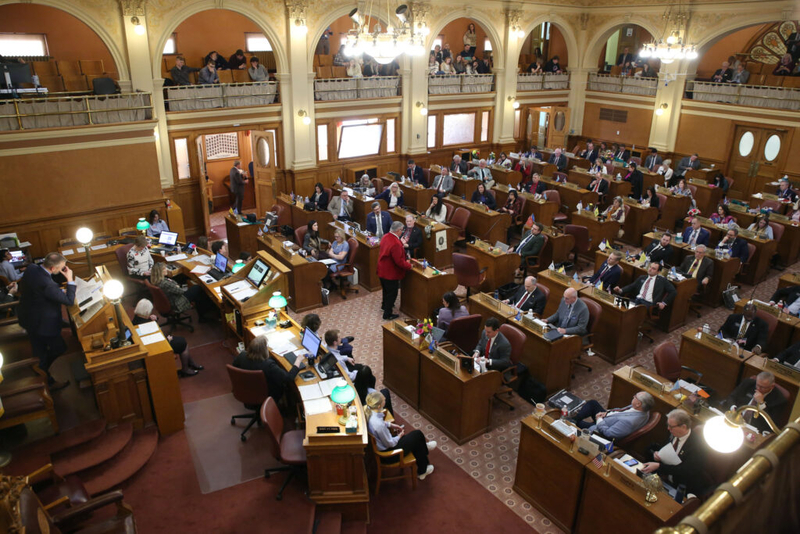
The South Dakota House of Representatives meets at the Capitol in Pierre on Feb. 10, 2026. (Photo by Makenzie Huber/South Dakota Searchlight)
A Republican rupture that shook the South Dakota Legislature two years ago is returning to the ballot Tuesday, this time with more money and organization on the side that lost control in 2024, plus a governor primary that’s expected to increase turnout.
Campaign finance reports reviewed by South Dakota Searchlight show a total of at least $2 million spent by 23 groups so far this year to influence legislative primary races.
The result is a slate of Republican primaries that will test whether the 2024 intraparty revolt was a lasting or temporary shift.
That year, 14 Republican legislators lost to challengers from their own party in the primary. Many of the ousted lawmakers had supported legislation that sought to regulate, rather than defeat, a proposal for a five-state carbon capture pipeline proposed by Iowa-based Summit Carbon Solutions that would have run through eastern South Dakota.
Opponents of the legislation — expressing concern about the private property rights of landowners along the route — referred it to voters, who rejected it in the 2024 general election. Opponents also won enough legislative seats in 2024 to replace the Republican legislative leadership team and ultimately pass legislation banning eminent domain for carbon pipelines — a law that has so far kept the pipeline out of the state. Additionally, the pipeline opponents installed one of their own as the chairman of the state Republican Party.
The pipeline fight turned out to be the opening salvo in a broader struggle among South Dakota Republicans over economic development. Subsequent debates have centered on incentives and regulations for data centers, and state government’s role in aiding businesses.
Ten of the 14 Republican lawmakers who lost their seats two years ago are trying to rejoin the Legislature this year, aided by political action committee spending for them or against their opponents.
Dueling philosophies
Spearfish Republican Scott Odenbach, who became the state House majority leader in 2024 with support from newly elected lawmakers, called the spending against him and his allies in this year’s Republican legislative primaries “totally unprecedented.”
“I think it’s a desperate attempt from the business class to take back what they lost in 2024,” Odenbach said.
One of the people leading the spending on the other side is Rep. Taylor Rehfeldt, R-Sioux Falls. She voted for the pipeline regulations bill that was later placed on the ballot and defeated by voters. She won reelection in 2024 but was ousted by Republican colleagues from her position as assistant House majority leader.
“Rep. Odenbach has actively played in primaries himself since being elected, including through political organizations aligned with his own agenda, so his comments are a little amusing,” Rehfeldt wrote in a statement to Searchlight.
Indicating that the fight is about more than just economic development, Rehfeldt criticized failed proposals from some Republican legislators that she described as extreme. One example is a bill that would have subjected librarians to criminal liability for failing to prevent children from obtaining materials deemed obscene.
“The reality is this effort is being driven by South Dakotans who are tired of dysfunction, political theater, and unserious legislating,” Rehfeldt said. “They are tired of watching energy get wasted on headlines and chaos while real issues affecting families, communities, healthcare, education, and public safety take a back seat.”
PAC ties to business leaders, governor race
One of the biggest spenders in this year’s primary is the South Dakota Republican Forward political action committee, chaired by Rehfeldt.
So far this year, Rehfeldt’s PAC has reported spending $271,000 on ads, $216,000 on postage and $140,000 on printing to influence legislative races.
Rehfeldt’s state-registered PAC received $675,000 from the federally registered Republican Forward PAC. Republican Forward is a super PAC. Due to U.S. Supreme Court decisions, super PACs are legally allowed to raise and spend unlimited amounts as long as there’s no coordination with candidates. In South Dakota, political action committees can receive unlimited contributions from other political action committees.
Republican Forward’s fundraising includes large amounts from the Sioux Falls business community: $500,000 from POET ethanol (which sought to capture carbon dioxide from its ethanol plants for the carbon capture pipeline, to capitalize on tax credits incentivizing the practice), $300,000 from First Premier Bank Chairman and CEO Dana Dykhouse, $150,000 from MarketBeat founder and CEO Matthew Paulson, and $100,000 from Lloyd Companies. Among other donors, Republican Forward has also received $100,000 from Genesis Farms Cannabis Company, which has multiple medical marijuana outlets across the state.
Dykhouse said he was motivated to get involved after seeing Republican legislators oppose state-funded economic development programs. He said that could result in “our children and grandchildren leaving the state because they didn’t have opportunities.”
“That’s what we want to change,” Dykhouse said. “We don’t want our kids to have to leave to get jobs. We want them to stay here.”
The same federal super PAC has also funded spending by the state-registered Rushmore Principles PAC against Gov. Larry Rhoden and state House Speaker Jon Hansen in the race for the Republican nomination for governor. Rhoden signed a bill into law banning eminent domain for carbon pipelines, and Hansen has been a prominent opponent of the carbon pipeline and state economic development programs.
The primary beneficiary of the spending against Rhoden and Hansen is another Republican candidate for governor, U.S. Rep. Dusty Johnson. The other candidate in the four-way race is businessman Toby Doeden.
A committee that bears Johnson’s name, Dusty PAC, has also been active in legislative races. It has the same treasurer as Johnson’s candidate committee, and Dusty PAC is chaired by Jeff Erickson, longtime chairman of the South Dakota Board of Economic Development. The PAC has spent $232,000 this year to influence legislative races, in some cases supporting Republican lawmakers who lost their 2024 primaries.
Nathan Sanderson was director of policy and operations in former Gov. Dennis Daugaard’s administration. Johnson served as Daugaard’s chief of staff. Daugaard has endorsed Johnson for governor.
Sanderson is now executive director of the South Dakota Retailers Association. The association’s PAC has spent $47,500 this year to influence legislative races.
“I think that it’s very clear that a broad swath of South Dakota is interested in making state government boring again,” Sanderson said. “I don’t think that it’s any specific issue. It’s an approach to governance.”
Republican Sioux Falls Mayor Paul TenHaken expressed similar motivations for spending by his South Dakotans for Common Sense PAC. It reported raising $340,500 and spending $214,000 since the beginning of the year. That includes a $150,000 contribution from a federal PAC affiliated with NetChoice, a trade association that advocates for data centers.
“I don’t, quite honestly, feel that the majority of the state even knows what it means to be a true Republican anymore. And so I think we have to just get rid of labels,” TenHaken said. “I just want people who are less loyal to a party and more loyal to our state and our future, our kids.”
Former lawmakers receiving support
Candidates receiving support from the Rehfeldt, Dusty, TenHaken or other similar PACs include Erin Tobin, of Winner, who lost her primary race in 2024 after supporting the carbon pipeline regulations bill. Tobin lost to Mykala Voita, of Bonesteel, whose efforts in the Legislature have included her successful sponsorship of a bill allowing concealed pistols on college campuses. Tobin is running against Voita on Tuesday.
Another candidate receiving support is Katie Washnok, who ran a close but unsuccessful race two years ago against Sen. Carl Perry, who recently described himself as being in favor of “anybody but Dusty” for governor. Washnok and Perry are both from Aberdeen and are in a rematch Tuesday.
Other candidates with support from that same side of the Republican aisle include Sen. Glen Vilhauer, a certified public accountant from Watertown serving on the state budget committee. He faces a challenge from Rep. Josephine Garcia, of Watertown, who has backed failed legislation that would have banned lab-grown meat, required employers to use the federal E-Verify system to check whether employees are in the country legally, and required blood donors to disclose whether they’ve received a COVID-19 vaccine.
Jean Hunhoff, who was the state’s longest-serving female lawmaker when she lost her primary in 2024, also has backing in her return bid. Hunhoff is in a rematch with the person who defeated her in 2024, Sen. Lauren Nelson of Yankton, who sponsored the bill that would have criminalized librarians and has unsuccessfully backed efforts to approve the use of state funds for private educational options.
Current leader resists push from ‘business class’
Odenbach, who became House majority leader after the 2024 election, runs the state-registered Liberty Tree PAC. He uses it to support candidates on the “other side of the Republican divide” from those aligned with Republicans like Rehfeldt and Johnson.
Odenbach said “the Sioux Falls business class” is afraid that “conservative principles and the free market might govern the state instead of crony capitalism and sweetheart deals.”
Economic developers emerge mostly unscathed from critical winds that blew into Pierre
Odenbach’s Liberty Tree PAC has spent $48,000 this year, including support for Voita in her race against Tobin; for Sen. Taffy Howard of Rapid City, who introduced several bills to restrict state economic development programs; and for Representatives Kathy Rice of Black Hawk and Terri Jorgenson of Piedmont, who in the 2024 primary beat out Gary Cammack, who was the House majority whip at the time.
Sen. Mark Lapka of Leola was elected in 2024 as a prominent opponent of the carbon pipeline. His Land & Legacy PAC gave $50,000 this year, including $5,000 to Voita, $5,000 to Howard, $10,000 to the Senate president pro tempore installed after the 2024 elections, Chris Karr, of Sioux Falls, and $10,000 to The People First, a PAC supporting Speaker Hansen’s campaign for governor.
Rep. Phil Jensen of Rapid City and Sen. John Carley of Piedmont run the South Dakota Freedom Caucus PAC. The caucus says it advocates for liberty, limited government and conservative values. The PAC has spent $33,000 this year, including $3,500 each to Jensen and Carley’s campaigns, and donations to the campaigns of other members of the caucus, including Rice, Rep. Dylan Jordan of Clear Lake, and Garcia.
Some spending to influence legislative races has focused on specific issues. One report filed by Forge the Future Project, based in Sioux Falls, shows $521,000 in spending on digital ads and mailers supporting 17 candidates. Forge the Future Project is not listed as a state or federal PAC, so information on its donors is not readily available. The group’s website says it advocates “for a favorable regulatory environment to bring valuable AI products to market in America” and “empowering parents to have oversight over their children’s online activities.”
Comeback attempts
Among the 14 Republican legislators who lost their primary races in 2024, 10 are attempting a comeback:
- Former Rep. Fred Deutsch, R-Florence, running for House District 4.
- Former Rep. Byron Callies, R-Watertown, running for House District 5.
- Former Rep. Tyler Tordsen, R-Sioux Falls, running for House District 14.
- Former Sen. Jean Hunhoff, R-Yankton, running for Senate District 18.
- Former Sen. Erin Tobin, R-Winner, running for Senate District 21.
- Former Sen. Ryan Maher, R-Isabel, running for Senate District 28.
- Former Rep. Gary Cammack, R-Union Center, running for House District 29.
- Former Sen. David Johnson, R-Rapid City, running for Senate District 33.
- Former Rep. Becky Drury, R-Rapid City, running for House District 34.
- Former Sen. Julie Frye-Mueller, R-Rapid City, running for Senate District 30.

Pierre, SD