Let police officers see the video first
Jul 13, 2026 | 5:15 am ET
Description
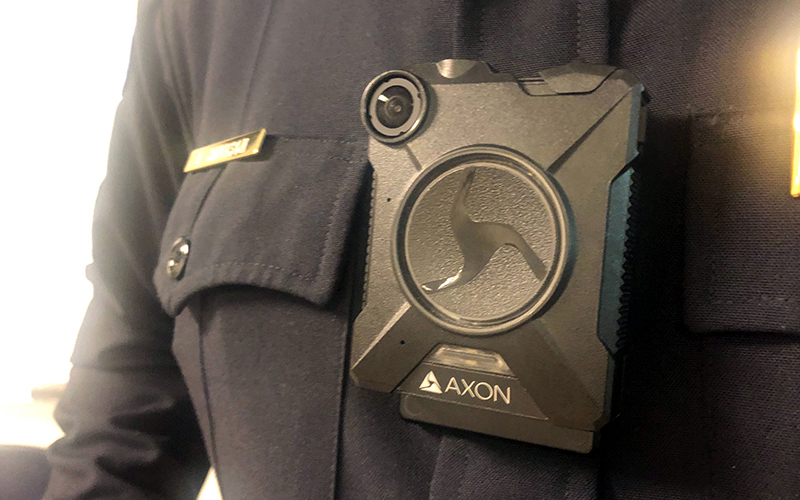
What a body camera records may not be what a police officer fully remembers during a moment of intense stress. (Photo by Bayne Froney/Cronkite News)
I spent 20 years in East Providence and retired as a captain. I’ve written after-action reports on calls I could describe in detail years later, and reports on calls where the first thing I wanted to know when it was over was whether I had actually done what I was sure I had done. Anyone who has been in one of those calls knows the difference.
Police body cameras are supposed to shed light. R.I. rules let officers keep footage in the dark.
That gap — between what an officer saw and what actually happened — is why I part company with the ACLU of Rhode Island’s testimony opposing proposed changes to police body-worn camera regulations now under consideration by the Rhode Island Department of Public Safety. The changes would allow a police officer to provide an unrecorded oral briefing to a supervisor, then be able to view their body-worn camera footage, and then give a formal audio or video recorded statement about what they remember about a use of force incident and perceived at the time it happened. Right now, officers are not permitted to view any camera footage until after making a recorded statement.
The ACLU’s instinct is a good one. But the rule it is defending is built on a faulty assumption about how the human brain works under lethal-force stress.
The ACLU says the proposed changes would encourage “a generic, vague narrative that can later be ‘amplified’ or corrected.” That framing assumes the pre-video statement is the pure truth and the post-video statement is rehearsed embellishment. Thirty years of peer-reviewed research on critical incidents says the opposite is closer to reality.
This is not opinion. It is measured, published data.
In a 2008 study of 157 officers involved in shootings, officers reported the following perceptual and memory distortions during the incident:
- Diminished sound — 84%
- Tunnel vision — 79%
- Acting on “automatic pilot” — 74%
- Slow-motion time — 62%
- Memory loss for part of the event — 52%
- Memory loss for some of their own behavior — 46%
- Memory distortion — remembering something that didn’t actually happen — 21%
Other reviews looking at sample sizes between 86 and 348 officers have produced the same profile at different magnitudes. Roughly nine out of 10 officers in a shooting experience at least one significant perceptual disturbance, and one in five will honestly report seeing or hearing something that did not occur.
That isn’t lying. Under a genuine threat of death, the sympathetic nervous system is not a courtroom stenographer. It is a survival system — and when it’s over, it hands back a partial, distorted set of memories that feels, subjectively, like crystal clear truth.
Ask an officer to give a formal, on-the-record statement within hours of a lethal-force incident without the corrective input of the video, and here is what you get: honest recall of 40% of the auditory environment, a tunnel-vision slice of the visual field, and — one time in five — something that did not happen. Then, defense counsel, prosecutors, and civil plaintiffs spend three years litigating every discrepancy between that statement and the video, treating each one as evidence of dishonesty rather than what it usually is.
The current rule doesn’t preserve truth. It freezes the distortions of a traumatic event into a formal record and hangs the officer with them. It also hands the public a demonstrably inaccurate account and calls it the official version.
Under a genuine threat of death, the sympathetic nervous system is not a courtroom stenographer. It is a survival system — and when it's over, it hands back a partial, distorted set of memories that feels, subjectively, like crystal -clear truth.
The Major Cities Chiefs Association issued a formal recommendation in May 2024 that officers should be permitted to review body-camera footage before giving a statement. NYPD and the New York State Police allow it. Connecticut, Florida, and Texas have statutes that specifically permit it, according to a 2024 U.S. Department of Justice report. These are not fringe outliers.
The ACLU is right that a bad-faith officer could give a deliberately vague oral briefing and then tailor the formal statement to whatever the video shows. That risk is real. It is also solvable — and the amendments should be strengthened, not defeated, to solve it:
- Record the initial oral briefing too. If it exists, it should be on tape.
- Require the formal statement to flag every point where the video changed or added to the officer’s recollection.
- Codify a waiting period — at least 24 hours, including a sleep cycle, because REM sleep materially improves memory consolidation.
Those three fixes give the ACLU what it actually wants and what the public deserves — a transparent, verifiable record — without forcing a traumatized officer to formally testify to the contents of their own tunnel vision.
I understand why civil liberties groups are wary. Every time the rules loosen, somewhere a bad cop uses the daylight. But the answer isn’t to pretend the human brain records use-of-force incidents like a security camera. It doesn’t.
A rule that treats a stress-distorted, tunnel-visioned, partially amnesic first statement as the officer’s real account, and the video-corrected version as suspect, isn’t protecting the public. It is producing a worse factual record for everyone.
The Department of Public Safety has the right instinct. Rhode Island should adopt the amendments — and then go further by putting the supervisor briefing on the record and codifying a waiting period. That is the rule that produces the most accurate account of what actually happened, which is what accountability is supposed to mean.

Providence, RI