Legislature sends bill to Gov. Mills to restrict ICE access to schools, hospitals
Apr 14, 2026 | 5:11 pm ET
Description
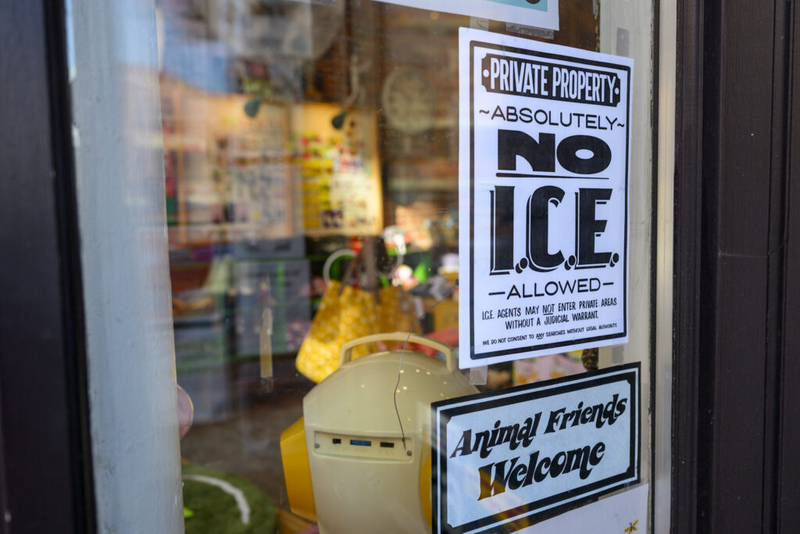
Anti-ICE flyers have appeared in shop windows across Portland since the U.S. Department of Homeland Security launched its operation in Maine on Jan. 20, 2026. (Photo by Jim Neuger/ Maine Morning Star)
The Maine Legislature passed a bill on Tuesday that would prevent immigration agents from entering public schools, state libraries and hospitals without a judicial warrant.
The legislation, which was narrowed in committee and spurred heated floor debate, is a state-level version of the “sensitive locations” policy that President Donald Trump revoked.
“I do not support the way ICE behaved recently,” Rep. Amy Arata (R-New Gloucester) said during a late night meeting of the budget committee on Monday.
She was referring to U.S. Immigration and Customs Enforcement’s large-scale operation in Maine in January. The vast majority of the nearly 200 people ICE arrested had no criminal convictions, or pending criminal charges.
“However, I think this is not the proper reaction to it,” Arata said of the bill. “There are some legitimate times when ICE may need to have access to certain places. So, seems like this is an overreaction.”
The policy in the bill had been common practice for ICE for decades, countered Rep. Ambureen Rana (D-Bangor).
Federal “sensitive locations” policies had been in effect across administrations of different political parties, including Trump’s first term, from 2011 through January 2025. Former President Joe Biden had expanded the definition of “protected areas” and imposed the greatest limits on officer discretion.
“I just want to clarify that there are exemptions in this bill,” Rana added.
Public overwhelmingly backs bill to restrict ICE access to schools, hospitals, child cares
This legislation, LD 2106 sponsored by Rep. Ellie Sato (D-Gorham), only restricts voluntary consent for entry in the absence of a valid judicial order signed by a judge, which is different from an administrative warrant issued by ICE itself (the types of warrants most often relied on by the agency recently).
Specifically, the bill would prohibit workers at public schools, state libraries and state health care facilities — which only pertains to Dorothea Dix Psychiatric Center and Riverview Psychiatric Center — from voluntarily allowing immigration agents into those locations’ private areas or providing them access to records in the absence of a judicial warrant.
The initial proposal also sought to mandate such restrictions for childcare facilities and other hospitals. That’s no longer the case under the version passed, however the measure does provide the option for those facilities and others to adopt such policies. The state attorney general would be required to draft and publish model policies and guidance within 60 days of the law taking effect.
Any cost increases are expected to be minor and can be absorbed within existing budgeted resources, but that didn’t stop the bill from ending up on the “appropriations table.” The budget committee decided to approve it Monday night, and the Senate finally enacted it on Tuesday.
Votes largely fell along party lines, with Democrats in favor. However, Rep. Lucas Lanigan (R-Sanford) supported the legislation after sharing a personal story on the floor on April 8.
Lanigan’s wife a couple of years ago became a U.S. citizen, a lengthy process he said cost them tens of thousands of dollars. His son, who was born in the U.S., recently asked him if he should carry his passport when going to work. Lanigan advised him to, saying, “It literally disgusts me to have that conversation.”
“I’m just asking as a House, as Maine people, just to think about someone else’s shoes,” Lanigan said.
Augusta, ME