Legislation would use technology to force Rhode Island’s bad drivers to take it slow
Apr 01, 2026 | 5:07 pm ET
Description
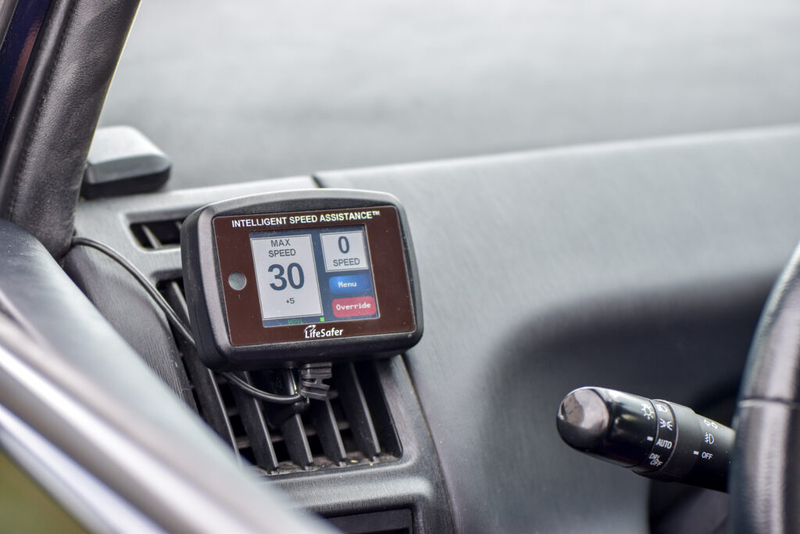
An 'intelligent speed assistance' device is seen affixed to a car's air vent. The device keeps vehicles from exceeding a street's posted speed limit. (Photo by Christopher Shea/Rhode Island Current)
The Rhode Island State House parking lot doubled as a part of a test track Tuesday afternoon, where a Toyota Prius hatchback took several loops to and from Rhode Island’s capitol building.
But it wasn’t the car being tested. Instead, the focus was on a small device clipped to the Prius’ driver-side air vent and connected to the vehicle’s accelerator that prevents it from exceeding posted speed limits. Pressing the gas pedal to go faster than the speed limit triggers resistance in the pedal, keeping the vehicle at the posted speed.
Advocacy groups such as the Providence Streets Coalition are pushing to have these “intelligent speed assistance” devices as an alternative to repeat offenders getting their licenses taken away by Rhode Island traffic court judges.
Under state law, the only court-prescribed remedy for drivers convicted of moving violations four times within an 18-month span is to have their licenses suspended for up to one year or revoked by for up to two.
Nicole O’Loughlin, political director for the Providence Streets Coalition, likened the device to attaching a Breathalyzer to vehicles of drivers convicted of driving while intoxicated.
“It’s not like we’re reinventing a new thing that has never happened here,” O’Loughlin said in an interview. “This is a way to start retraining drivers to what a responsible speed is.”
Championing the coalition’s proposal is Sen. Matthew LaMountain, a Warwick Democrat who chairs the Senate Committee on Judiciary where his bill had its initial hearing Tuesday afternoon. Companion legislation is sponsored across the rotunda by Rep. Julie Casimiro, a North Kingstown Democrat.
Casimiro did take spin of the demo car, telling Rhode Island Current she was amazed by its ability to halt acceleration.
“It’s almost scary how it knows where you are,” she said.
Though he joked he was “too big” to take part in the test drive, the 6’-foot, 5-inch tall LaMountain said he sees merit in allowing the device to be used under a hardship license for repeat speeders.
“Giving the courts more discretion to actually impose restrictions that will save lives is a commendable approach,” LaMountain said when introducing the bill to the committee. “It’s clear that fines just don’t work to prevent this kind of mayhem on our streets.”
The Providence Streets Coalition’s political director unfortunately knows that too well.
O’Loughlin’s 6-year-old nephew Hudson was killed while riding a bicycle in an alleyway after being struck twice by a driver in San Diego. She told lawmakers the suspected driver had her license suspended for nine years and “multiple excessive speeding charges.”
“She had no care for those around her, and her actions killed our sweet boy who was just starting out his life,” O’Loughlin said. “My story is not unique, but here in Rhode Island we have the power to change it.”
Between 2017 and 2023, AAA found 87 pedestrian and cyclist-related deaths from hit-and-runs in Rhode Island. The study published in March did not state how many of those fatalities were the result of excessive speeding.
At least one was the Feb. 14, 2023, death of Zacory Richardson, who was struck and killed by a vehicle while crossing North Main Street in Providence. Lisa Pope, who was Richardson’s girlfriend, said in a statement in support of the legislation his loss “highlights the devastating consequences of reckless driving.”
“Streets like North Main, where high speeds are common, put pedestrians at extreme risk — a risk that can be mitigated with this bill,” said Pope, a member of the Families for Safe Streets group.
The New York-based organization was founded in 2014 by Amy Cohen after her 12-year-old son Sammy was struck by a speeding van as he was leaving home for soccer practice. Cohen made the trip up from New York to Providence to lend her support to legislation that has already been enacted in Virginia and Washington D.C.
Virginia’s law takes effect July 1. Washington D.C.’s super speeder legislation took effect Oct. 1, 2025.
“It’s a common sense measure,” Cohen told Rhode Island Current. “We need another tool in our toolbox.”
On March 31, 2026, Rhode Island Current Reporter Christopher Shea takes a test drive onto Interstate 95 North in Providence in a car equipped with technology that prevents the car from exceeding the speed limit. (Video by Dylan Giles/Providence Streets Coalition)
Stopping the pedal from reaching metal
Rhode Island Current took the demo Prius out for a drive with Dylan Giles of the Providence Streets Coalition in the passenger seat. In the back were Justine Cote from the Rhode Island Department of Transportation’s Office of Highway Safety and Tommy Poole of LifeSafer — the manufacturer of the device in the car, who explained how it actually keeps a car from speeding.
The touchscreen device includes an image of the posted speed limit along with how fast the car is traveling.
When the device picks up that it’s in an area where the speed limit increases, the device flashes green, allowing the car to move faster to keep up with the posted cap. As drivers approach a lower-speed zone, it flashes red.
“What happens is it intercepts the wires from the gas pedal,” Poole said of the device. “So when you push down that pedal, it’s reading that voltage and using the GPS tracker to determine what the speed is and readjust the voltage out in the engine to match whatever the speed limit is.”
The device can be overridden, but the circumstances would have to be set by the Rhode Island Traffic Tribunal, according to the legislation.
The technology does have its limits. Poole said speed limiting devices are only compatible with vehicles equipped with throttle sensors, which became standard across the automotive industry in the early 2000s.
“There are some projects working on trying to control those older ones,” he said. “But once you get to those muscle cars, those carbureted vehicles, it’s much more difficult to control them.”
Streets like North Main, where high speeds are common, put pedestrians at extreme risk — a risk that can be mitigated with this bill.
The devices are also able to collect data, which raised alarms from the American Civil Liberties Union (ACLU) of Rhode Island. Their letter of testimony to the Senate Committee on Judiciary notes that LaMountain’s bill as written does not clearly establish what specific data the devices would collect.
“This should be spelled out,” the ACLU wrote. “ We cannot see a reason for any data to be maintained for more than a few days, but it could be stored indefinitely under the legislation.”
Any data that is collected should be minimal, the ACLU added.
The ACLU, along with the state’s Office of the Public Defender, both also raised concerns about the cost drivers would have to pay to keep the devices affixed to their cars. A policy paper from Families for State Streets notes an average installation fee of $150, and a daily user fee of $4 per day.
“Many people, especially our clients, would find this cost prohibitive, especially when added to all of the other costs and fees that come along with license reinstatement,” Angela M. Yingling, the public defender’s legislative liaison, wrote to the committee.
Liza Birch, founder and board president of the Providence Streets Coalition, told lawmakers she is open to having the legislation amended to address those concerns.
LaMountain’s bill was held for further study by the committee, as is standard practice for initial legislative hearings. Casimiro’s companion bill has not yet been scheduled for its initial hearing before the House Committee on Judiciary.
Providence, RI