Lawsuit causes South Dakota secretary of state to issue new guidance on federal-only voter notices
Sep 15, 2026 | 7:59 pm ET
Description
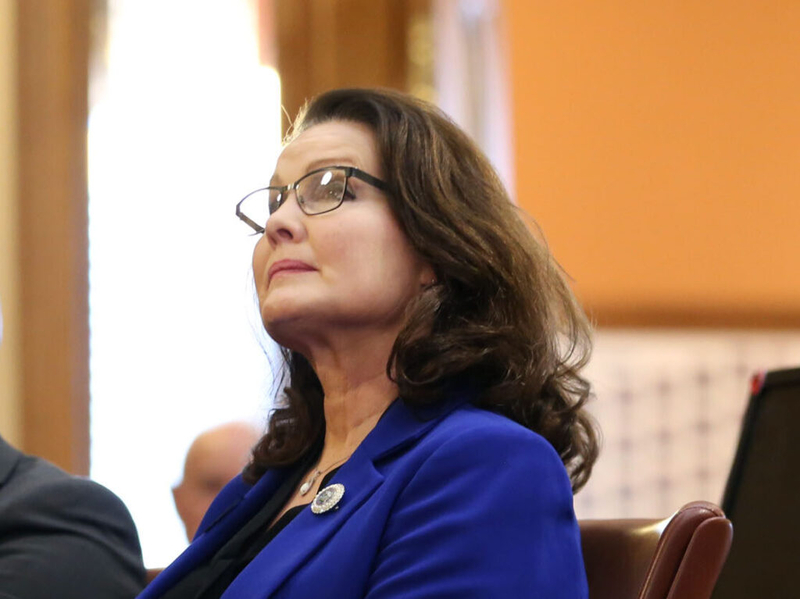
South Dakota Secretary of State Monae Johnson listens to Gov. Larry Rhoden give his 2025 budget address on Dec. 2, 2025, at the Capitol in Pierre. (Photo by Makenzie Huber/South Dakota Searchlight)
South Dakota Secretary of State Monae Johnson has instructed county auditors to send voters stripped of their right to vote in state and local elections more accurate letters explaining why.
The letters will also offer guidance on how to get those rights back for those who feel they shouldn’t have lost them.
The instructions are an outgrowth of a federal lawsuit against the state filed by the League of Women Voters and a Sioux Falls man named Jaysen Hill. He alleges he wasn’t able to vote in local contests in the June 2 primary because of a registration error and wasn’t offered an explanation or an opportunity to address it in time to cast a ballot.
The League is a nonprofit organization focused on voter registration and civic education. It argues that the procedures used to implement a new law requiring proof of citizenship by people who register to vote are unconstitutional.
That law is one of two passed by lawmakers in the past two years to create a class of “federal-only” voters in South Dakota. Such voters get ballots that allow them to vote in federal races like U.S. House or Senate or president, but not in state or local contests or ballot questions.
A 2026 law requires newly registering voters to provide a birth certificate, passport, driver’s license, non-driver’s identification card or tribal identification card, or “any other type of acceptable documentary evidence of citizenship” permitted under federal law. Photocopies can be used in place of all of them except driver’s licenses and state or tribal identification cards.
A related law from 2025 designates newly registering voters and voters requesting absentee ballots as federal-only if they list only a mail-forwarding service or post office box as their address, unless they can provide a physical address and prove 30 days of state residency.
Hill sent a photocopy of his identification card when he mailed in his voter registration and was tagged as a federal-only voter as a result, the lawsuit says. Even so, he got a letter from the Minnehaha County auditor erroneously saying that had happened because he’d failed to provide a physical address — something he’d done correctly.
Letter issue spurs request for immediate intervention
The League takes issue with several procedures surrounding the implementation of the proof-of-citizenship requirement.
Last week, the group asked U.S. District Judge Eric Schulte to issue an order that would immediately stop the state from tagging voters as federal-only without offering an accurate reason and a way to remedy the issue.
US Supreme Court blocks Trump rule limiting mail voting, sides with Dem states
On Monday, Johnson filed a document saying that while she doesn’t have the authority to mandate what kind of letters local auditors send federal-only voters, she did send auditors two alternative form letters on Monday that address the League’s concerns. One explains to such voters that they failed to produce documentation of their citizenship, and the other says they’ve failed to provide a residential address.
She also sent a separate letter to auditors that says “it has come to my office’s attention that some county auditors may be sending out a notice concerning the failure to provide a residential address” to voters who did that but didn’t offer proof of citizenship.
Auditors should do three things, Johnson said in that letter:
- Stop sending inaccurate letters to people registered as federal-only.
- Start sending accurate ones.
- Send new letters to federal-only voters who got inaccurate ones to tell them how to get back their “full-voter status” in time for them to do so by the voter registration deadline of Oct. 19.
The document also says Johnson contacted the state’s registration system vendor and asked it to disable the auto-populating letter feature that had been producing the allegedly problematic letters for counties.
League asks judge to put it in an order
Schulte scheduled a snap hearing for Tuesday after Johnson’s filing. He wrote that he’d been “on the cusp” of issuing a ruling, but that he wanted to assess the impact of Johnson’s actions on his need to do so.
At that hearing, Schulte asked William Hancock, a Campaign Legal Center attorney for the League, if Johnson’s actions satisfied the “simple fix” request the League outlined in its court paperwork and during last week’s hearing.
Petition to clarify South Dakota proof of citizenship law shot down over technicality
They did, Hancock said. But he added that they only represent “the first step” toward a more permanent, longer-term remedy.
Hancock noted that Johnson’s declaration did not include a promise to maintain the new procedure going forward, and that she could “walk it back” any time.
He also argued that Johnson had continued to downplay her role as the state’s top election official, and said the state hadn’t taken steps to correct the problem until “the 11th hour,” when a ruling from Schulte was imminent.
Johnson’s office did not address the issue in the months before the primary, Hancock said, or support changing the rules to address it when the Board of Elections voted down the League’s proposed procedural changes at a meeting in July on a technicality, and did not agree to address it in correspondence with the League in the weeks that followed.
The League would still like an order, he said at the hearing, which was livestreamed into an empty courtroom in Sioux Falls because all the parties appeared remotely.
Drew Driesen, a lawyer for the state, argued that it would be all but impossible for Johnson to “walk back” her guidance so near to an election. County auditors are preparing for advance voting, which begins Friday, and are too busy to reverse course twice in one week.
No order is needed, Driesen said.
Schulte told Driesen that a filing from Johnson pledging not to rescind the guidance “would help,” but told both parties he still needs “to get this order out” in a timely fashion. He gave Hancock until noon Wednesday to offer any additional written arguments to support the request for an order in the League’s favor.
While Johnson’s actions and a potential order from Schulte would deal with the immediate issue of notice to federal-only voters, both sides would still need to deal with the rest of the issues in the case in the coming weeks and months.
The lawsuit additionally asks Schulte to force the state to accept photocopies of driver’s licenses, tribal IDs and nondriver IDs for voter registration, and to rescind guidance requiring in-person registration for people who use such IDs as proof of citizenship.

Pierre, SD