Kansas Supreme Court turns to new death penalty appeal by serial killer John Robinson
Sep 15, 2026 | 7:31 pm ET
Description
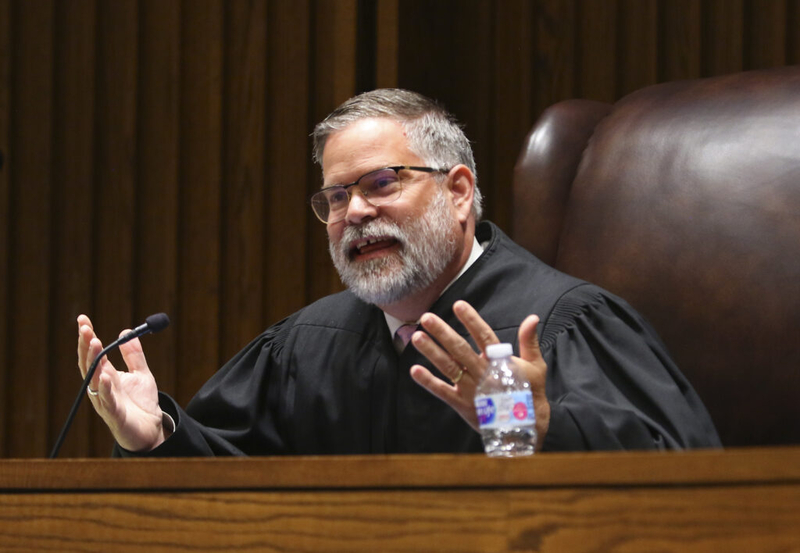
Kansas Supreme Court Justice Caleb Stegall, seen here in May 2022, shared skepticism of the latest round of appellate arguments offered by an attorney representing serial killer John Robinson, who was convicted in 2002 of killing three women in Kansas and sentenced to death in 2003. The latest line of appeal alleges inadequate defense of Robinson during his original trial. (Photo by Thad Allton for Kansas Reflector)
TOPEKA — The Kansas Supreme Court took up the latest appeal of serial killer John Robinson Sr. a quarter century after he was sentenced to death and a decade after the state’s highest court upheld his capital murder sentence in the slaying of a woman found in a barrel on Robinson’s farm near La Cygne.
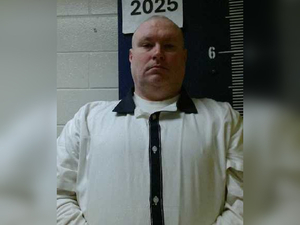
Robinson, an 82-year-old inmate at El Dorado Correctional Facility, relied on the alias “Slavemaster” in online chat rooms to make contact with potential victims.
In one of the longest trials in Kansas history, a Johnson County jury in 2002 convicted Robinson of killing three women. The jury recommended that he be put to death and District Judge John Anderson III, the son of a former governor, imposed the sentence in 2003. In Missouri, Robinson subsequently entered pleas in the deaths of five other women that resulted in a series of life sentences.
The Kansas Supreme Court previously upheld in 2015 with a 415-page opinion one of Robinson’s death sentences in Kansas but vacated a second death sentence because it was “unconstitutionally multiplicitous.”
In the latest appeal to the state Supreme Court, questions center on whether the trial court’s handling of the case conflicted with state law and violated the Eighth Amendment protection against cruel and unusual punishment under the state’s Bill of Rights.
Madeline Cohen, who specializes in death penalty appellate cases, told the Supreme Court on Monday during oral argument that Robinson’s remaining death sentences should be vacated. She said he received ineffective counsel because trial attorneys didn’t grasp nuances of state law regarding the jury’s consideration of the death penalty after finding a person guilty of a capital murder. She said prosecutors’ presentation of a single aggravating factor — that Robinson orchestrated a “common scheme” of murder warranting imposition of capital punishment — violated the state constitution.
“The defect in Mr. Robinson’s case is entirely a function of how the prosecution charged this case, presented evidence to the jury, instructed the jury and argued the case,” Cohen said.
She said the state Supreme Court should declare Robinson’s trial lawyers provided inadequate defense because they didn’t attack the prosecution’s reliance on the common-scheme theory. She claimed the result was that defense counsel “egregiously neglected their representation” of Robinson.
She said it was unlikely Robinson would have been acquitted of murder, but there was a chance he could have avoided an execution order.
“There was a huge amount of evidence sitting in counsels’ files — that they never read — that they could have used to completely dismantle the prosecutor’s common-scheme theory of capital murder,” Cohen said. “I don’t want to suggest that Mr. Robinson is not guilty of some kind of crime and had no involvement in these women’s deaths. What I’m trying to explain is there was a mountain of evidence in the discovery that really undermined the state’s theory that these women’s deaths were all connected in this tidy way they argue.”
Jacob Gontesky, who urged the Supreme Court to reject the entirety of Cohen’s arguments, said Johnson County District Judge Robert Wonnell was justified in dismissing this new avenue of appeal on Robinson’s behalf. He said Robinson’s attorneys didn’t offer Wonnell, a finalist this year for a vacancy on the Kansas Supreme Court, evidence suggesting there was reasonable probability of reversing the remaining capital conviction.
“The idea that counsel did almost no work, or as Miss Cohen states today, that they left the state’s case untested and somehow missed the common-scheme element, is flatly contradicted,” Gontesky said. “The hearing established in almost numbing detail that Mr. Robinson (was) represented by a multidisciplinary, seasoned capital defense team consisting of multiple attorneys, investigators and, yes, mitigation specialists along with a jury consultant and multiple experts.”
Justices Melissa Taylor Standridge and Caleb Stegall peppered Cohen with questions about her reading of court precedent on death penalty cases.
“I struggle with seeing how we can pin ineffectiveness on lower court counsel for failing to predict this novel development of the law,” Stegall said.
In 2015, a majority on the state Supreme Court affirmed a death-penalty conviction for Robinson and made it clear they believed the trial judge demonstrated “diligence and commitment to Robinson’s fair trial rights. The caution he exercised and the preventative measures he employed were well planned and reasonably calculated to mitigate the risk of extraneous factors influencing the outcome.”
“These efforts have facilitated our determination that the sentence of death was not imposed under the influence of passion, prejudice or any other arbitrary factor,” that opinion said.
Justice Lee Johnson, who retired from the Supreme Court in 2019, wrote a dissenting opinion that said prosecutors failed to prove capital murder.
“From a legal, factual or logical viewpoint, one simply cannot say that those duties were fulfilled in this case,” Johnson wrote. “This court should not provide cover for a prosecutor’s charging mistakes in any case, much less a death penalty case. Accordingly, both capital murder convictions should be set aside, along with both corresponding sentences of death.”
He challenged “retroactive application of the death penalty to murders that predated the legislative authority to impose that draconian penalty.” He said the court’s majority fashioned a “theory of prosecution whereby a murder completed years earlier is subsequently utilized as an element of a capital murder that is ‘completed’ after the fact by adding a new killing.”

Topeka, KS