Lawmakers must put women’s health, dignity and lives ahead of politics
Jul 01, 2026 | 7:52 am ET
Description
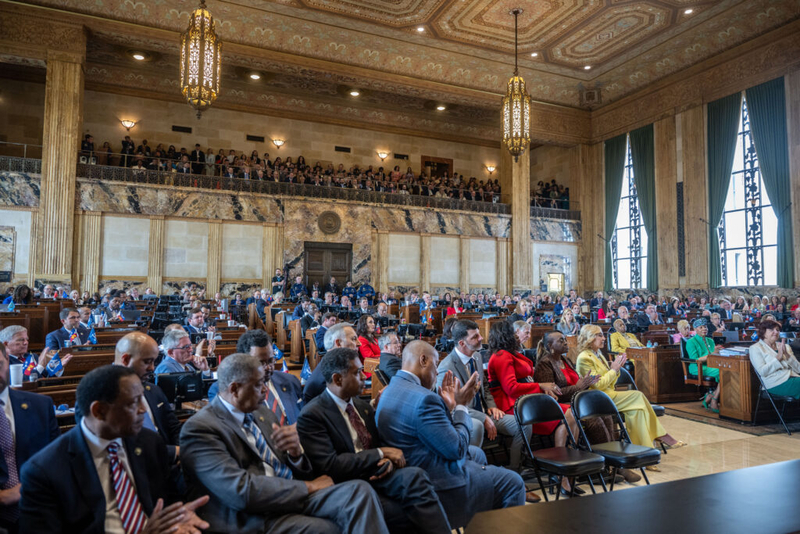
State lawmakers listen as Gov. Jeff Landry addresses a joint session of the Louisiana Legislature on the opening day of their lawmaking session at the State Capitol on Monday, March 9, 2026. (Photo by John Ballance/The Advocate-Pool)
Like millions of Americans, I remember exactly where I was when the Supreme Court overturned Roe v. Wade four years ago.
I was at a baseball game in Philadelphia with colleagues, trying to enjoy a summer evening while anxiously awaiting the decision. We had spent the entire day discussing what life might look like if Roe were overturned and what the consequences would be for states like Louisiana, where lawmakers had enacted a trigger law that would drastically restrict reproductive healthcare.
What no one at that game knew was I wanted to expand my family. At that moment, the reality of becoming pregnant felt overshadowed by a growing sense of fear. Louisiana was already facing significant gaps in maternal healthcare access, and I knew those challenges would only worsen under an abortion ban.
Looking back, that day foreshadowed much of what would follow.
A little over a month later, I attempted to schedule my first prenatal appointment. To my surprise,
I struggled to find a provider willing to schedule me before the 12-week mark — a policy I had never encountered before. Eventually, I secured an appointment, but I never made it to that first visit.
Less than a week later, I began experiencing symptoms of a miscarriage.
I sought care at several hospitals in my area and was repeatedly turned away. Only one facility offered any meaningful assistance. After nearly a week of physical pain and emotional distress, a compassionate midwife confirmed that I was miscarrying.
She also explained that I would not be able to receive the care I needed to manage the miscarriage. It took nearly two months for me to pass that pregnancy, and I endured the process with little more than Tylenol for pain relief.
Since sharing my story, I have had opportunities I never could have imagined. I visited President Joe Biden at the White House on multiple occasions and spent seven months traveling across the country with Vice President Kamala Harris, advocating for reproductive freedom and healthcare access in all 50 states.
I spoke at the Democratic National Convention, helped launch a nonprofit organization alongside the late Cecile Richards and have shared hundreds of stories from women who have been denied essential and sometimes life-saving healthcare because of the laws in their states.
Yet despite those accomplishments, I often find myself feeling profoundly disappointed because I still live in a state that does not fully recognize my humanity or respect my autonomy.
Louisiana laws have not improved since 2022. In many respects, they have become even more restrictive.
Each year since the fall of Roe, the Louisiana Legislature has advanced increasingly aggressive versions of the state’s abortion ban, often under the guise of targeting bad actors. In reality, these policies continue to make it harder for women to access essential healthcare.
Whether someone needs miscarriage management, is carrying a pregnancy with a fatal fetal diagnosis or is experiencing a medical emergency, these laws have created confusion, fear and barriers to care. It should never be acceptable for women to bleed in parking lots, travel hundreds of miles to find treatment or be forced to navigate a healthcare system that treats them as political talking points rather than patients.
The consequences are evident. Louisiana’s Black maternal health outcomes remain among the worst in the nation. Black women represent for roughly 37% of births in Louisiana, yet they account for nearly 60% of the state’s pregnancy-associated deaths, according to a review of state vital records data from 2020-22. This illustrates how disparities in access and quality of care translate into disproportionate outcomes.
Yet instead of confronting this crisis, some lawmakers have dismissed it outright. U.S. Sen. Bill Cassidy, R-Baton Rouge, infamously remarked in a 2022 interview with Politico that if Black women were excluded from Louisiana’s maternal mortality statistics, “we’re not as much of an outlier as it’d otherwise appear.”
State Rep. C. Denise Marcelle introduced legislation this year that would have addressed Louisiana’s alarming Black maternal health disparities through a formal study and comprehensive review of the crisis. Even that modest step was blocked by opposition.
And yet, there are still reasons for hope.
On the anniversary of the Dobbs decision last week, news broke that Planned Parenthood would reopen in New Orleans. Following the closure of Planned Parenthood health centers in Baton Rouge and New Orleans last September — which left approximately 10,000 patients without access to care — this reopening represents an important step forward. The health center will provide preventive services such as cancer screenings, Pap tests and other routine healthcare that communities across Louisiana desperately need.
It is a positive step, but it is not enough.
We need lawmakers who will clarify Louisiana’s healthcare laws so that patients and providers are no longer forced to operate in fear and uncertainty. We need leaders willing to study and address the Black maternal health crisis with the urgency it deserves. We need policies that support and incentivize doulas, midwives, nurse practitioners, physicians and other healthcare professionals to establish practices in underserved communities across Louisiana.
Four years after the Dobbs, the question is no longer whether these laws have consequences — the evidence is all around us. The question is whether our leaders will finally have the courage to put the health, dignity and lives of Louisiana women ahead of politics.
Baton Rouge, LA