Lawmakers look to extend NCC split property tax rates, advance reassessment reforms
Jun 04, 2026 | 6:00 am ET
Description
Photo courtesy of Spotlight Delaware
Why Should Delaware Care?
Almost a year after Delaware’s first-in-a-generation property reassessments sent shockwaves through the state, and particularly New Castle County, lawmakers are still dealing with the fallout. Legislators, after months of anticipation, will introduce a slate of bills today meant to ease taxpayer concerns. But the decision to extend a controversial policy combined with the little amount of time in this year’s legislative session could create roadblocks to enacting the reforms.
The biggest legislative controversy of last summer is back before the General Assembly.
Lawmakers are set to introduce a bill today that would indefinitely extend New Castle County school districts’ controversial ability to tax commercial and residential properties at different rates.
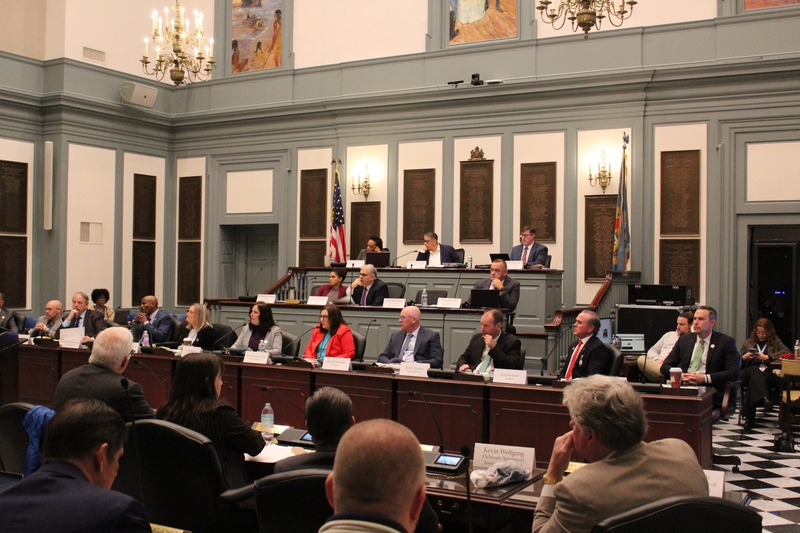
Authored by Rep. Kim Williams (D-Stanton), the bill will be filed among a slew of property tax-related proposals by lawmakers who took part in the Delaware General Assembly’s months-long committee investigation into the fallout from last year’s first-in-a-generation property reassessments.
Enacted last summer as a one-time fix, the separated tax rates – sometimes called split rates – were meant to provide residents with temporary relief from the post-reassessment tax bill sticker shock.
While the split rates reduced some homeowners’ property bills by several hundred dollars, they also sparked outcry from small business owners and spurred a months-long legal challenge by landlords and hotel operators in Delaware’s northernmost county.
Regardless, the ability for school districts to levy different tax rates for residential and non-residential property will expire on June 30 unless legislators act.
If Williams’ bill is enacted, commercial properties in New Castle County could continue to be taxed at a higher rate than their residential counterparts, but that potential increase would be slightly lower than currently allowed.
Commercial properties in New Castle County currently can be taxed at a rate up to two times higher than residential properties. Williams’ proposal would lower that multiplier to 1.85.
She said the decrease was meant to show small business owners that lawmakers were making a “good faith” effort not to overtax them while also ensuring residents can afford to pay their bills.
“It’s a balancing act,” Williams said.
A handful of other property tax-related bills and resolutions are set to be filed today along with the split rate extension.
If passed, the bills could work in tandem to make immediate changes to address short-term concerns and create new working groups to investigate long-term solutions.
Whether the General Assembly will pass the package in its entirety during the final 10 working days of the legislative session remains to be seen.
Searching for standards, long-term solutions
Seven pieces of legislation will be introduced today between both the House of Representatives and the Senate – five bills and two resolutions, Rep. Cyndie Romer (D-Newark) said.
Romer herself authored two of the bills and one of the resolutions.
Her most sweeping proposal – the resolution – would create a stakeholder working group to develop statewide standards for conducting property assessments. Those standards could include establishing requirements for how property data is collected and maintained, among others.

According to the resolution, the legislation developed by Romer’s working group could prevent counties from certifying their tax rolls should their assessments not meet the to-be-determined state standards.
While Romer said she usually bristles at the idea of creating working groups that can prolong direct action, she realized there is not a quick fix to address the multiple issues that occurred during New Castle County’s property reassessment.
Those issues led to results that confounded Romer. Those included the results of a Spotlight Delaware analysis that found properties in some of Wilmington’s poverty-stricken communities saw some of the largest percentage increases in median property value across the state.
So she set out to correct the assessment process, and to ensure the new property reassessments do not create the same fallout as their predecessors.
“I didn’t feel like we could do nothing,” Romer said. “We needed to fix this problem, even though we realized it was going to take time to truly fix it.”
Along with Romer’s statewide standards resolution, she said another resolution aiming to address longer-term property tax policies is also likely to be introduced today.
While Romer’s resolution is geared more toward establishing standard operating practices for assessments, the other would create a working group to investigate other potential policy levers the state or its three counties could employ to ease the property tax burden on residents.
The legislature’s joint property tax committee discussed some of these policy levers, such as homestead exemptions, during hearings last fall.
Looking for additional revenues
Meanwhile, State Sen.Dan Cruce (D-Wilmington) will introduce a bill he hopes will help counties and municipalities create additional revenues “not off of our small businesses and not off of our neighbors.”
Cruce declined to comment on the specifics of his bill ahead of today’s official filing, but he called it a “specific” proposal that relates to the state’s telecommunications tax cap.
Currently, Delaware counties can include the value of a telecommunication company’s poles, cables, wires and more when calculating its annual property tax bill.
But state law limits how much those companies can be taxed to their 2015 levels. That means telecommunications companies are being taxed based on property valuations from more than a decade ago.
It is unclear, however, if Cruce’s bill would change or remove that tax cap.
Other legislation in the package
Along with Romer’s assessment standards resolution, she also penned two bills for the property tax package.
One of those bills would require the city of Wilmington to share its permitting data with New Castle County, closing an information sharing gap that led to fingerpointing last fall about who was to blame for some of the most widely criticized assessment issues in northern Delaware.
Romer’s second bill would allow New Castle County school districts to reset their property tax rates this summer, following the conclusion of an ongoing review of the most recent assessment and the possible enactment of Williams’ split rate extension.
Williams also wrote a second bill for the package. That legislation would expand property tax exemptions for seniors and people with disabilities, building upon House Bill 159.
Today’s slate of bills comes on heels of another property tax bill working its way through the legislature from Senate President Pro Tempore David Sokola (D-Newark).
Senate Bill 322 would rescind school districts’ current ability to automatically implement a 10% tax increase after property reassessments, instead allowing them to seek additional funding without holding a referendum vote.
Instead of taking an automatic 10% hike, districts – should they meet certain criteria – would be able to implement an up to 2% tax increase each year without seeking approval from voters. That approach mirrors the process in many other states.
Lawmakers must pass each of the bills included in the forthcoming property tax package in both the House and Senate before the General Assembly gavels out for a final time on June 30. Any bills that fail to pass by that date will effectively be dead in the water.
The package will now join a growing list of legislation – including next year’s nearly $7 billion state budget, healthcare reforms, banking code modernizations, hemp regulations and more – that lawmakers have only 10 working days left to address.
Julia Merola contributed to this report.
Dover