Lawmakers divided on influence of newest Nebraska Economic Forecasting Board Pillen appointees
Sep 22, 2026 | 6:55 pm ET
Description
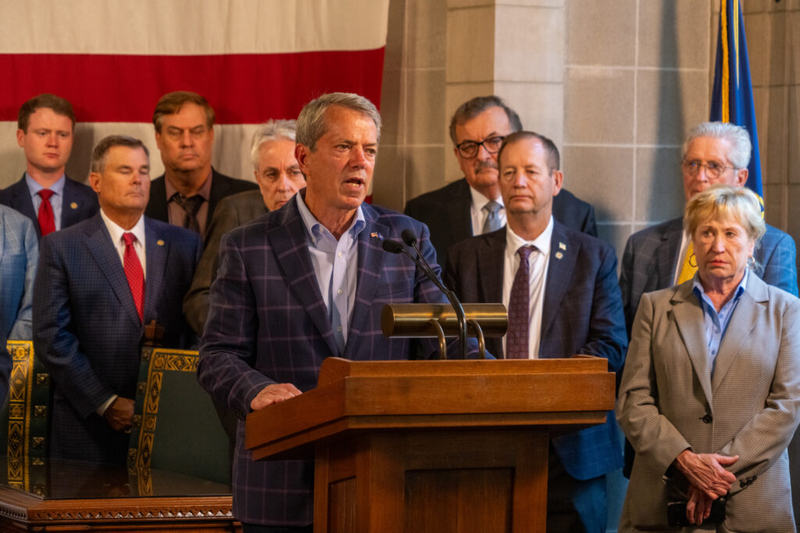
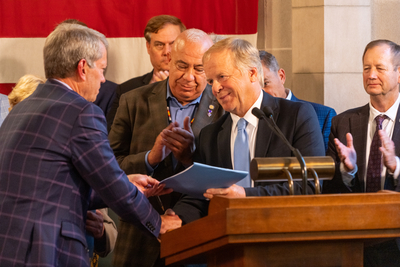
Gov. Jim Pillen hosts a news conference at the end of the Legislature's special session to address property taxes that begin almost one month prior. To his far left is State Sen. Lou Ann Linehan of the Elkhorn area, chair of the Legislature's Revenue Committee. Aug. 20, 2024. (Zach Wendling/Nebraska Examiner)
LINCOLN — As criticism clouds Nebraska Gov. Jim Pillen’s latest appointments to a state advisory board predicting state tax revenues, lawmakers are divided on what influence the most well-known of those newest board members will have.
The nine-member Nebraska Economic Forecasting Advisory Board will meet Oct. 30 and project whether Nebraska faces a budget shortfall through mid-2029, and at what scale. The meeting comes just days before the Nov. 3 general election, in which Pillen faces a tougher-than-usual four-way race to hold onto the governor’s seat.
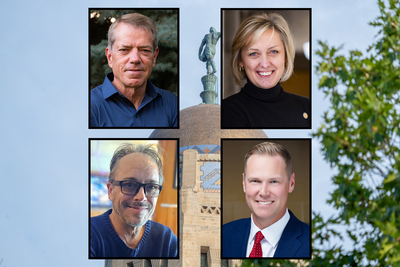
Two of Pillen’s newest appointees, former state Sens. Tom Briese of Albion and Lou Ann Linehan of Elkhorn, were key allies for Pillen in enacting major income tax cuts in 2023, as well as supporting multiple property tax proposals throughout 2024, which were significantly slimmed back.
In November 2023, Pillen elevated Briese to state treasurer, where he served for two years. And last year, Pillen appointed both Briese and Linehan as members of a new School Financing Review Commission to review state and local funding of K-12 schools, seeking to reduce property taxes.
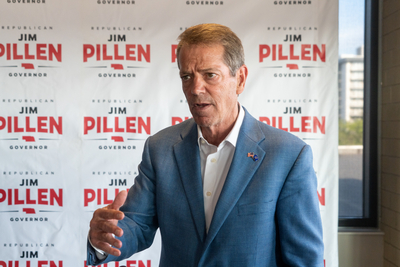
Pillen last week said he believes new perspectives are always good, doesn’t play “goober politics” and believes Nebraska’s diverse economy “puts us in great shape” economically.
“I’m not a speculator,” Pillen said Friday when asked what he’s expecting next month. “I learned in my business if you speculated, you went broke, so I don’t speculate.”
‘A head-scratcher’
Pillen’s appointments have faced resistance, including from former state Sen. John Stinner of Gering, a six-year chair of the Legislature’s Appropriations Committee. He told the Omaha World-Herald that recent forecasting board appointments have been “too political.”
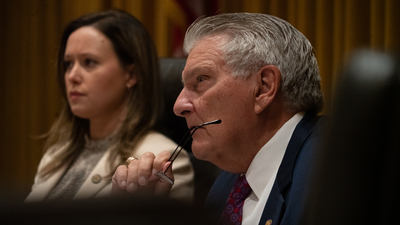
Stinner told the Nebraska Examiner he worries the next forecast could be “rosier” than reality.
“It’s a head-scratcher for me why anybody would do this,” Stinner said this week. “It’s a distortion, and people need to understand that it’s all about politics with this current administration.”
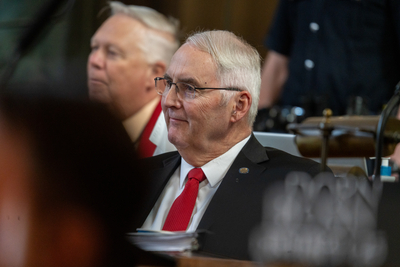
State Sen. Rob Clements of Elmwood, the outgoing four-year chair of the Appropriations Committee, disagreed. Clements was appointed to the Legislature in February 2017 and served out the next six years with Stinner, seven with Briese and eight with Linehan.
“Senators Briese and Linehan are independent thinkers, and I don’t know that there’s any political portion of that,” Clements said. He said he believes Briese and Linehan always acted in “good faith for Nebraska, not as rubber stamps of the governor.”
The forecasting board was created in 1984 as a way to reduce politics in predicting state revenues. It replaced forecasts made by the Department of Revenue, which reports to the governor. Membership consists of four gubernatorial appointees and five appointees from the Legislature’s Executive Board.
The Omaha World-Herald and Flatwater Free Press first reported on the new appointments last week.
‘No preconceived notions’
Like Clements and Pillen, Linehan and Briese reject the idea that they’re in this for politics.
“I arrive really with no preconceived notions as to where they’ve been, where they should be going, other than look at the data, look at the numbers objectively and see where they lead us,” Briese told the Examiner.
Added Linehan: “I’m hoping, mostly, that I learn a lot and that we can get closer to what the actual numbers are versus what we forecast.”
In addition to Briese and Linehan, Tim Wilson, a retired certified public accountant from Omaha, joins the board. Pillen reappointed Matt Miltenberger, who was campaign manager and chief of staff for former Gov. Pete Ricketts.
The three departing board members are:
- Former state Sen. John Kuehn of Heartwell, a legislative ally of Ricketts. Ricketts had appointed Kuehn to the forecasting board shortly after Kuehn left office in January 2019.
- Thomas Henning, a Kearney businessman who had been on the forecasting board since 2010.
- Leslie Andersen, a banker from Bennington who had been on the board since 2002.
Despite their disagreements, Stinner, Clements, Linehan and Briese agree on the importance of an accurate forecast, which in part sets a ceiling for state spending.
Missed revenue targets can lead to unexpected surpluses, or to the predicament Nebraska faces now: an approximately $208 million deficit through June 2027, which must be addressed next year.
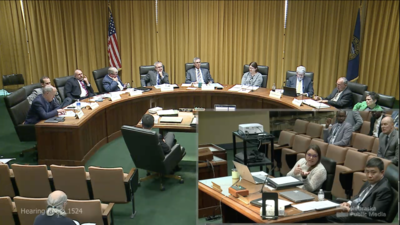
If the shortfall isn’t fixed, it would grow to almost $847 million by July 2029, according to the latest state projections confirmed in July.
These figures will be revised at the Oct. 30 meeting and set the stage for the 2027 legislative session, where the budget, as it has for the past two years, will likely dominate debate. The figures will again be revised in February and April as the budget-writing process moves forward.
“I’m glad that the Appropriations Committee just can’t say, ‘I think we’ll just raise the forecast a little bit, that should make it a lot easier,’” Clements said. He said the forecasting board process is better than the Legislature deciding spending based on its own revenue forecasts.
What’s in a forecast?
State Sen. Mike Jacobson of North Platte, who faces reelection this fall, seeks to chair the Legislature’s Revenue Committee next year. He came to Pillen’s defense as he faced reporters’ questions Friday about the budget and forecasting board at an unrelated news conference.
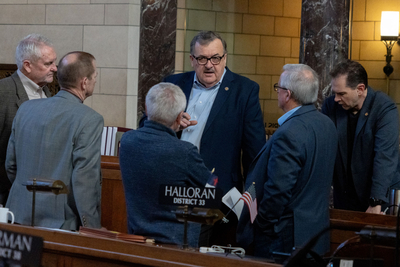
Jacobson said the forecasting board had more “rose-colored glasses” and overforecasted revenue in part because of higher-than-expected tax refunds as a result of federal changes.
“I don’t think it’s a bad thing putting money into our residents’ pockets,” Jacobson said.
Pillen has long said that because Nebraska cut income taxes, it must cut spending as well.
After the news conference, Jacobson said Briese and Linehan will be a “welcome addition because they understand how the sausage is made.”
Board members receive a plethora of data before each meeting and receive a briefing from economists from the Legislative Fiscal Office and Nebraska Department of Revenue. Jacobson called the forecasters the “boots on the ground” who add nuance to the economic picture.
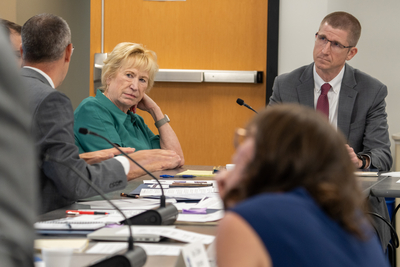
All nine members anonymously write down their projections for tax revenues for the current fiscal year and each year of the following biennium. This is done four times, for sales and use taxes, individual income taxes, corporate income taxes and miscellaneous taxes.
Once estimates are submitted, an average is calculated. The board can remove outliers, if there are any, but is not required to. A board member can then motion to accept a projection as the board’s consensus.
It takes a simple majority to accept a projection — five votes.
The state has seen revenues more closely match projections the past two months after multiple months where revenues missed the mark. Jacobson said he expects continued improvement. Clements said that while he’s seen improvements, he predicts an increase in Nebraska’s shortfall.
‘Cook the books’
But while Jacobson, Clements and the appointees are confident politics weren’t part of the appointments, others are more skeptical, including outgoing state Sen. Machaela Cavanaugh of Omaha, who said they’re a “clear attempt” to impact the board’s decisions.
She pointed to a social media post from a colleague, state Sen. Ashlei Spivey of Omaha, who wrote: “As the saying goes, ‘It is easier to cook the books when you pick the chefs.’” Cavanaugh and Spivey serve on the Appropriations Committee with Clements.
Cavanaugh said she “1,000%” would agree that someone such as Linehan is her own person and won’t take marching orders, but she said the “catch” is how aligned Linehan is with Pillen.
“She was selected because she has the same objective, and that is to put more money to property tax relief, to keep the tax cuts that she implemented that have put us in this position … both that she was the architect of, to keep those in place and force the Legislature to cut funding to direct services as a result,” Cavanaugh said.
But Linehan said the conversation with Pillen’s staff was whether she was willing to serve, “end of conversation.”
“There was no other additional ‘This is what we can do,’” Linehan said. “That is all just made up in people’s minds. And I don’t believe, after watching Tom Briese and Lou Ann Linehan, that anybody thinks we would do that.”
“Certainly no instructions, marching orders, even recommendations or suggestions,” Briese said.
‘There’s enough checks and balances’
Stinner, a Republican, also blamed Linehan’s legislation for repeated deficits, and he criticized Clements for more closely toeing the line on the governor’s budget proposal. He said lawmakers need to assert their independence on the governor’s recommendation, which he said is just that.
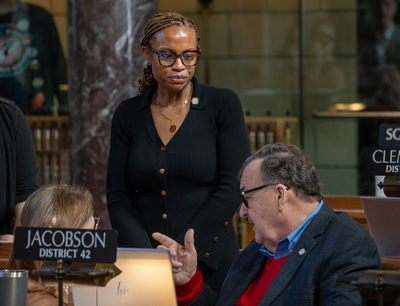
Clements said that like Linehan and Briese, he was independent and did what he felt was best for the state. He and Jacobson said Linehan and Briese are also just two of nine votes.
“They can let their opinion be made, and they can make a motion for a rosier picture, but they would need five votes in agreement with what they’re proposing,” Clements said. “There’s enough checks and balances there that it isn’t likely to affect an outcome of the forecast.”
Linehan said her record in decades in public service, including with the U.S. State Department and as a chief of staff to former U.S. Sen. Chuck Hagel, speaks for itself: “I try to find the right answers. I ask tough questions, and I challenge information I don’t think is accurate.”
A different forecast?
In addition to pulling out outliers, there’s another caveat to the forecast: The Legislature is under no obligation to accept the forecast when drafting the next budget.
Stinner and Keisha Patent, who leads the Legislative Fiscal Office, confirmed that is an option. No Appropriations Committee chair has used that authority, Patent said, to her knowledge.
Stinner said he never felt a need to sidestep the board. He went to meetings, watched the board’s work and “had no problems with what the outcome was.” Clements, too, never used the authority. He said he didn’t know that was an option or that the board could remove outliers.
The budget shortfall also includes a legislatively estimated spending increase of about 2.4% in the next two years, nearly $400 million in total. The Legislative Fiscal Office, at the direction of the Legislature’s Appropriations and Revenue Committee, projected that figure.
Pillen, while he incorrectly blamed the forecasting board for the spending estimate, said a spending increase is “not happening as long as I’m your governor.”
During his time in office, spending has increased each year, according to data from the Nebraska State Treasurer’s Office. Though reports on Nebraska’s “general fund,” the state’s main checking account, show decreases, that’s in part because of more spending of federal funds and across state cash funds. Some cash funds were swept to shore up the general fund.
The November election
Pillen’s Democratic opponent, former state Sen. Lynne Walz of Fremont, said in a statement that Pillen had “stacked” the advisory board “with the same people who helped him write his tax plan and the reason we are in the budget crisis today.” Walz came in at the same time as Linehan and Briese in 2017, overlapping all six years with Stinner as Appropriations chair.
“Nebraskans deserve the truth about the state of their budget — not appointees who will project inaccurate numbers to make the governor look good before the election in November,” Walz said.
Stinner has added another quirk to this year’s governor’s race: He’s endorsed Walz. He said that decision wasn’t made lightly and came from a “realistic viewpoint” about the budget.
Pillen’s campaign, too, has touted some cross-partisan support, such as from former state Sen. Heath Mello of Omaha, leader of the Omaha Chamber of Commerce. Pillen’s campaign touted Mello’s support specifically in favor of the governor’s work around an economic tax incentives package this spring.
Multiple senators told the Examiner that by Oct. 30, many voters will have voted or made up their minds, regardless of the forecast, so they discounted the electoral stakes of Linehan and Briese joining the board.
The governor said the $400 million spending estimate is one quick area to solve. On top of a total $21 billion budget over the next three years, he said Friday, that’s something in the business world that he and Jacobson know “you solve that percentage before breakfast.”
“Only politicians who want their name in the paper are trying to make something of that, make sense?” Pillen said. “Not asking you to agree with it, but hopefully it makes sound, simple mathematic sense.”
‘Confidence in our result’
State Sen. Brad von Gillern of Elkhorn, the current Revenue Committee chair, also downplayed the roles of Linehan and Briese. He wrote in an opinion piece in the Omaha World-Herald that neither the governor nor any state senator is motivated to encourage a specific forecast.
“The fact that these two former senators are fiscal hawks should not in any way taint their reputations, their future efforts, nor predict any particular outcomes,” von Gillern wrote, saying the “worst thing” any forecaster could do is come to an inaccurate projection, politics aside.
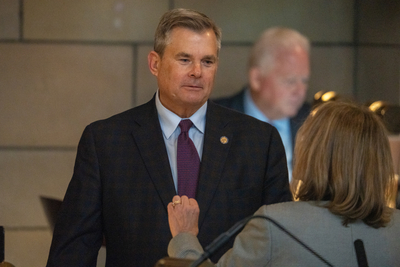
Von Gillern faces his own tough reelection bid against Cindy Maxwell-Ostdiek, a registered nonpartisan whom von Gillern faced in 2022, a different time economically and politically. If von Gillern is not reelected, Jacobson said he would run for speaker of the Legislature and not Revenue chair, confirming months of speculation that von Gillern might seek the speakership.
While hopeful for an improved projection, von Gillern echoed Jacobson, Patent, Stinner and others: “The right number is the right number, and the Legislature will budget accordingly.”
Briese said he’s seen some of the negative comments on his appointment but is focused on doing his best and remaining objective. He said he has the utmost respect for outgoing members and believes it’s important that people have confidence in the forecasting process and result.
“It’s likewise important to conduct ourselves and conduct our work in a manner that generates that confidence in our process and confidence in our result.”
Nebraska Examiner reporter Erin Bamer contributed to this report.
Editor’s note: This article has been updated to clarify Heath Mello’s support for the governor.
Lincoln, NE