Moore wants new congressional maps for Maryland after Question 3 victory
Nov 04, 2026 | 7:31 pm ET

Description
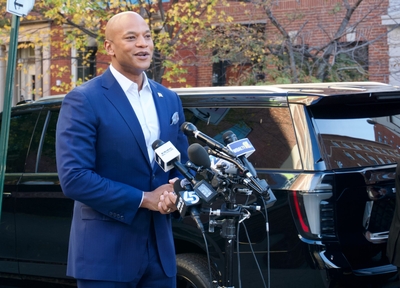
Maryland Gov. Wes Moore (D) said Wednesday he wants the General Assembly to move forward on new congressional maps after the passage Wednesday of Question 3, Maryland's redistricting-focused ballot question. (Photo by Christine Condon/Maryland Matters)
Gov. Wes Moore (D) said Wednesday that he wants to see new congressional maps for Maryland after the General Assembly convenes in January and that he is “ready to engage” with lawmakers on the subject of redistricting.
The remarks came as part of the governor’s victory lap Wednesday, the day after “historic” wins by Democrats in elections nationwide and Maryland voters’ approval of Question 3, which loosens restrictions on redistricting in the state.
Moore invested significant political capital on the question, which passed with 60% of the vote just weeks after polls showed that voters were skeptical.
“Two weeks ago, everybody said that Question 3 was done,” Moore told reporters outside of Mount Vernon’s Ceremony Coffee Roasters, the day after his reelection. “I am very proud to say that, in a loud and resounding fashion, Question 3 passed in Maryland, and we made sure that Maryland could help to meet the moment.”
Meeting the moment, to Moore, should come in the form of new maps that would give Democrats the advantage in all eight of the state’s congressional districts come 2028— in response to the GOP-led effort to draw district lines in its favor leading up to Tuesday’s midterms. Republicans currently hold just one of those eight seats, the 1st District where eight-term GOP Rep. Andy Harris was reelected Wednesday.
“Donald Trump is not done. He has already been very clear about his intention to go after additional states,” Moore said. “The courts have spoken, the people of Maryland have spoken, and it is time to make sure that Maryland does meet this moment.”
Legislative leaders Wednesday welcomed the passage of Question 3 and said they look forward to working with the governor on redistricting. But it did not appear to be on the top of anyone’s list of priorities.
House Majority Leader Del. David Moon (D-Montgomery) said he believes the legislature should take up other, more pressing, issues first in January, especially given that new congressional maps couldn’t be used until 2028 anyway.
“It would be, I think, a big misread to make mapmaking the first priority of the legislature,” Moon said. “The first priority of the legislature is going to be work on the top concern of Marylanders and that continues to be healthcare access and affordability.”
Maryland House Speaker Joseline Peña-Melnyk (D-Prince George’s and Anne Arundel), who campaigned for Question 3, was noncommittal Wednesday, saying through a spokesperson she was “very pleased that the voters had their say and approved Question 3.”
“Question 3 does not require new maps to be drawn but ensures Maryland is on even ground with other states moving forward,” the spokesperson said. “We welcome the opportunity to continue conversations with the Governor and the Senate President to determine the best approach for our state. The House has met this moment before and we will be ready again when it’s necessary.”
Question 3 clarifies that requirements for electoral districts that are compact and contiguous apply only to General Assembly districts, after a 2022 court decision said those restrictions should apply to congressional districts as well. It also states that the neither the state constitution nor the Declaration of Rights govern congressional redistricting, and grants the Supreme Court of Maryland original jurisdiction to review the state’s redistricting plans.
Months of congressional redistricting fights end with win for Question 3
The House of Delegates passed a new map during this year’s General Assembly session, but the Senate declined to take it up. Maryland Senate President Bill Ferguson (D-Baltimore City) resisted redistricting for much of the year, publicly sparring with Moore and citing potential legal concerns with drawing new maps that could fall in the courts.
Ferguson reversed course after the U.S. Supreme Court “gutted” the Voting Rights Act, and agreed to an August special session where lawmakers pushed Question 3 on to the ballot.
Ferguson said in a statement Wednesday that he was pleased with passage of the ballot question, which “gives Maryland clear legal standards for redistricting.”
“I’ll be discussing any next steps with my Senate colleagues and other state leaders,” his statement said. “We will certainly take into account the results of how mid-cycle redistricting efforts played out across the country and any further actions other states may pursue. Regardless, lowering costs, growing our economy, and protecting programs Marylanders rely on will remain our top priorities.”
The map previously approved by the House earlier this year could provide a template for the future. That map swept across the Chesapeake Bay, connecting Maryland’s rural and red Eastern Shore with blue strongholds in Annapolis and Columbia. It also divided parts of Baltimore City into three different districts, and divided Democratic counties Montgomery and Prince George’s.
Sen. Clarence Lam (D-Anne Arundel and Howard), who has long supported redistricting, said he agrees with the governor that new maps are necessary, because more red states will attempt mid-decade redistricting in an effort to improve their electoral outcomes in the future. And future years may not be as good for the Democrats as this year was, meaning Republicans could find more success in gerrymandered districts.
“We have massive tailwinds — tailwinds that we will perhaps never again see in our lifetimes,” Lam said. “That tailwind will not be present in 2028.”
Lam said he does not think the House map passed earlier this year will be the final map, since it could have diminished Black representation in Maryland’s congressional delegation by dividing heavily minority districts.
“It may be a starting point for discussion, but I think there’s some genuine considerations,” Lam said. “There have been some concerns from colleagues to not break up Baltimore City to the degree that it was broken up before. There are also some concerns of not losing African American representation in our federal delegation.”
Moon believes the legislature can approach the district lines with a fresh set of eyes, given the approval of Question 3.
“We can operate with a little bit of a clean slate of mind here, because the constitutional amendment that just passed has the effect of alleviating, I believe, any concerns about potentially having a map struck down in court,” Moon said.
Annapolis, MD