Dems flip seats in Montana Legislature
Nov 04, 2026 | 8:11 pm ET
Description
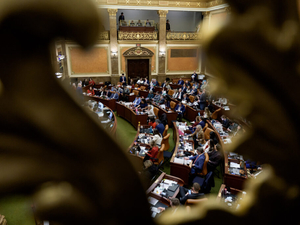
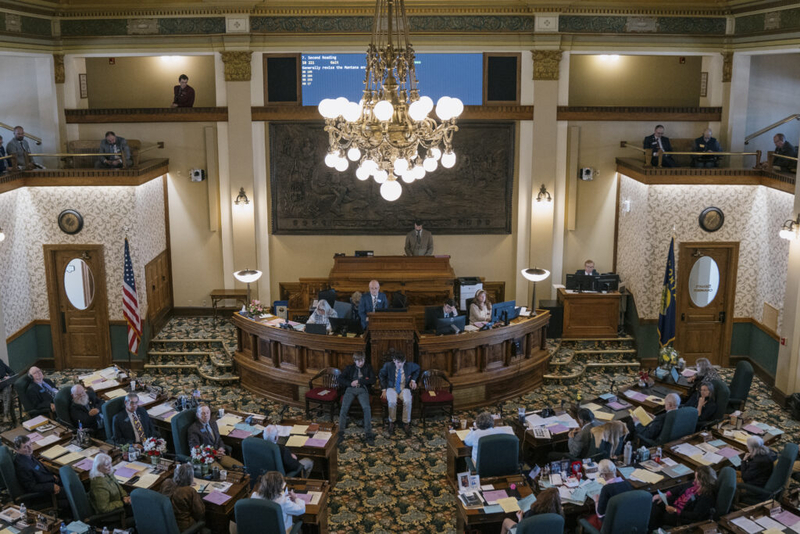
The Montana Senate is seen during the Wednesday, February 12, 2025 session. (Nathaniel Bailey for the Daily Montanan)
Montana Democrats flipped two seats in the state Senate in the midterm election, giving the party 20 members in the upper chamber, the highest number it’s had there since 2019.
Republicans will have a 30-to-20 advantage in the 2027 Legislative session and a majority in the House as well, though it likely will be slimmer in the lower chamber once the final results are tabulated.
Even late Wednesday, the Montana Secretary of State’s Office reported that only 78% of the precincts in the Treasure State were completely counted.
In Senate District 10, Margaret Mitchell, a Democrat, flipped a seat previously held by Jeremy Trebas who ran unsuccessfully for the Montana Public Service Commission. With all precincts in the Great Falls district reported, Mitchell took 3,701 votes to Republican Jessica Drydahl’s 2,832, a 14-point win in a seat the Democrats will hold for the next four years.

Mitchell plans to be a voice on bills dealing with the tech industry and related issues. She said the Legislature needs more engineers. Mitchell was formerly an executive at American Express. She’s a mom, grew up in Great Falls and graduated from Montana State University, where she’s now an adjunct professor teaching about blockchain.
“This will be new to me,” Mitchell said. “I’m going to put my nose to the grindstone to learn very quickly how to be effective.”
In order for Democrats to flip more seats, they need to deliver on promises and come to the Legislative session with solutions, she said. She also added that a split government could lead to solutions-oriented work for Montanans.
“It was a common theme when I was at the door, that people want us to work across the aisle and work with each other for Montana,” Mitchell said. “I think focusing on the things that really matter to Montanans and will affect their lives is what’s going to make the difference. And when they see Democrats being effective and focusing on the things that are most important to them, we will gain their trust.”
Meanwhile, further south, Scott Rosenzweig flipped a seat for the Democrats in Senate District 29, which previously had been held by John Esp of Big Timber. The seat includes the Treasure Valley from Livingston to Gardiner, and north to Clyde Park, as well as part of Bozeman.
With 12-of-15 precincts fully reported, Rosenzweig had 56% of the votes to Republican Jason Gunderson’s 44%. Rosenzweig said the ballots left were all in Gallatin County and he expected them to break largely for him.
Despite relatively small gains for the Democrats, Rosenzweig said he woke up to a much different political climate.
“I personally feel like even though the Democratic Party didn’t win any majority, I feel like I woke up in a much more committed purple state,” Rosenzweig said Wednesday.

He, too, said he’s interested in tech legislation and is vehemently opposed to the concept of a sales tax. Capital gains changes are on his to-do list as well. Hotel taxes need to increase, he said, and vowed to address infrastructure issues in rural tourist hotspots.
The district is partially in Park County and partially in Gallatin County. Gardiner is one of the entrances to Yellowstone National Park.
“I have two counties, one of them is large and relative to the other, economically successful,” Rosenzweig said. “The other is very sparsely populated and suffers a burden of tourism infrastructure upkeep costs and gets nothing from the state in support.”
Republicans in the Montana Legislature appeared to be relatively calm about the election results in the Treasure State.
Sen. Greg Hertz, in a statement, said that state Republicans outperformed their counterparts in other states around the nation. Hertz is chair of the Montana Republican Legislative Campaign Committee and is from Polson.
Montana House results
Montana Republicans were expected to keep at least 55 seats in the Montana House. Republicans had 58 House seats during the 2025 Legislature. House Democrats held all 42 seats going into election night, and gained at least one and potentially as many as three.
Hertz added that the redistricting in 2023 played a part for Montana Democrats during the midterm elections.
“Ironically, the Democratic-backed 2023 legislative redistricting map helped preserve Republican majorities. By creating relatively few competitive districts, the map insulated Republicans from significant losses even in a strong Democratic election year,” Hertz said in a statement. “The results demonstrate the unintended consequences of partisan redistricting.”
The contested House races include House District 4, where Paul Koch held a 500-vote lead over Republican Shaun Pandina. None of the five precincts in that race have been fully counted.
In House District 20, Democrat Steve Keller beat Melissa Nikolakakos by 46 votes with all three precincts fully reporting.
Rep. Curtis Schomer, a Republican in House District 48 looking for reelection, had a 15-vote lead over Democrat challenger Tucker Colvin. The three precincts in that race have not been fully reported.
And in House District 57 — Rosenzweig’s former seat — Democrat Becky Edwards appeared to be on the way to a win over Republican Bob Crank.
With around 85 total seats, Montana Republicans will also be well short of a supermajority, which in Montana would be 100 total seats between the House and Senate.
Helena, MT