Arkansas election shows shift in Democrats’ favor, but far short of other states’ gains
Nov 04, 2026 | 8:30 pm ET
Description
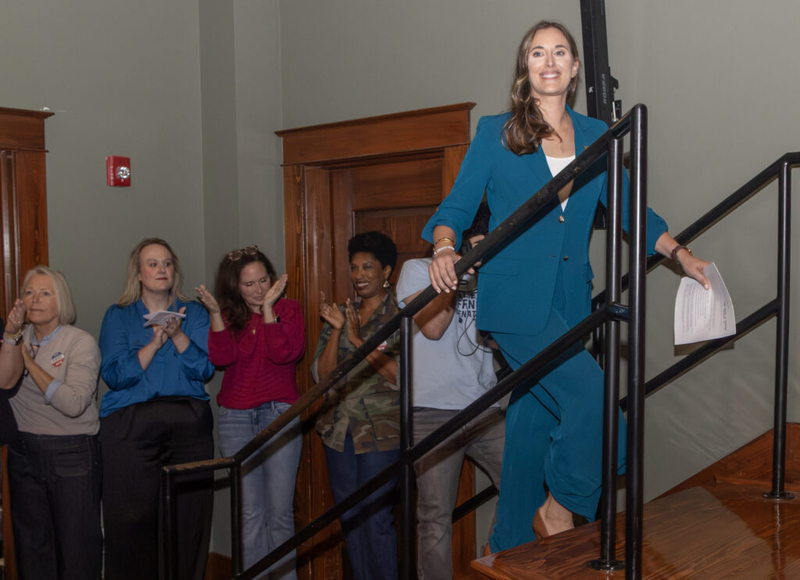
Hallie Shoffner prepares to deliver her concession speech to supporters at the Mosaic Templars Building in Little Rock, Arkansas on Tuesday, Nov. 3, 2026. (Photo by John Sykes/Arkansas Advocate)
After losing her bid for U.S. Senate, Arkansas Democrat Hallie Shoffner had a message for the national party.
“Just because a state is considered unwinnable does not mean its people are unworthy,” Shoffner said in her concession speech Tuesday night in Little Rock.
Shoffner’s 12-point, nearly 105,000-vote loss to incumbent Republican U.S. Sen. Tom Cotton came as Democrats won congressional seats and governor’s races by sizable margins nationwide.
Other states went blue after years and even decades of Republican dominance, but “in Arkansas, we had something of a red wall,” said John Davis, a University of Arkansas associate professor of political science who has studied the state’s shifts in political power.
Democrats have not won a statewide or U.S. House race in Arkansas since 2010. Three of the state’s four Republican congressmen defeated Democratic challengers Tuesday, and central Arkansas’ U.S. Rep. French Hill led Democrat Chris Jones by more than 4,000 votes as of Wednesday evening, though The Associated Press had not yet called the race.
Jones indicated Wednesday he was waiting to see if provisional ballots could close the gap, declaring “we are not done yet” in a Facebook post.
But AP voter data shows an electoral shift toward Democrats in all 75 counties, two years after Republican President Donald Trump won 64% of Arkansas’ vote.
AP graphics may not be republished.
“Homegrown, high-quality candidates” like Shoffner and Jones contributed to Democrats’ down-ballot gains, said Jay Barth, a Hendrix College professor emeritus of politics.
“In some places, especially rural areas, it was a slightly demobilized Republican electorate, and then in urban and suburban areas, I think [Democrats] had a little bit more of a true blue wave,” Barth said.
Democrats’ pickups concentrated in 3 counties
Democrats flipped 11 state legislative districts, the party’s biggest gain in the General Assembly in more than two decades. Republicans have held supermajorities in both chambers of the General Assembly since 2016, and the Democrats broke the House supermajority needed to pass most budget bills by winning 10 seats.
The pickups were concentrated in Benton, Washington and Pulaski counties, the state’s three most populous. Democrats also gained one House seat each in Conway, Jonesboro and the Delta.
The party also retained legislative seats by larger margins than its 2024 wins. Rep. Diana Gonzales Worthen of Springdale received more than twice as many votes as her Republican challenger, two years after flipping Arkansas’ only majority-Latino district.
At the time, Gonzales Worthen’s 2024 win was Democrats’ first net gain in the statehouse in 20 years. Democrats have said repeatedly since then that they hoped to capitalize on their growing momentum.
The Senate will keep its Republican supermajority after Democrats gained one seat in northern Pulaski County.
Republicans lose ground in northwest Arkansas
Cotton is the U.S. Senate’s third-ranked Republican, and he will lose his Intelligence Committee chairmanship in January since Democrats took control of the chamber.
He won his first U.S. Senate term in 2014 when he unseated Democratic then-Sen. Mark Pryor by more than 144,000 votes. Cotton easily won reelection in 2020 without a Democratic opponent.
But Cotton’s 6,000-vote margin over Shoffner in Benton County, formerly a Republican stronghold, exemplified the party’s loosening grip on Arkansas, Barth and Davis said.
Trump won Benton County with 62% of the vote in 2020 and 2024. This year, Cotton won roughly 51% of the county’s vote.
Democrats flipped four Benton County state House seats, including one that bleeds into Washington County, where the party already holds a few legislative seats. The party made both state and local gains there, winning an 8-7 majority on the Washington County Quorum Court.
Washington County voted for Democrat Robb Ryerse over Republican U.S. Rep. Steve Womack, who won the county in 2024. Womack won reelection Tuesday with nearly 28,000 fewer Benton County votes than his 2024 win.
Northwest Arkansas’ shift away from Republicans in federal races “softened the margins for victory” down the ballot, “largely due to a really impressive ground game for Democrats,” Davis said.
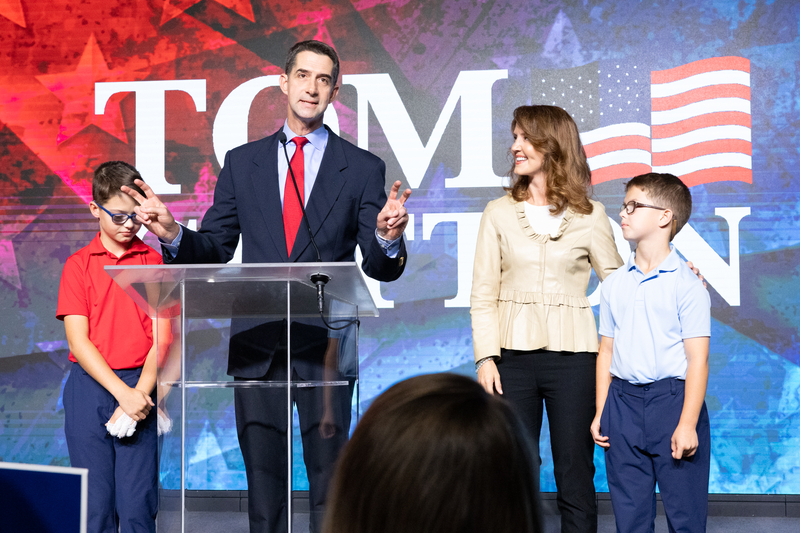
Statewide, Shoffner received a greater percentage of the vote against Cotton than either Democratic opponent of Arkansas’ other Republican U.S. senator, John Boozman, who won reelection by 24 percentage points in 2016 and 34 percentage points in 2022.
A first-time candidate and sixth-generation Arkansan, Shoffner built her campaign on her decision to close her family’s soybean farm last year under financial strain she attributed to Trump’s tariffs. She portrayed Cotton, who declined to debate her twice, as uninterested in everyday Arkansans.
Shoffner attempted to appeal to Republicans, independents and non-voters, saying Arkansans “don’t have to change your party to change your senator.” Cotton and his allies spent millions on ads portraying Shoffner as soft on immigration.
Jones and Shoffner both attempted to tie their opponents to Trump, whose approval rating in Arkansas and nationwide has declined.
The rising cost of living fueled Trump’s unpopularity, and Arkansas Democrats prioritizing “kitchen table issues” above its opposition to the president was a good messaging strategy, Little Rock state Sen. Clarke Tucker said.
“Republican attempts to paint and define Democrats as extremists failed in large part because voters understand that Democrats care about affordability for working families, a successful economy [and] the price at the gas pump,” said Tucker, who unsuccessfully challenged Hill in 2018.
‘Dust your boots off’
National Democrats poured money and attention into red states that flipped federal seats but invested much less in Arkansas, even though Shoffner’s campaign received some national media attention.
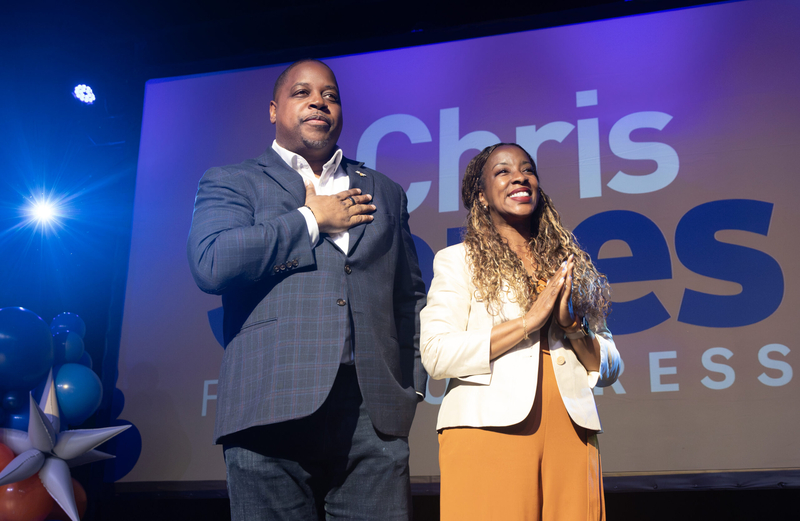
The Democratic Congressional Campaign Committee directed fundraising efforts to Jones in October. Barth said the effort “probably could have paid off” if it had happened earlier in the race.
Jones also received former Vice President Kamala Harris’ endorsement. Former Transportation Secretary Pete Buttigieg and former Massachusetts U.S. Rep. Joe Kennedy III campaigned for Jones on the ground in central Arkansas, and Illinois Gov. JB Pritzker spent money on ads supporting Jones’ bid.
Hill has not made any public statements since polls closed Tuesday night.
If Hill wins, it would be his narrowest margin of victory in his seven congressional elections, even after Republican state lawmakers redrew the 2nd District in 2021 to favor their party. Hill’s closest race before Jones was his 2018 victory over Tucker by nearly 16,000 votes.
Jones first ran for office in 2022 when he lost the governor’s race to Republican Sarah Huckabee Sanders, who was reelected Tuesday. He was far from the only Arkansas Democrat to run for at least the second time.
Seven of the 11 Democrats who flipped state legislative seats had run in the same district or region before, with some unseating Republicans who previously beat them. Repeat candidates have the advantage of familiarity regardless of party, Tucker said.
“I think one message to the [Democratic] candidates who got close would be to take a week off and catch your breath, dust your boots off, and get ready to go start hitting the streets again,” Tucker said.
Little Rock