Larry Rhoden: Rancher, welder and three-decade politician makes his case to earn SD’s trust
Jul 16, 2026 | 10:46 am ET
Description
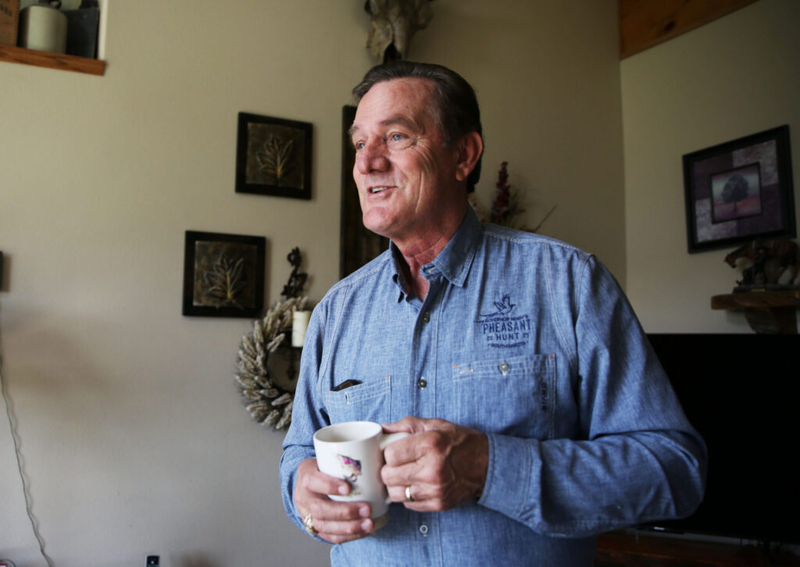
South Dakota Gov. Larry Rhoden drinks a cup of coffee on June 26, 2026, in the living room at his ranch near Union Center. (Photo by Makenzie Huber/South Dakota Searchlight)
South Dakota Gov. Larry Rhoden leaned forward in a leather recliner in his living room, considering the criticism from a former colleague about their disagreements.
“I think there’s probably some fair statements in there,” Rhoden finally said.
In his late 30s and early 40s while on the Meade School District Board, Rhoden couldn’t back up his opinions effectively during debates, Terry Koontz said. She served with him on the board more than 25 years ago.
“Of all the board members I worked with, he’s the worst,” Koontz said.
Toby Doeden: A bitcoin evangelist and anti-property-tax crusader who wants to be governor
The two clashed over policies ranging from rural education and homeschooling to the proposed location of a rodeo arena near Sturgis Brown High School. Rhoden became frustrated and angry when the board didn’t vote his way — which Koontz said was often.
Koontz’s characterization of Rhoden stands at odds with the reputation he’s built in state politics over the last two decades as a convener and collaborator. Rhoden, 67, said he’s changed.
“At that age, I wasn’t patient with people, especially when I thought they were stuck on stupid. It got me angry.”
That frustration, he said, pushed him to be more considerate of others’ opinions as he continued in politics. He believes those and other life lessons have prepared him to seek his own four-year term as South Dakota’s lead executive, after being elevated from lieutenant governor 17 months ago when Gov. Kristi Noem resigned to join President Donald Trump’s administration.
“Every step of the way you learn, you mature,” Rhoden said.
Koontz’s experience colored her impression of Rhoden, pushing her to vote for “anyone but him” as he climbed South Dakota’s political ladder. In the four-way race for the Republican nomination for governor in the June 2 primary, she voted for political newcomer Toby Doeden. She plans to vote for Doeden again — and against Rhoden — in the July 28 runoff between the two.
Ranch provides roots and a refuge
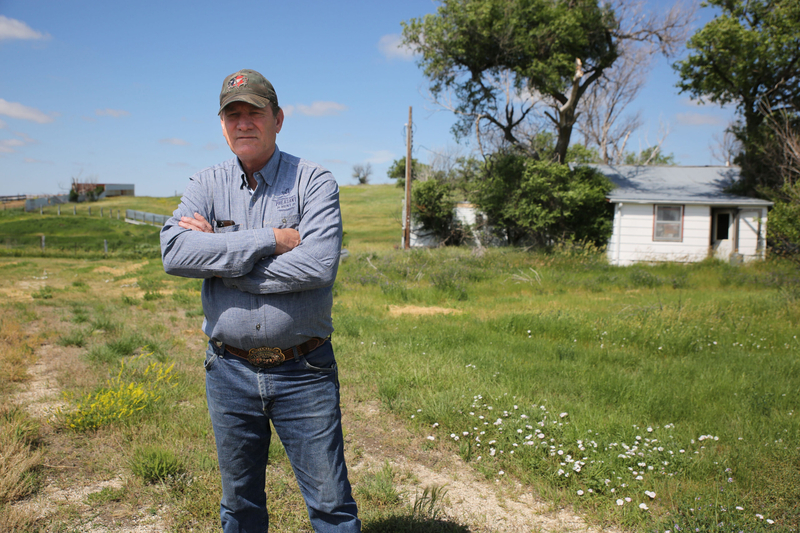
Walking along the gravel road winding through his ranch, Rhoden points out a small white house hidden behind trees and overgrown shrubs. He grew up there with his father, mother, three brothers and twin sister.
Rhoden learned how to drive at 8 years old on a tractor pulling a mower in a nearby field, and he attended a two-room country school down the road in Union Center. One of his first memories of chores on the ranch was gathering and washing chicken eggs with his sister to sell at a Sturgis grocery store about 45 miles away.
He knew his future was on the family ranch spanning a couple thousand acres. Both sets of grandparents homesteaded within 20 miles of his home, and he can point toward the location of the log cabin his mother grew up in nearby.
He surrounds himself with reminders of his family history, including furniture he crafted from his mother’s childhood cabin, and a gavel and knife handles he made from a black walnut tree that shaded his childhood summers.
His ancestors came to South Dakota with “big ideas and big hopes, and then they got slapped in the face with reality the first winter they spent out here,” Rhoden said.
His family stuck it out, and he sees that same determination in his neighbors today.
“It was the ones who were the toughest and the most industrious, that gutted it out, the smartest that were able to find a way to eke out a living, and that became the foundation for our state,” Rhoden said. “I think about that a lot.”
But as Rhoden’s career in politics has advanced, his time on the ranch has dwindled.
During his 16 years in the Legislature, he struggled to keep up with chores at home. A neighbor drove several miles to his ranch daily to feed his cattle during the three-month legislative sessions. When Noem asked Rhoden to temporarily add interim secretary of agriculture to his duties as lieutenant governor, he sold the cattle to that neighbor’s son and leased some of his land out to him.
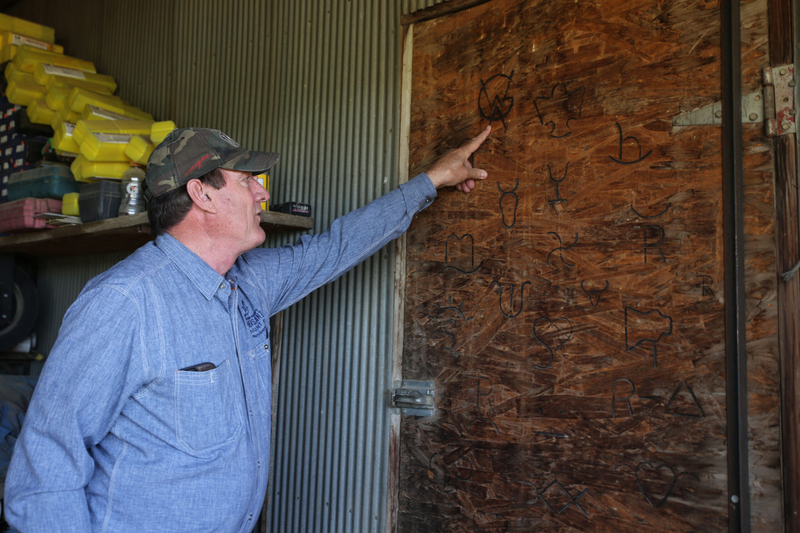
Rhoden’s father taught him to weld, and Rhoden started a business years ago on the ranch making custom branding irons. Since he became governor, the youngest of his four sons has largely taken that over.
Now, welding serves as therapy.
“Anytime we come home, if there’s still daylight, I’ll change clothes and come out to the shop and light up the forge,” Rhoden said.
National Guard, political experience
Rhoden graduated from high school at the private Sunshine Bible Academy in 1977. He attended a vocational ranch management program in Rapid City but dropped out, saying he didn’t think the vocational classes were practical enough for ranch life. Rhoden is one of 12 governors in South Dakota history to lack a college degree.
He joined the South Dakota National Guard in 1978, went to welding school for his occupational specialty and served for six years, mostly in a maintenance battalion in Sturgis as part of the 842nd Engineering Company.
His time at basic training tested his mental and physical limits, he said. Being “yelled at in the face” taught him to keep his cool in stressful situations, something he said served him well while leading lawmakers in the “pressure cooker” of the Legislature as assistant House majority leader and then House majority leader. He served as a legislator from 2001 to 2014 and again from 2017 to 2018.
Rhoden’s wife, first lady Sandy Rhoden, learned alongside him in his political career. The two met and married each other in their early 20s, raised their four sons and now have nine grandchildren. Though Sandy, a former teacher, said she didn’t expect her husband to become governor, she saw he was “cut out for leadership” positions early on.
“There’ve been times I’ve had to encourage him to do things because I feel like I have a really good perspective of his abilities. If it’s not something I think he’d be good at, I’m not going to encourage him to do it,” Sandy said. “But if I think he should, then I do. And with the governor’s race, I don’t know of anybody else who I think is more capable of governing right now.”
Rhoden suffered some setbacks while attempting to win higher offices. He lost a bid for majority leader in the state Senate in 2011 and said he learned how to “be effective because of who you are and not what your position is” as a rank-and-file member. He described learning how to “lose well” in his failed bid for the U.S. Senate in 2014, when he finished second in a five-way primary that included former governor and eventual U.S. Sen. Mike Rounds.
Rhoden introduced and endorsed Rounds at that year’s Republican convention, and called for party unity.
“That paid dividends for me for years after that,” Rhoden said, “because they had all of the leaders of the party there, and my stock went up in value because of that. And I think it ultimately had an impact on Kristi’s decision to ask me to be a running mate.”
It took Rhoden “probably a total of three seconds,” he said, to accept Noem’s invitation to be her running mate in 2018. The two had previously served together as legislators.
“It’s that sense that God put you on the planet to do more than serve yourself,” said Rhoden, a lifelong Baptist.
“I remember an old-timer who told me, ‘You should run for office for what you can do, not what you can be,’” Rhoden added. “I think there’s a lot of wisdom in that. Too many people want a title rather than want to make a difference in serving the state.”
After he took over for Noem when she departed in January 2025, she sparked national controversy as secretary of the Department of Homeland Security. Federal agents under her authority fatally shot two people during immigration enforcement operations in Minneapolis.
“There are people that think it’s a detriment to be tied to Kristi, and people that think it’s an advantage,” Rhoden said. “For me, it doesn’t really matter, because other people’s opinions aren’t going to change the way I view my relationship with her, my past working experience with her, and how much I valued the job she did.”
Trust and relationships
Rhoden said his faith is what makes him effective as governor.
“Having the moral compass of speaking the truth all the time and putting that ahead of any political agenda is central for me when I talk about my ability to build relationships and bring people together,” Rhoden said. “That’s all predicated upon trust and people’s trust in your integrity.”
But he acknowledged he can still get frustrated and angry like he did when he served on the school board. Some of his modern colleagues have observed that.
Republican former Senate President Pro Tempore Lee Schoenbeck, of Watertown, said he’s gone “toe to toe” with Rhoden behind closed doors.
“But the thing with Larry is I always knew even if we disagreed about one thing he’d have my back as far as the institution went on another thing,” Schoenbeck said.
Schoenbeck added that Rhoden was accessible to make deals and talk through issues during Noem’s administration when she was not. Schoenbeck expects an inclusive decision-making process if Rhoden is elected.
“Larry understands that when you live in Union Center, you can see a lot of land but not many people,” Schoenbeck said. “He gets that he needs a lot of those other folks that come from a lot of different places and perspectives to make sure he’s making good decisions.”
Nancy Turbak Berry, a Democratic former legislator who served with Rhoden, said she has appreciated Rhoden’s commitment to civility in difficult situations. She is a plaintiff in a lawsuit attempting to invalidate anti-abortion-pill legislation that Rhoden signed into law in March.
Despite their political differences, Turbak Berry said Rhoden has been “open and respectful” to her input through the years — including her unsolicited text messages to him during his governorship and on the campaign trail.
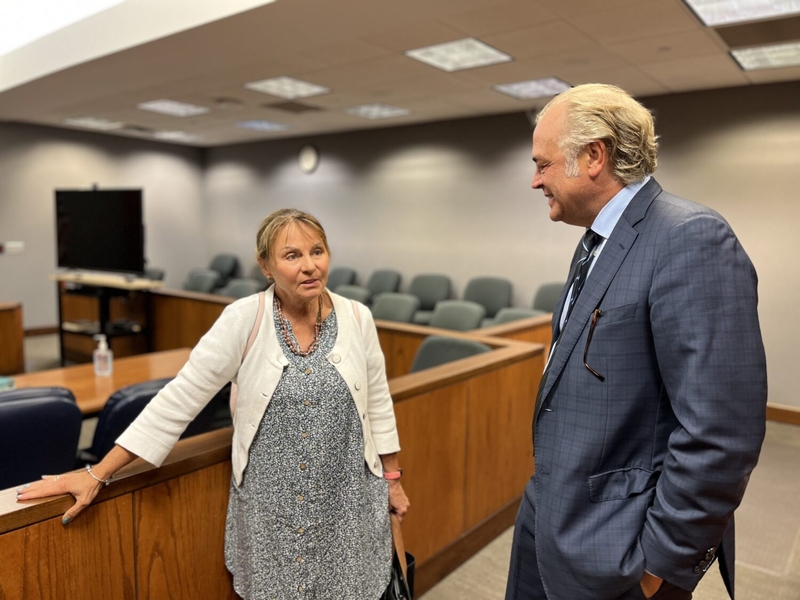
“A lot of people in Republican politics in South Dakota have become so arrogant about the power that comes with a one-party state that they think they don’t have to deal with anybody outside of the party,” Turbak Berry said. “A lot of people would ignore me or respond with hostility. Rhoden has never done that.”
That dynamic has earned her vote — she temporarily switched her party affiliation ahead of the primary to vote for him, she said. She plans to vote for him again in the runoff before switching her registration back.
“I trust him,” Turbak Berry said.
Rhoden was registered as a Democrat early in his life. Both of his parents were children of the Great Depression and “beholden,” he said, to President Franklin D. Roosevelt and his Depression-era federal work programs.
“I always say I was Democrat by birth and Republican by choice,” Rhoden said, adding that Ronald Reagan (who was also a former Democrat) had the largest political influence on him as a young man.
It wasn’t until the 1990s, a few years before he made a run for the Legislature, that he switched his party affiliation to Republican.
Legislative record
During his legislative career, Rhoden worked to support what he called “conservative values.”
He sponsored a successful bill in 2004 that exempted trucking services from sales taxes, saving trucking companies and costing the state about $4 million annually.
He worked for years to restrict the Department of Game, Fish and Parks’ use of the open fields doctrine, which allowed the department’s law enforcement officers to enter private land without a landowner’s permission while enforcing hunting and fishing laws. In 2021, while Rhoden was lieutenant governor, lawmakers passed legislation he supported that specified when the department’s officers can enter private land and when they must obtain permission or a warrant.
Rhoden was the main sponsor of a bill to change the taxable valuation of agricultural land from a market-based system to a productivity-based system, which helped to limit the growth of property taxes on farm and ranch land.
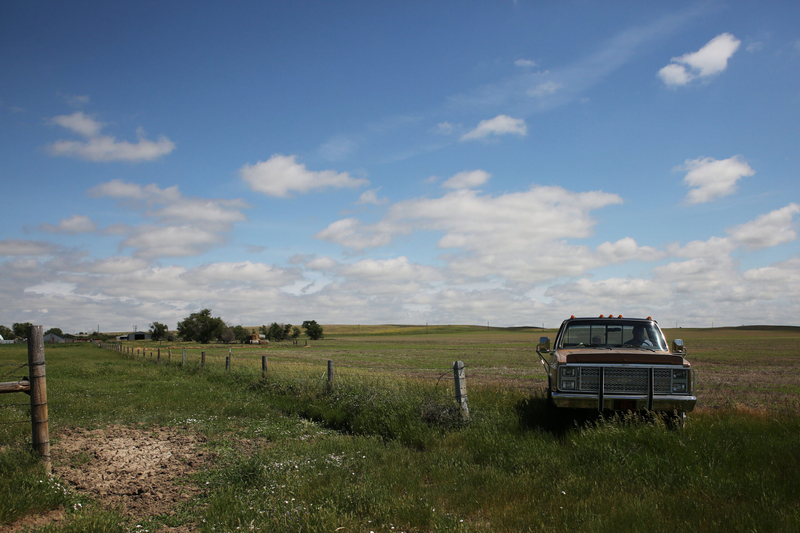
Rhoden supported pro-gun bills and anti-abortion legislation. That included the 2005 abortion trigger ban that went into effect after the U.S. Supreme Court’s Dobbs decision in 2022. The law prohibits all abortions except those deemed medically necessary to save the life of the mother.
“It’s kind of laughable when I see stuff on Facebook of people trying to brand me as moderate or whatever,” Rhoden said. “I think people get confused. They think you can’t be conservative if you get along with people, or that if you’re not picking fights then you’re not a conservative.”
Rhoden also introduced the successful legislation in 2003 that designated rodeo as the official sport of South Dakota.
‘Steady hand at the helm’
After taking over for Noem, Rhoden said, he didn’t decide to seek his own term as governor until he proved to himself that he could do the job.
His potential candidacy ultimately hinged, he said, on his ability to win approval for the construction of a $650 million men’s prison in Sioux Falls — the largest capital project in state history, which had already failed in the Legislature once — during a special legislative session in September of last year. Rhoden argued a new prison is needed to replace dangerously out-of-date facilities at the state’s 145-year-old penitentiary, and to provide more programming space to help people avoid returning to prison after their release.
By the time of the special session, there were already three other Republican candidates for governor, all with lawmakers supporting them who didn’t particularly want Rhoden getting a policy win and joining the race, he recalled. Lawmakers approved the prison plan, using money set aside during the prior several years to avoid taking on debt.
Republican governor candidates spar over prison policy in dueling speeches
That was the last of what Rhoden has called the “three P’s” that he inherited as unresolved issues when he became governor: the prison, a pipeline and property taxes.
In addition to getting the prison approved, he brought an end — for now – to a controversial carbon-capture pipeline proposal by signing a bill into law that bans such projects from using a process known as eminent domain for gaining access to private land. He also signed several bills into law that will lower property taxes for homeowners in the coming years, including two that rely on higher sales taxes to bring property taxes down.
Dave Knudson served as Senate majority leader in the Legislature while Rhoden was House majority leader. Knudson said he voted for Rhoden in June and plans to do so again this month.
“I think the important thing is we have a steady hand at the helm of state government that won’t run us off the road at all and just continue to make life better on an incremental basis for the average citizen,” Knudson said. “I think Rhoden has the ability to do that.”
If he makes it past the runoff and is elected in November against Democratic nominee Dan Ahlers, Rhoden said the next four years will look similar to the last year and a half: task forces and roundtables to seek understanding and collaboration on divisive issues, conservative fiscal policy, and investment in South Dakota’s industries and workforce.
“It’s hanging meat on the bones of the visions we’ve laid out,” Rhoden said.
“I’m not just talking big talk. We’ve delivered results,” he added. “I’ve been doing the job, and we’ve been doing a pretty good job of delivering results for South Dakota, and that’s what we’ll continue to do if they give me another four years.”

Pierre, SD