Knox County Schools takes “Roots” off banned book list, restores to libraries
May 26, 2026 | 6:31 pm ET
Description
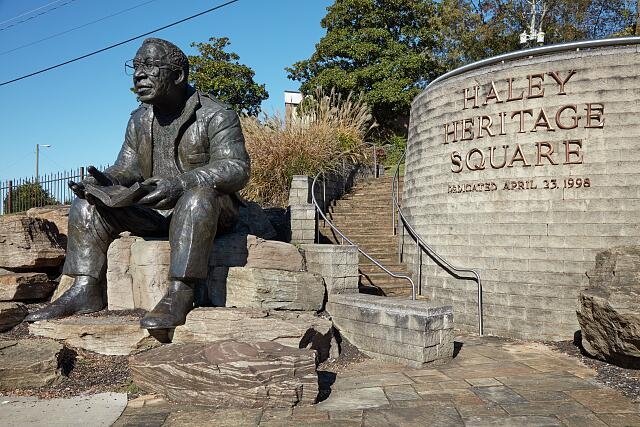
"Roots," by Tennessee author Alex Haley, has been taken off the Knox County Schools banned book list. (Photo:
Haley Heritage Square in Knoxville. Library of Congress)
An East Tennessee school district has reversed its ban on “Roots: The Saga of an American Family,” the Pulitzer Prize-winning novel by Alex Haley, after weeks of community backlash, board member pressure, and statewide criticism, all unfolding in the same city where a 13-foot bronze statue of Haley has stood for nearly three decades.
Knox County Schools Superintendent Jon Rysewyk said the district will return the 1976 novel to school library shelves, walking back a decision that had added Roots to a growing list of banned books and ignited debate about race, history and the reach of state law into public school libraries.
In a memo to the Knox County Board of Education dated May 26, 2026, Rysewyk said the decision to return Roots to shelves was effective immediately and that the initial removal “was in no way a commentary on the historical, cultural, or literary value of the novel.
He said he spent the weeks following the ban consulting independently with multiple attorneys to review the specific content flagged under the law, and found no consensus.
“There were discrepancies even among the legal experts I consulted regarding their interpretation of the relevant sections of the Tennessee Code and the referenced terms as they applied to “Roots,”” he wrote. Rysewyk noted that his review committee had applied the law consistently and in good faith, but said the legal uncertainty ultimately drove his decision.
“Removing any book from circulation is, and should be, an immense decision. Our intent will always be to err on the side of access, which is the decision I have made with regard to “Roots,”” Rysewyk said.
The reversal drew immediate attention not just because of the book’s stature in American literature, but because of where it happened. Haley spent part of his childhood in Lauderdale County , and later lived and wrote in Knoxville and Alex Haley Farm in nearby Clinton. Two miles from where the Knox County school board meets, his likeness sits frozen in bronze in Morningside Park, in what was, at the time of its 1998 installation, the largest public statue of an African American in the United States.
District spokeswoman Carly Harrington confirmed that Roots was added to Knox County Schools’ banned book list in May 2026, bringing the district’s total to 124 banned titles, up from 113 in May 2025.
The removal was triggered by Tennessee’s Age-Appropriate Materials Act, a state law that broadly restricts materials from school libraries if they contain nudity, sexual abuse, sexual content, or excessive violence. The law is stricter for library materials than for classroom instruction, as a book can still be taught by a teacher as part of a curriculum, but cannot remain on library shelves for independent student checkout if certain content is present.
In an interview, Assistant Superintendent of Academics Keith Wilson said that an internal review committee identified a specific passage in the novel that it determined crossed the legal threshold. Wilson noted this was the second time this year a passage from the novel had been brought up for review, but the first time it did not result in a finding of violation. He said the law’s focus is on specific passages, not the historical significance of a work as a whole.
The ban sparked swift and pointed criticism from a board member, educators and state lawmakers.
Knox County School board member Katherine Bike sent a memo to her colleagues demanding the book’s return.
“Removing Roots is not a neutral act,” Bike wrote. “It sends a message to our students, particularly our Black students, about whose history is worth protecting. I don’t believe that is the message any of us intends to send. Intent and impact are two different things.”
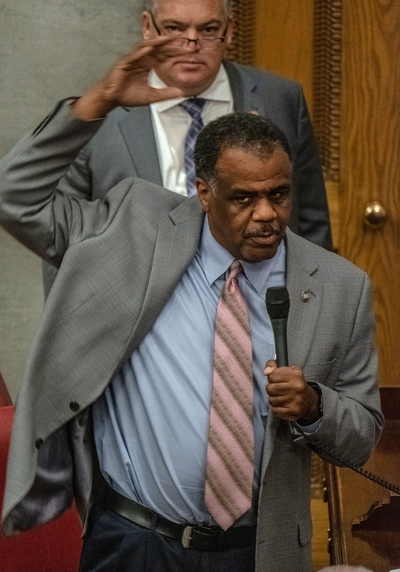
On Tuesday after the reversal was announced, State Rep. Sam McKenzie, whose district includes the Haley statue, called the ban a grave injustice and said he was disappointed but not surprised.
“’Roots’ won a Pulitzer Prize and became a cultural touchstone that inspired and united millions of Americans,” McKenzie said. “I knew that taking it out of the hands of thousands of schoolchildren in Knox County would be a grave injustice.”
McKenzie said he has taken legislative action in response to book removals like this one. During the current 114th General Assembly, he sponsored HB2434, which would prohibit the removal of books until a final determination can be made about their appropriateness for the age and maturity level of students, and whether the material is consistent with the educational mission of the school. He also filed the Freedom to Read Act, HB1051, aimed at keeping books like Roots accessible to students.
McKenzie pointed to the particular irony of the ban’s timing and location.
“I am often reminded of the importance of Mr. Haley’s pivotal works when I see the statue of him in Alex Haley Heritage Square in Knoxville and also his significant contributions to the University of Tennessee, where many of his historical documents are housed,” he said. He also noted that the state legislature designated Roots as one of the first ten official Tennessee state books in 2024.
State Rep. Gloria Johnson, went further in her criticism, writing on Facebook her memory of visiting the Haley statue with Rep. Justin Jones, and called the ban part of a broader pattern.
“I’m so disgusted that a law passed by the TN legislature has resulted in the book Roots being banned,” she wrote, connecting the timing of the removal to what she described as a legislative special session aimed at diluting Black voting power in Tennessee.
“This isn’t coincidence folks, it’s the agenda of the white supremacist supermajority working exactly as intended.” Johnson said she is planning legislation for the next session to address what she called white supremacy in the Tennessee legislature.
The controversy in Knox County is part of a broader national debate over book bans in public schools. The reversal does not change state law. The Age-Appropriate Materials Act remains in effect, and the district’s review process that led to the removal of Roots along with 123 other titles, continues to operate across Knox County school libraries.
Rysewyk said district staff will present to the board at a June 1 work session on the Age-Appropriate Materials Act and how it will be applied going forward.
Nashville, TN