As Kentucky GOP numbers have grown, 25 counties still have more registered Democrats
Jul 02, 2026 | 10:51 am ET
Description
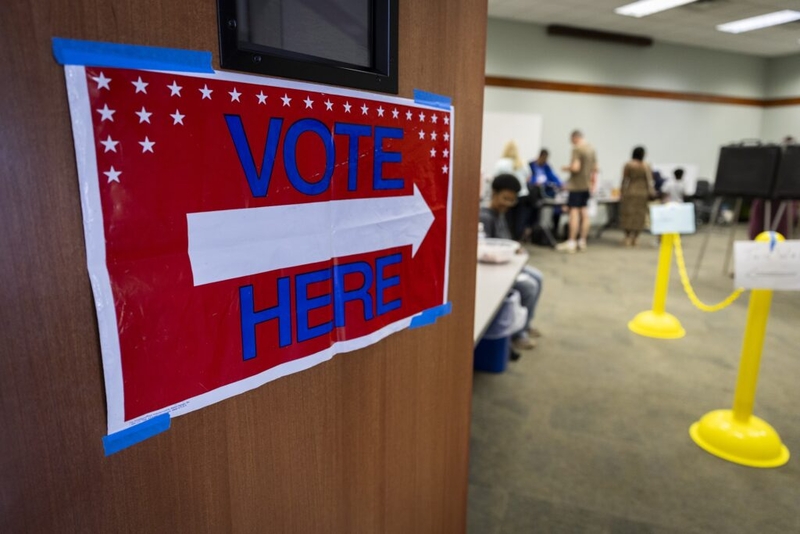
Primary Election Day at the Tates Creek Lexington Public Library precinct in Lexington, Kentucky. Photo by Arden Barnes for the Kentucky Lantern
While Republicans have been gaining more members through Kentucky voter registration in the last few years, Democrats still hold the registration edge in some Kentucky counties.
Democrats have an advantage in about 25 counties, according to June voter registration numbers: Bath, Breathitt, Carroll, Christian, Elliot, Fayette, Floyd, Franklin, Fulton, Henderson, Jefferson, Knott, Letcher, Magoffin, Marion, Menifee, Morgan, Muhlenberg, Nicholas, Perry, Robertson, Rowan, Todd, Union, Webster and Wolfe counties.
The Kentucky State Board of Elections typically publishes a report of current voter registration statistics on the first of the month.
Some of this can be leftover from the “old coalition that has just held on in many counties” from when Democrats were the majority party in the Bluegrass State, said Nicholas Hazelett, the chair of the Johnson County Democratic Party. He also helps with voter registration efforts throughout Eastern Kentucky.
At the state level, Republicans gained the majority of registered voters in July 2022.
“I think that a lot of places have held on because there’s still local Democrats on the ballot, and there is a familiarity to being a Kentucky Democrat at least,” Hazelett said. “They may not vote for a federal candidate that’s Democrat, but they still vote blue on even the governor’s race and elections down ballot.”
Several of the counties have Democratic local officials, particularly on their fiscal courts. However, when it comes to the General Assembly, most of them are represented by Republicans.
Republicans flip counties
Since the 2022 statewide change, a few local Republican parties have flipped their own voter registration, gaining the advantage in their communities. Carmine Iaccarino, the chairman of the Woodford County Republicans, said shifting their voter registration numbers to overtake Democrats in December had been a “goal of longtime party members.” He is also the vice chair of the Republican Party of Kentucky’s 6th Congressional District.
In terms of how county party members did it, Iaccarino said “it was as simple as just getting our message out, talking to neighbors, convincing folks that we interact with regularly that really the values of the Republican Party better reflect the values that they care about.”
“When I’m talking to my neighbors, they care about those things, not sort of these sideshows that are being pressed as sort of partisan issues by the Democrat party right now, and it’s things as simple as good jobs, the economy, the bread and butter issues, and I know that sounds cliche, but it really does have an impact,” he said.
However, Woodford Republicans still have work to do, Iaccarino added. As of June, Republicans had just 120 more voters than Democrats in the county.
“Woodford is purplish right now, and we think that we’re going to expand our majority significantly over the next year and coming years, but this is not a moment where we’re spiking football,” he said.
In Eastern Kentucky, Pike County Republicans launched a “Turn Pike County Red” campaign in 2021. In June, they flipped voter registration to their advantage for the first time with 54 more voters over Democrats.
Terri Walters, the chair of the Pike County Republican Party, said she views the county as being “built on strong conservative values, strong voices, strong backs” but “Democrats have held the majority of voter registration, almost somewhat generational in terms of party affiliation.”
“For decades now the Democratic Party’s connection to the voter has frayed, and that’s been definitely noticeable to the voters here, and the Republican Party has been showing the people that they’re the party that aligns with their priorities for governmental representation, and more importantly, what are considered Appalachian and Eastern Kentucky values, very conservative values,” she said.
Walters said that the local party tabled at festivals, schools, local party picnics, Lincoln Day Dinners and more to get new Republican voters. She added that online access to register to vote or change party affiliation also helped.
Democrats organizing
When it comes to organizing in rural Kentucky, Hazelett said Democrats are still active. After President Donald Trump won a second term in 2024, “locally we’ve had a lot more people come out of the woodwork.”
“A lot of people are saying, ‘If not me, then who is going to organize and bring the party back to some kind of semblance of strength locally?’” Hazelett said.
However, there is “a little bit of a disconnect” between national Democrats and rural Democrats, Hazelett said. Kentucky voters have a history of sending Republicans to Washington in congressional and presidential elections, but have frequently had a Democratic governor. Hazelett said he feels Kentucky Democrats are supportive of politicians like Lt. Gov. Jacqueline Coleman, who is running for governor in 2027, and Beshear’s senior adviser and former state representative Rocky Adkins, who is a rumored candidate for governor.
“I think a lot of people say the messaging and the communication at the national level has been a little bit lopsided for more suburban and urban areas, and that’s why we’re kind of in the place that we’re at,” Hazelett said.
The Democratic National Committee has looked to bring in new Democratic voters in Kentucky. In March, the DNC held registration blitzes at the University of Kentucky and Morehead State University and aimed to close the party’s voter registration gaps in the state. Democrats have the registration advantage in both Fayette and Rowan counties, where the universities are.
Hazelett thinks Democrats can gain support again from rural voters on issues like affordability.
“A lot of people, I think, are willing to pull the lever for a different person if we actually get out there and work hard enough to earn their vote, not just expect their vote,” he said.
Frankfort