Audit finds former Missouri Gov. Mike Parson’s state flights often lacked a public purpose
Jul 02, 2026 | 2:21 pm ET
Description
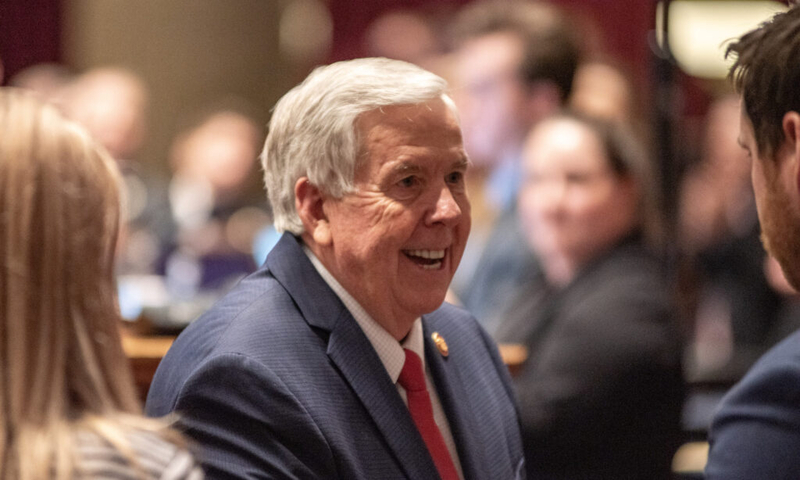
Missouri Gov. Mike Parson prior to the State of the State address on Jan. 24, 2024 (Annelise Hanshaw/Missouri Independent).
Former Gov. Mike Parson’s office spent $375,000 flying him around on state aircraft without keeping flight records showing why, and for a third of those flights auditors could not identify any state business purpose.
That finding anchors a closeout audit of the governor’s office released Thursday by State Auditor Scott Fitzpatrick, which gave the office a “fair” rating — the second-lowest on the auditor’s four-point scale — and faulted Parson’s administration for improper payments to top staff, records that vanished when he left office and nearly half a million dollars in other agencies’ expenses quietly shifted onto the governor’s books.
For Parson, who spent much of his six and a half years in office fending off questions about his travel habits, the audit lands as an official coda to a familiar controversy: a governor whose air travel had already drawn years of scrutiny, and a paper trail that rarely explained what public business he was conducting or why taxpayers were paying for it.
Parson, in a written response included in the report, strongly disagreed with what he called “so-called findings,” saying none of the issues cited “constitute unethical conduct” and reflect “differences in interpretation or perception — not wrongdoing.”
The audit covered 174 trips Parson took on state aircraft, primarily during the final 18 months of his term. For every one of them, flight records listed only a generic purpose — typically “Flight for Governor Parson.”
Two moments that explain Mike Parson’s six years as Missouri governor
Because the governor’s office never archived Parson’s official calendar and his press releases were removed from the state website when his term ended, auditors were forced to reconstruct his itinerary using the Wayback Machine, an internet archive. Even then, they could not identify a state business purpose for 58 of the 174 flights.
Fifty-three trips — 30% — included a stop in Bolivar, where Parson lives. Eight of those flights went to Bolivar and nowhere else. Parson told auditors he often stopped there for personal business, so auditors excluded the Bolivar legs from their analysis entirely.
The audit also flagged 16 flights Parson took around the state in 2024 for trips that included signing events for “No Turnin’ Back,” his commemorative biography. On most of those trips, Parson also conducted other business. But one flight — to Marceline, home of the book’s publisher — had no purpose other than kicking off the book tour, according to the governor’s own media advisory.
The flight cost taxpayers $1,386.
And a December 2023 flight to Arlington, Texas, where Parson watched the University of Missouri play in the Cotton Bowl, carried the spouses of his chief of staff and deputy chief of staff — a violation of state policy, which bars everyone but state employees, officials and the first family from state aircraft.
Auditors noted the same travel documentation failures had appeared in the previous four audits of the office.
A familiar controversy
The findings fit a pattern that has trailed Parson for nearly his entire tenure.
Within his first two years in office, the St. Joseph News-Press documented 130 trips on the state-owned Beechcraft King Air 250 — including 20 to Bolivar. When state aircraft wouldn’t do, Parson turned to private planes supplied by donors and paid for by Uniting Missouri, the political action committee formed to support his 2020 campaign.
In December 2019, Parson flew to Washington, D.C., on the private plane of Rick DeStefane, a nursing home executive whose company had paid $8.3 million to settle a federal Medicare fraud investigation and whose facilities had racked up health and safety citations. DeStefane rode along, joined Parson at the White House and posted photos of the trip on Snapchat. Weeks later, Parson flew to the Super Bowl in Miami on the plane of an Independence businessman.
A Democratic official filed an ethics complaint arguing the flights amounted to illegal coordination between Parson and the PAC. The Missouri Ethics Commission dismissed the coordination allegation but fined Uniting Missouri $2,000 in 2020 for failing to properly report the value of the two flights.
Pro-Parson PAC has spent $110K on private plane expenses so far in 2023
The private travel never stopped. In the first three months of 2023 alone, Uniting Missouri spent more than $110,000 on private planes, most of it paid to an aviation company connected to lobbyist and longtime Parson adviser Steve Tilley — even as Parson insisted he was done with elected office.
The new audit examined only state-funded travel. But it identified the same underlying problem that dogged the private flights: no one could say, on paper, what the public was getting for the money.
Beyond the aircraft, auditors questioned lodging bills, including $355 in taxpayer-funded hotel costs for Parson to play in the John Deere Pro Am golf tournament in East Moline, Illinois, over the July 4th holiday in 2023. The office could produce no business justification. Parson told auditors he played at the request of Missouri’s John Deere tractor dealerships.
Auditors also found the state paid $594 for two nights of lodging in Hawaii for Parson and the First Lady during an October 2023 trip his staff described as a vacation. Parson personally reimbursed the other three nights, saying a battleship visit and crew luncheon that justified the charge appeared reasonable but was never documented.
Payments ‘in violation of state policy’
The travel findings were one item on a longer list.
The audit found the office paid $28,058 in compensatory time to four of its highest-paid employees — the chief of staff, deputy chief of staff, general counsel and legislative director, who earned between roughly $120,000 and $186,000 a year — in violation of a state rule that bars overtime pay for top-level staff except in “unusual circumstances.”
The office kept no timesheets documenting the extra hours. Without them, auditors wrote, the office cannot demonstrate the payments weren’t bonuses — which the Missouri Constitution prohibits for public employees.
Auditors also flagged $30,449 in tuition reimbursements to three employees that violated office or state policy.
That included $18,000 to Parson’s chief of staff for a second master’s degree — pursued while office policy barred reimbursement for duplicate degrees — with the final $3,000 approved after he had stepped down to part-time work in the administration’s waning days. When he began repaying the money after resigning his full-time post, as office policy required, Parson personally waived the remaining balance after $4,200.
The office also used $472,000 of its own appropriations to absorb other agencies’ expenses in fiscal year 2024 — including a bathroom remodel, an HVAC replacement and a mahogany door in the Capitol, plus $50,000 toward a trade mission billed to the Department of Economic Development. There were no written agreements and no documentation explaining the transfers, which auditors said “circumvents the appropriation process” and obscures the true cost of running the office.
And roughly $210,000 in state-paid food flowed through the governor’s mansion during the audit period, including about a dozen dinners and luncheons involving the Parsons’ friends and family that auditors said appeared to have no business purpose.
Then there are the records that simply cannot be found. State law required Parson’s office to transfer its official records to the State Archives when his term ended. It didn’t. Parson’s calendar, the office’s employee manual and policies, its Sunshine Law request log and its internal control plan are all missing — unlocatable by his former staff, by Gov. Mike Kehoe’s administration and by the archives.
‘We have no knowledge’
Kehoe’s office, in a response signed by chief of staff Adam Gresham, kept its distance. No one in a policymaking role under Kehoe served during the audit period, Gresham wrote, and “we have no knowledge of the facts discussed in the auditor’s report.” He added that most findings don’t reflect current practice: the office pays no compensatory time, handles travel differently and maintains a Sunshine Law log.
Parson was less measured. Beyond disputing the findings, he complained that a departed administration “no longer” has “access to their records,” writing that records “are placed in archive, so you exclusively can construe or neglect what records you decide to review.”
Fitzpatrick — whose statewide career began when Parson appointed him treasurer in 2018 — answered that argument directly in the report. The problem, the auditor noted, is that the records were never placed in the archive at all.
Parson’s response “does not indicate any specific inaccuracies or misinterpretations in the report,” Fitzpatrick wrote, and the findings are “supported by sufficient and appropriate evidence.”
Jefferson City, MO