Kansas Supreme Court tosses conviction of man found guilty of breaking court order that didn’t exist
May 27, 2026 | 1:15 pm ET
Description
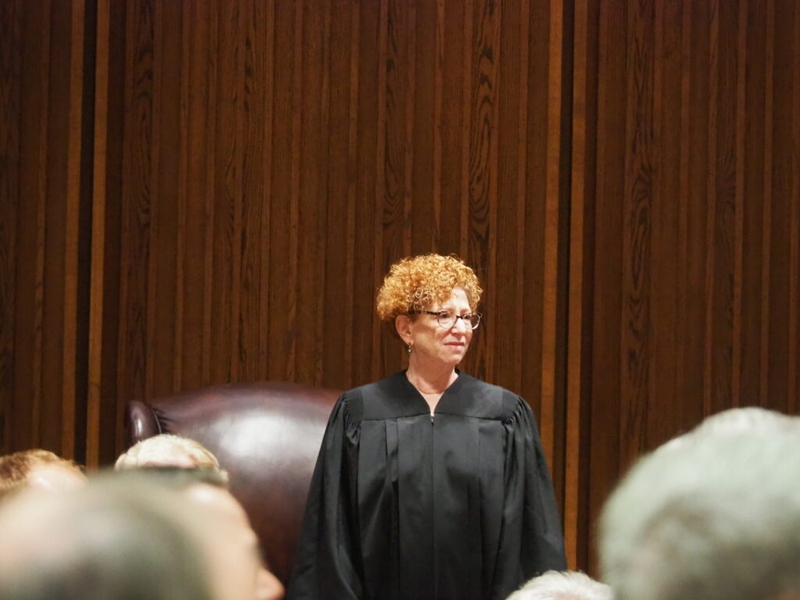
Kansas Supreme Court Justice Melissa Taylor Standridge agrees with colleagues that a Kansas man's conviction for violating a protection for abuse order must be overturned because the defendant was subject to a protection from stalking order — not an abuse order — at that time. (Photo by Tim Carpenter/Kansas Reflector)
TOPEKA — The Kansas Supreme Court reversed the conviction of a man in a troubled relationship with the mother of his children who was found guilty of violating a protection from abuse order that had never been issued against him.
Justices of the Supreme Court on Friday agreed with a 2024 decision by the Kansas Court of Appeals that John C.T. Boese was improperly found guilty of breaking a protection from “abuse” order by Marion County District Judge Susan Robson. That verdict was imposed despite evidence during the bench trial supporting only Boese’s violation of the protection from “stalking” order that had been granted in 2021 to M.M., who feared for her safety amid threats of domestic violence attributed to Boese.
Supreme Court justices concurred with the lower appellate court’s decision to throw out Boese’s 2022 conviction for breaking a nonexistent abuse order.
Both of the state’s appellate courts rejected a recommendation from Kansas’ assistant solicitor general to view the discrepancy as harmless error.
“We cannot,” said Supreme Court Justice Caleb Stegall in a written opinion issued Friday. “We affirm the Court of Appeals’ decision and reverse Boese’s conviction and vacate his sentence.”
Under Kansas precedent, Stegall said, charging documents in criminal cases set the outer limit of what conviction could result. The defendant was charged with violation of a PFA — not a PFS.
The Supreme Court’s opinion said there was overlap in state statute in terms of PFA and PFS orders designed to shield potential victims, but it was “important to recognize these are materially and legally distinct orders with their own unique procedures, protections, scope and potential penalties.”
During oral argument before the Supreme Court in 2025, Assistant Solicitor General Steven Obermeier argued for preservation of Boese’s conviction and sentence of 12 months of probation.
He said it was the defendant’s obligation to sound an alarm about potential shortcomings in charging documents prepared by prosecutors for use in subsequent court proceedings.
“Can I just sit back, not say anything and wait till the jury verdict to say, ‘King’s X — you charged me with the wrong crime?'” Obermeier said. “If you find there’s a defect in the complaint or if it’s deficient, you need to raise that to the court. Otherwise, we’ll assume you know what you were charged with.”
Obermeier, who spent more than 30 years as a Johnson County prosecutor, also told the Supreme Court: “What does it matter to the defendant what kind of order he violates? The statute says you shouldn’t violate a court order by contacting the victim.”
During oral argument last year in the case, Supreme Court Justice Melissa Taylor Standridge answered his question.
“What does it matter?” Standridge said. “It’s a due process issue. You need to know what order you are charged with violating.”
She elaborated on concern Obermeier appeared to propose the state’s appellate courts bail out the Marion County judge and prosecutor involved in Boese’s trial.
“The bottom line is the state just made a mistake. Why should we try to fit a square peg in a round hole?” Standridge said. “I’m talking about, you charged a crime. You did it wrong. There was insufficient evidence of the crime you charge. And, now, you’re all the way up here at the Supreme Court saying, ‘We made a mistake, so can you do some legal gymnastics and figure out how to fix it?'”
Michael Whalen, the Wichita attorney representing Boese, told Supreme Court justices the constitution protected accused persons against conviction except when proof beyond a reasonable doubt demonstrated a defendant committed the crime as charged.
In this instance, he said, the state shouldn’t have charged or convicted Boese of violating a PFA because only the PFS existed.
“The power of the state to charge and prosecute its citizens for criminal violations of the law is a fearsome one,” Whalen said.

Topeka, KS