A Kansas hospital garnished wages of patients who qualified for free care. Then they fought back.
Jul 14, 2026 | 9:00 am ET

Description
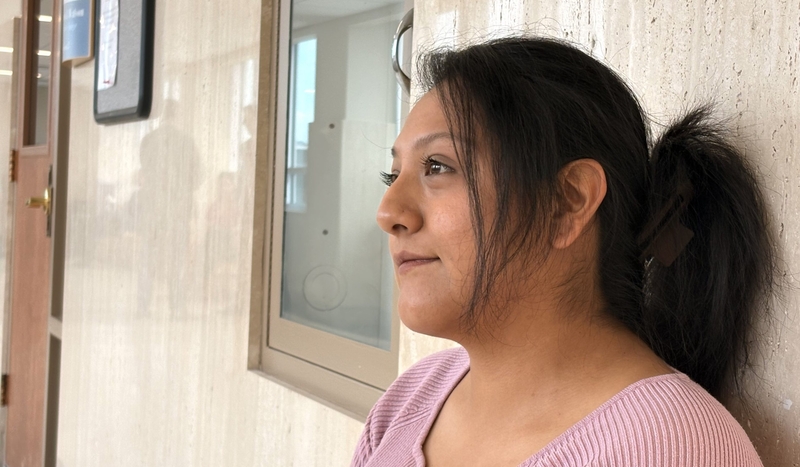
Mariana Villegas, a mother of two from Topeka, fought a hospital for suing her for medical debt when she qualified for free care. She appears at the Shawnee County Courthouse on April 14, 2026. (Photo by Anna Kaminski/Kansas Reflector)
TOPEKA — When $300 disappeared from Mariana Villegas’ paycheck, she rationalized it.
She had worked fewer hours to stay home with her sick daughter, sure, but it still seemed like a lot to go missing, she said. She let it slide.
Then it happened again.
Villegas had no idea a local hospital had sued her last fall for $2,200 in medical debt plus interest and was garnishing her wages.
“I don’t have much,” Villegas said after a May court hearing, “so I don’t know what they’re trying to take from me.”
A judge had awarded the hospital operator, Stormont Vail Health, a default judgment in August 2025 because Villegas didn’t show up to any of her court hearings, which she said she didn’t know about, allowing the hospital to start taking a cut from her paycheck.
A Kansas Reflector investigation found a disconnect between institutions seeking to recoup medical debt and those running from it. Most debt collection cases in Shawnee County, where Villegas lives and works, end in default judgments after those who owe don’t show up in court, giving automatic victories to debt collectors.
Villegas’ case is one of more than 2,000 debt collection cases Stormont Vail filed in Shawnee County last year. She fought the garnished wages in court, and the judge who handled her challenge questioned whether law enforcement properly notified her of the debt.
In response to questions from Kansas Reflector for this story, the hospital and the sheriff’s office responsible for telling Villegas about the hospital’s debt lawsuit said they are reexamining their policies to ensure compliance with state and federal laws.
For months, the hospital fought back-and-forth with Villegas’ attorneys from statewide legal aid group Kansas Legal Services. But, ahead of an August hearing that would have examined the intricacies of Villegas’ case, the organizations jointly announced last week that they agreed to settle 11 medical debt cases, including Villegas’, worth $200,000 across five Kansas counties.
“Our goal is not to sue patients,” said Tim Shultz, deputy general counsel and chief compliance officer for Stormont Vail, in an interview. “Our goal is to provide healthcare, and we want to do that in as fair a way as we can, regardless of financial need, but we don’t know what the need is unless the patients tell us.”

Thousands of cases
Villegas visited a Stormont Vail emergency room for non-elective medical treatment in 2024. Her bill was $2,184, which the hospital sent four times via an online portal and mailed twice to Villegas’ previous address, according to court records. A hospital financial assistance employee said in a court filing that Villegas declined to take a hospital handbook that contained financial assistance information.
Villegas said in a court filing she was never told about the organization’s financial assistance policy. Her annual income from working full-time at a McDonalds near Topeka was well below the hospital’s financial assistance threshold for free care. The garnishment encompassed her outstanding medical bill and interest that continued to accrue while taking an average of 25% of her biweekly paycheck. She owed around $2,400 when a judge in August 2025 issued a default judgment against her.
Kansas Reflector has followed Villegas’ case since March, examining court documents, tax filings, pay stubs and regulations, and attending court hearings that revealed larger issues beneath the surface of debt collection cases.
More than 60% of all debt collection cases in Shawnee County in 2025 ended in default judgments, which is triggered when defendants don’t show up to court or respond to a court summons, according to data from the Kansas Judicial Branch.
Judge Robert “Tuck” Duncan, a retired Shawnee County judge filling in on the limited judgment docket, said at one of Villegas’ hearings in April that he spent three hours the previous Sunday signing dozens of default judgments for people who didn’t show up to court.
“This is really important,” Duncan said. “I have thousands of these cases. Thousands.”
In Shawnee County alone, Stormont Vail filed more than 2,100 debt collection cases in 2025, excluding medical liens, according to county court records. In 2024, the organization filed nearly 1,900 debt collection cases. This year, the organization has filed more than 1,000, as of July 7.
Under federal tax codes, nonprofit hospitals like Stormont Vail must offer financial assistance and create policies to widely publicize the assistance and inform patients of legal action for outstanding medical bills.
Financial assistance guidelines and standards vary from state to state and institution to institution, said Mark Rukavina, a national consumer advocate focusing on healthcare affordability.
While garnishing wages to remedy debt is more common in some states than others, some hospitals set up payment plans directly through the institution to address medical debt, Rukavina said.
“Unfortunately, not all do, so they take what I think of as these drastic actions and what the regulations call extraordinary collection actions,” he said.
Rukavina said hospitals should avoid extraordinary collection actions, including wage garnishments.
“Garnishing wages is a pretty extreme act, especially for low-income people,” he said.
In Villegas’ case, the 27-year-old single mother said she was scraping together coins to feed her two kids.
“If I feel it, they feel it two times worse,” she said in April.
Settlements and refunds
Third-party attorneys for Stormont Vail blamed Villegas in court for failing to apply for financial assistance earlier and neglecting to ensure her address was up-to-date. The hospital had been using Villegas’ previous address, her mother’s house, to notify her of her debt, and she said by the time she found out about the legal action, it was too late.
The hospital has a policy that allows patients with medical debt to submit the necessary paperwork to prove eligibility for financial assistance at any time throughout the collection process. Katie King, a Kansas Legal Services staff attorney, said she knew of at least one additional case among the 11 that involved a garnishment and a patient who said they had no idea Stormont Vail sued them.
The 11 patients’ eligibility for charity care was never in dispute, said Matt Keenan, executive director of the legal aid group, which represented all of the patients.
Not all 11 were uninsured, but each qualified for discounted care under Stormont Vail’s financial assistance policies, Keenan said. Their debts ranged from $1,300 to $51,000 and mounted because they couldn’t afford co-pays and high deductibles, he said.
The group secured nearly $162,000 in medical debt settlements and more than $7,000 in refunded garnishments.
“I knew Stormont Vail would do the right thing,” Keenan said. “I have a lot of confidence in their new leaders.”

Before Villegas’ case was settled, Keenan called it one of “the most mystifying cases” he had seen in his legal career.
Jay Howard was named Stormont Vail’s new senior vice president and chief legal officer in February, and Shultz was promoted to fill Howard’s previous position as deputy general counsel and chief compliance officer. In an interview, Shultz said the cases came on Stormont Vail’s radar when “Kansas Legal Services started raising extraordinary counterclaims that are not typically raised in cases of this nature.”
Kansas Legal Services attorneys argued in court documents and at Villegas’ hearings that Stormont Vail violated federal tax code regulations that govern nonprofit hospitals.
Stormont Vail “100%” disagrees with those accusations, Shultz said.
He said the organization balances providing care for those in need while ensuring it meets its bottom line. He declined to provide specifics on what financial assistance policies the organization is reexamining in the wake of the settlements.
“I don’t think we’re going to stop filing collections actions, which may include garnishments,” he said, “because we’re trying to strike that balance, and it’s rather simple for somebody that has a true financial need to let us know.”
Tacked and mailed
When a patient owes Stormont Vail, the hospital first uses its own communication channels to reach patients, such as through mailed bills and statements and messages on an online healthcare portal.
The hospital eventually hands the debt off to a collection agency, which then tries its own methods, Shultz said. If a patient still doesn’t pay, a third-party law firm may pursue legal action on behalf of the hospital, which can then lead to wage garnishments, Shultz said.
In Villegas’ case, the Shawnee County Sheriff’s Office said in a court document that it knocked on the door at the address the hospital provided, tacked to the door a notice of their visit and mailed a notice of the lawsuit to the same address.
Kansas Legal Services attorneys said in court that Villegas wasn’t properly served.
“Without proper service, nothing valid in the case can come from it,” said Mark Hegarty, a legal aid attorney representing Villegas at the April 14 hearing.
Duncan, the judge, set aside Villegas’ default judgment at that hearing, paving the way for a deeper analysis of her case. He said he believed everyone subject to a debt should be able to have a conversation about its components.
He didn’t want to be “in the gotcha business,” he said, shifting his focus to “giving due process with respect to the merits of the case,” which included questions about how Villegas should have been notified of her debt.
Courts, Duncan said, generally expect multiple attempts to notify someone at different times. That must include adequate documentation that shows an address is, indeed, a person’s dwelling, and personal service couldn’t be accomplished.
“I think anybody who looks at the return of service in this case would have to acknowledge none of that is on that document,” Duncan said. “It merely says, ‘on this day, we tacked and mailed.’ ”
He added: “My concern is the next step, which is perhaps the absence of reasonable diligence in making several attempts to ascertain who is at those premises.”
Duncan said he didn’t blame the hospital.
Shawnee County Sheriff Brian Hill said in an emailed statement that the office takes court concerns seriously.
“The return in that case reflects the method, date, time, and address of service. The court’s comment appears to concern whether the return should have included additional detail regarding prior attempts or the basis for service at that address,” Hill said. “We understand that concern and are reviewing whether return-of-service documentation should be clarified or expanded going forward.”
Whether a service is legal in a particular case is ultimately up to the court’s interpretation of the facts and record before it, Hill said.
But that won’t be determined in Villegas’ case.
More than fine print
Rukavina, the consumer advocate, said hospitals are ultimately responsible for informing patients about financial assistance and potential legal action, including garnishments.
“There is no exporting this,” Rukavina said. “They could use third parties to help facilitate these actions, but those third parties are operating on behalf of the hospital and should conform to and adhere to the policies of the hospital.”
Stormont Vail covered more than $77 million in charity care in fiscal year 2025, which spanned from July 2024 to June 2025, said hospital spokeswoman Taylor Bugg. In fiscal years 2024 and 2023, that number was around $78.1 million and $78.7 million, she said.
As a contingency of its nonprofit status, the organization must offer financial assistance to low-income patients, which is available to Kansas residents who meet certain requirements and earn an annual income of less than 300% of the federal poverty level. For a family of three, like Villegas’, that amounts to less than $79,950.
Patients are eligible for free care if they earn an annual income below 200% of the poverty line. Villegas made around $14,500 annually.
The hospital is required by federal rules to keep written financial assistance policies, publicize its eligibility standards and take reasonable steps to determine a patient’s eligibility before pursuing extraordinary collection actions such as garnishments.
Shultz, the hospital’s deputy legal counsel, acknowledged a disconnect exists between hospitals and patients who owe debts.
“The disconnect is with the patient,” he said.
The onus to communicate financial need rests on the patient, Shultz said.
Stormont Vail publicizes its financial assistance policies and makes staff available to provide and process assistance information. A recent visit to Stormont Vail’s main hospital in Topeka proved the ease of access to paperwork detailing income requirements and the documentation needed to receive discounted or free care. And searches on the hospital’s website produced clear descriptions of financial assistance. However, those steps don’t account for someone in the throes of a medical crisis, Rukavina said.
“If somebody has a chronic condition or an ongoing health issue, it wouldn’t necessarily be top of mind for some people. It’s easy to understand how bills sort of get overlooked,” he said.
The Kansas Legislature in 2026 had an opportunity to pass a bill that would have required mandatory patient screenings for eligibility for financial assistance or charity care. After healthcare organizations including the Kansas Hospital Association, the University of Kansas Healthcare System and Memorial Health Systems came out in opposition to House Bill 2736, citing cumbersome administrative burdens, Kansas House Republicans and Democrats alike voted it down.
Peter Pitts, president of the Center for Medicine in the Public Interest, wrote in February testimony that the bill ensured “charity care policies function as intended rather than as fine print.”
“HB 2736 addresses a persistent and well-documented failure in the American healthcare system: hospitals too often pursue aggressive billing and debt collection practices without first ensuring that patients are informed of, or screened for, financial assistance and charity care for which they may qualify,” Pitts said.
Keenan with Kansas Legal Services said Villegas’ case was the canary in the coal mine, leading attorneys to represent 10 more people who qualified for financial assistance at Stormont Vail but still had medical debt collection cases filed against them.
One of the questions that remains is why people weren’t showing up to court.
“It’s a major issue that is below the surface on a lot of the cases,” he said.
But, he said, the legal aid group is “turning the page” alongside Stormont Vail.
He added: “The new leadership doesn’t change the fact that the older leadership was tone-deaf to what these men and women were saying, which is, ‘We don’t have anything.’ ”
All 11 patients were working when the hospital sued them, he said.
Villegas said she is working to earn her high school diploma and saving to become a homeowner.
“Isn’t that who we need to fight for,” Keenan said, “people who are trying to get ahead?”
Topeka, KS