Kansas Democrat tries new tactic with fetal personhood bill, Wyoming keeps trying to ban abortion
Mar 14, 2025 | 5:42 pm ET
Description
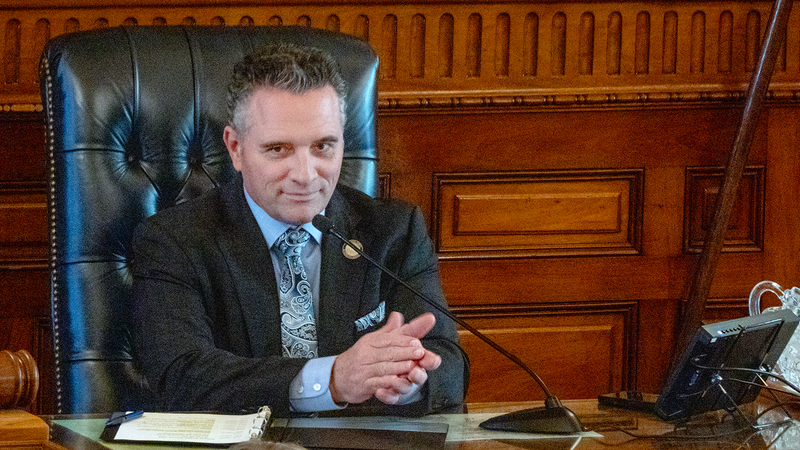
Kansas Senate President Ty Masterson presides over the Senate on Wednesday, March 5, before debating a resolution to make seats on the state Supreme Court elected positions. (Photo by Sherman Smith/Kansas Reflector)
Abortion-related bills continue to be introduced and debated in statehouses across the country, especially in states where the procedure is already banned.
Many bills aimed at further restricting abortion access have so far not been as successful as in prior years, including new attempts to restrict travel to states where abortion is legal for a procedure and efforts to restrict abortion medication.
Meanwhile, states where abortion is broadly legal continue to try to expand and further protect access.
It can be hard to monitor it all, so States Newsroom’s Reproductive Rights Today team tracks certain bills or maneuvers that could alter the reproductive legal landscape in a legislative roundup. Depending on the partisan makeup of a legislature and other state government officials, some bills have a higher chance of passing and becoming law than others.

Kansas
Although Kansas voters overwhelmingly rejected a measure to allow abortion bans in August 2022, they also resoundingly supported anti-abortion candidates in the November 2024 election. As a result, legislators are pursuing overturning abortion rights through the judicial process.
Kansas Reflector reported the state Senate adopted a resolution calling for the election of justices to the state Supreme Court by popular vote, replacing the merit-based system that the state has used for decades. Voters would have to approve that change via a constitutional amendment on the ballot in August 2026.
“Rather than a system that consolidates authority in the hands of an elite society of super voters, it’s time to restore the power to all Kansans,” said Senate President Ty Masterson.
Opponents say the change could create an environment where judicial appointments are influenced by money in politics.
One Kansas Democrat, Rep. Rui Xu, said on social media of the move, “Republicans are mad that our Supreme Court wanted us to fully fund school and not ban abortions so now they want to change the Supreme Court.”
House Bill 2062: An attempt to establish fetal personhood through child support legislation received support from one Democratic senator, who broke ranks with his party.
The bill would require courts to consider fetuses when determining child support payments, Kansas Reflector reported. It was amended to expand eligibility for tax credits for families as well. Sen. Patrick Schmidt, a Democrat from Topeka who proposed the amendment, said the move would make “lemonade out of lemons.”
The bill passed the Senate easily on Wednesday, and Schmidt told the Reflector his strategy was that the amendment would either kill the bill or create a child tax credit for all pregnant parents, both of which were a win. The freshman senator said if Democrats want to stop certain legislation, they have to try new things.
“The same tactics are not going to work in perpetuity,” he said. “They haven’t been working.”
The amendments will now have to be agreed to in both chambers before the bill heads to Democratic Gov. Laura Kelly for a signature or veto.
Michigan
House Bills 4133 and 4134: Amid calls from Republicans to repeal a federal law criminalizing the obstruction of or threats to reproductive health clinics, along with pardons issued by President Donald Trump to 23 individuals who violated that law, Michigan lawmakers have put forth a state law that would have the same effect.
The House bills, introduced by Democratic Rep. Laurie Pohutsky, would ban people from restricting a person’s physical movement or threatening bodily harm as they attempt to maintain or provide reproductive health services, including abortion, according to Michigan Advance. Pohutsky cited instances of anti-abortion protests in 2020 and 2021, after which several people were found guilty of illegally blockading a clinic. In one instance, a protester used a bicycle lock to chain themself in front of a door to the clinic.
The proposed law includes a wide range of penalties, from six months to life in prison if the actions resulted in someone’s death.
It’s unclear whether the legislation will advance, but it also covers crisis pregnancy centers, which are often run by anti-abortion groups, so Pohutsky said she hopes the Republican majority in the House will consider the bills.
Montana
House Bill 609: A House committee soundly rejected a bill that would restrict travel for Montana residents seeking an abortion out of state without a doctor’s recommendation on Thursday, voting 16-4 to table the bill and keep it in committee. Anyone who traveled out of state for an abortion when the fetus was considered viable could be criminally prosecuted, as well as those who help people travel or otherwise assist. The maximum prison sentence would be five years.
In November, nearly 58% of Montanans voted to make abortion a constitutional right, allowing the state to regulate abortion only after fetal viability with exceptions for the life and health of the pregnant person. But that hasn’t stopped some lawmakers from continuing to propose restrictions.
According to the Daily Montanan, Republican Rep. Kerri Seekins-Crowe told opponents of the bill that she would not apologize for her efforts.
“While I do respect women who have life-threatening conditions, that is truly not what this bill is about.”
Only two proponents spoke in favor of the bill, one of which was the Montana Family Foundation.
Senate Bill 479: Another measure to restrict abortion in Montana — this time by saying it has negative environmental effects — was also defeated on a tie after seven Republicans joined Democrats to vote against it in the Senate, the Daily Montanan reported.
As part of a national effort by anti-abortion group Students for Life of America, the bill is based on a belief that the medications used to end a pregnancy, mifepristone and misoprostol, pollute the water supply and contaminate the environment. There is no scientific evidence to support that claim.
The bill would have required providers to give patients medical biohazard supplies to properly dispose of medical waste, with penalties of a felony and three years in prison for violating the law. Manufacturers would be required to properly dispose of the drugs and mitigate environmental effects of “endocrine-disrupting chemical byproducts” in public waste systems “due to the disposal of tainted human remains entering the wastewater system as a result of at-home abortions.”
A motion to reconsider the bill also failed.
Wyoming
House Bill 64: Republican Gov. Mark Gordon vetoed a bill in early March that requires those seeking to terminate a pregnancy with abortion medication to wait 48 hours and have a transvaginal ultrasound, according to WyoFile. But the legislature successfully overrode the veto, and it is now law.
Gordon did sign a bill creating several regulations for clinics that perform abortions, prompting Wyoming’s only abortion clinic to file a challenge in court and include the new ultrasound law in their complaint.
Gordon said he opposes abortion but objected to the “invasive nature” of the proposed legislation, and the fact that it had no exceptions for rape and incest victims. Two other challenges to Wyoming’s abortion ban are still tied up in court, so abortion is legal in Wyoming. But the state’s lone clinic is not providing abortion care as its lawsuit proceeds, so most abortions happen with medication via telehealth prescriptions.
“Making it easier for mothers to have babies in Wyoming and supporting them afterward is a far better course,” Gordon wrote in his veto letter. “Mandating this intimate, personally invasive, and often medically unnecessary procedure goes too far.”