Crisis pregnancy centers fight for ultrasound use in clinics without government oversight
Jul 29, 2026 | 11:00 am ET

Description
Brandi Swindell, founder and CEO of the Stanton Healthcare network, examines items waiting to be given out to new mothers in the storeroom at the flagship crisis pregnancy center in Meridian, Idaho. Stanton, which unlike many other centers has a medical accreditation, offers traditional crisis pregnancy center services as well as free medical services including limited obstetric ultrasounds and sexually transmitted infection testing and treatment. (Otto Kitsinger for States Newsroom)
The auditors trying to learn how a dozen crisis pregnancy centers in Louisiana had spent nearly $1.2 million ultimately could not figure it out.
Despite a new law, the state had failed to establish a process for the centers or to track how they spent taxpayer dollars. That was surprising enough, auditors said. But then they learned something else: Every center they reviewed offered ultrasounds and other medical services. Yet none was licensed as a healthcare facility.
“They were providing medical services, and no, they were not licensed by our Department of Health,” said Gina Brown, performance audit manager for the Louisiana Legislative Auditor, who oversaw the review. There was no way to confirm the centers had a licensed medical director on staff, she said.
She said Louisiana’s crisis pregnancy centers are not subject to regular inspections to ensure providers have the proper licenses to perform specific medical services. And patients have no one with whom to file a complaint should something go wrong.
Anti-abortion crisis pregnancy centers in Louisiana and elsewhere have received hundreds of millions of taxpayer dollars just in the past few years. Yet there is little oversight — not only on how they’re spending the money, but also on how they’re caring for patients.
OB-GYNs, state lawmakers, government officials, reproductive health advocates, and current and former pregnancy center staffers told States Newsroom – as part of our ongoing series, Billion Dollar Baby Bump – that internal protocols are likely not enough to ensure all centers are offering high-standard health care to girls and women potentially unsure what to do about their pregnancies or facing difficult circumstances.
“I kind of wanted to get out of this whole movement, because I’ve seen more than I want to see now,” said Shari Richard, a registered diagnostic medical sonographer who has been teaching sonography courses and making videos for crisis pregnancy centers for decades. She said some ultrasound training programs within the program are robust, but that other classes do not require much hands-on experience to pass.
“The thing is, these nurses, they have good hearts,” Richard said of the staffers trained to offer ultrasounds. “They don’t know what they don’t know. So they are assuming they are in good hands, and that these people are going to train them on what they’re supposed to learn, and they come out knowing nothing.”
I kind of wanted to get out of this whole movement, because I’ve seen more than I want to see now.
Most of the centers have joined a national affiliate and membership organization for funding, guidance and support. But centers operate independently as nonprofits and create their own boards and policies, where ultrasound and pregnancy tests may be the only medical services offered, in addition to often religious-based counseling and material support like diapers and formula and baby clothes.
Centers can voluntarily join accreditation organizations subject to audits, but most states don’t have credentialing or disclosure requirements for the centers. And now, the honors system structure of the crisis pregnancy movement is increasingly under scrutiny at a time when centers report providing more free obstetric ultrasounds than ever before.
‘What’s your plan for this pregnancy?’ Comfort, shame and a missed diagnosis
At least 100 pregnancy centers across 49 states advertise that their free ultrasounds can “rule out” dangerous ectopic pregnancies, according to a review by the watchdog advocacy group Campaign for Accountability, which supports abortion rights.
Such pregnancies, which happen when an embryo implants in the wrong location, usually in a fallopian tube, are medical emergencies that can kill a pregnant woman if they aren’t taken care of. Almost all ectopic pregnancies are nonviable and potentially fatal, requiring immediate medical attention, often surgery, to end the pregnancy.
Some experts in the anti-abortion movement have warned pregnancy centers against making claims that could open themselves up to legal liability if the paid or volunteer nurse or sonographer misses an ectopic pregnancy or if the, often off-site and volunteer, medical director does not promptly review or accurately interpret the scan. The centers aren’t equipped to provide the multiple blood tests and ultrasounds needed to rule out an ectopic pregnancy, said Anne O’Connor, the vice president of legal affairs for NIFLA, during a webinar last year for “The ProLife Team Podcast.”
“Do not advertise ‘We can rule out an ectopic,’” O’Connor said. “We really don’t like to see that language because it is near impossible to rule out an ectopic.”
‘We agree that ultrasound is the practice of medicine’
During pregnancy, obstetric ultrasounds are used to determine a living pregnancy in the uterus, gestational age, and signs of complications, such as a miscarriage or ectopic pregnancy. Obstetric ultrasounds are also used in routine medical care to identify polyps and signs of cancer, or to place or remove an intrauterine device.
Obstetric ultrasounds on TV are typically noninvasive transabdominal ultrasounds. But in the earliest stages of pregnancy, to be able to see the embryo, the healthcare provider who performs a transvaginal ultrasound inserts a wand-like transducer into the patient’s vagina.
It can be a sensitive procedure, especially for people who have experienced sexual assault, said Dr. Abigail Liberty, an assistant professor of obstetrics and gynecology at Oregon Health & Science University.
A researcher currently studying people’s experiences at crisis pregnancy centers, Liberty said internal protocols are likely not enough to ensure every center has properly trained and trauma-informed staff and produces timely sonography reviews. She also noted that blood serum tests are required in addition to ultrasounds to determine ectopic pregnancies.
“Transvaginal ultrasonography is a unique skill, and it’s a newer skill,” said Liberty. “It requires a trauma-informed approach, and it requires a certain technical aspect to read ultrasounds.”
Louisiana is among 21 states that between 2022 and 2025 collectively allocated nearly a half-billion dollars to crisis pregnancy centers, as States Newsroom has reported. In some cases, patients and OB-GYNs have described missed ectopic pregnancies or a lack of information about needed care.
Earlier this year, Brown and auditor Emily Braun testified during two Louisiana legislative hearings for a bill that, as introduced, would have required all crisis pregnancy centers in the state that provide ultrasounds and other medical services to obtain licensing through the state health department. It was amended down to require centers to disclose they are not licensed. In a joint phone interview, they recalled that the final Health and Welfare Committee hearing on the bill in April was surprisingly contentious.
Some lawmakers argued against licensing, saying that if an ultrasound’s purpose is to show a woman that she’s carrying a baby and to dissuade her from an abortion, then that sonogram scan is not the practice of medicine.
“When someone goes to a crisis pregnancy center, what do you think the purpose of the ultrasound is? The baby, right? So, not to provide medical advice, to show them the baby, right?” said Republican state Rep. Raymond Crews during the April hearing. His office did not respond to requests for comment.
When someone goes to a crisis pregnancy center, what do you think the purpose of the ultrasound is? The baby, right? So, not to provide medical advice, to show them the baby, right?
But state and national lobbyists representing the crisis pregnancy centers have made a different argument: These centers are providing medicine, they’re doing it under the license of a medical provider, and that’s regulation enough.
“We agree that ultrasound is the practice of medicine. There’s no question there,” said Angie Thomas, senior counsel for Alliance Defending Freedom, during the Louisiana hearing. Her organization has for the past decade helped crisis pregnancy centers push back state attempts to require a disclosure that they are not licensed medical clinics.
“Centers operate under the license and supervision of medical directors in providing these services,” Thomas said at the hearing. Alliance Defending Freedom declined a request to interview Thomas and to comment for this story.
‘No way to know’
Braun said of the 12 centers that she surveyed in April 2025, nine reported they had a physician with an active license from the Louisiana State Board of Medical Examiners on staff, but she noted that she did not verify this.
“There’s just no way to know if you actually do have a licensed medical director at your facility,” Braun said. “That’s the point of being regulated, and that’s what we were trying to say in committee, but it just seems like that idea was not resonating.”
For decades, crisis pregnancy centers that offer ultrasounds across the country have operated within a structure of loose connections with other centers, most of them umbrellaed by one of the three large networks that all claim that centers follow appropriate medical standards and are associated with a licensed medical director. In most states, who those directors are is not public information, and centers often do not name their medical directors on their websites. That structure has allowed for the provision of services such as ultrasounds largely outside the bounds of state oversight.
Just a few states require specific healthcare facility licenses for health facilities that provide ultrasounds and other medical services, including California and Massachusetts. In California, 92 of 161 pregnancy centers were licensed in 2023, according to a report from the University of California Los Angeles School of Law Center on Reproductive Health, Law, and Policy. Massachusetts had four out of about 30 in 2024, according to the Massachusetts Department of Public Health.
With the help of the Alliance Defending Freedom, crisis pregnancy centers have overturned or prevented disclosure laws from being enforced or blocked investigations in California, New Jersey and, most recently, Delaware. As a form of oversight, attorneys general in California, Massachusetts and New Jersey have issued consumer alert warnings about crisis pregnancy centers.
In Hawaii — one of the few states to require crisis pregnancy centers that advertise and offer prenatal sonography to comply with the federal Health Insurance Portability and Accountability Act of 1996, known as HIPAA — a proposed resolution to have the attorney general investigate whether pregnancy centers in the state are complying with this 2017 law died in committee last year.
Months before the Louisiana Health and Welfare Committee rejected the licensing proposal, the legislature approved new state funding for the Pregnancy and Baby Care Initiative – agreeing to $2.26 million from the state’s pot of funding from the federal Temporary Assistance for Needy Families program. At least eight states have given TANF funds to crisis pregnancy centers in recent years, more than $102 million between 2017 and 2023, according to data from the consulting firm Health Management Associates.
“Why wouldn’t we be putting this in our hospitals and training our OB-GYNs if we’re going to be using state funds?” said Louisiana Democratic Rep. Aimee Adatto Freeman, who sponsored the pregnancy center licensing bill after reading the auditors’ report. She told States Newsroom the state has many maternal health deserts and she worries about the lack of oversight at crisis pregnancy centers offering prenatal care.
“One of my main concerns is always going to be when someone is practicing medicine without a license,” Adatto Freeman said.
‘We need to get them in earlier’
Richard was just starting out as a sonographer specializing in obstetrics in the 1980s when she realized the procedure could make a difference in discouraging abortions. She had experienced traumatic pregnancy losses, but had not thought much about a first-trimester abortion she’d had.
“When I got into ultrasound, I had no idea that that heart was beating as early as six weeks post (the last menstrual period), or four weeks conception,” said Richard, who is now 72. “And then I started flashing back to my own abortion. And I thought, whoa, I didn’t know.”
In contradiction to instructions from hospital supervisors, Richard said she would deliberately face the monitor toward women leaning toward termination. She made a VHS recording of an ultrasound of a 10-week fetus that she showed to congressional members in 1990 in arguing against never-passed abortion-rights legislation known as the Freedom of Choice Act.
“God just took and used me. He used that video in 12 languages around the world before internet days, and it went all over the world,” said Richard, noting she became pregnant soon after with her first child, which she took as a sign from God to keep spreading the ultrasound gospel.
In 1990, she founded Sound Wave Images producing ultrasound footage and started working with a physician to train staff at crisis pregnancy centers in southeast Michigan. For nearly four decades she has taught ultrasound courses designed for crisis pregnancy centers to offer limited obstetric ultrasounds and has spoken at the national pregnancy center conferences.
And now, Richard said, the purpose of ultrasounds at crisis pregnancy centers is also to change the woman’s mind by helping her visualize the life inside of her. In her trainings in recent years, she said she has encouraged centers to perform transvaginal ultrasounds early in pregnancy to compete with abortion pills, which are approved for use up to 10 weeks’ gestation.
“We’re going to get them in earlier because now they got a need for earlier ultrasounds, because they’re making decisions for the chemical abortion,” Richard said. “This is why we need to get them in earlier.”
Yet Richard and other pregnancy center movement leaders also acknowledge that crisis pregnancy center staffers typically lack the necessary training to diagnose dangerous complications — especially early on when they are difficult to see — and caution centers against doing so for liability reasons.
“You go in and you’re not seeing that gestational sac at like four weeks, five weeks, how do you know if it didn’t get stuck in the tube, or is she just a couple days early?” said Richard, noting she tells trainees, “‘You guys are not equipped to find an ectopic.’ Ectopics are very difficult to find. A lot of times they hide behind bowel gas. And learning how to do a limited ultrasound doesn’t teach you how to find an ectopic.”
That means pregnant women may be offered a fuzzy, black-and-white image of a developing embryo — but no hint of danger should something be going wrong.
Richard says she tells trainees if they can’t confirm an intrauterine pregnancy, they should ask the patient to come back in a few days, to caution the woman about the possibility of an ectopic pregnancy and to instruct her to visit an emergency room if she experiences severe pain.
A system of self-regulation
In 1998, the National Institute of Family and Life Advocates developed a national ultrasound training program for crisis pregnancy centers in the late 1990s. According to its website, NIFLA represents more than 1,800 pregnancy centers and says more than 1,600 of them operate as licensed medical clinics. The organization did not respond to requests for comment.
Other national religious right organizations, including Focus on the Family and the Knights of Columbus, are funding some of the expensive equipment and training needed to provide ultrasounds. And more anti-abortion crisis pregnancy centers provide obstetrical ultrasounds than ever before — according to the Charlotte Lozier Institute, the research arm of the anti-abortion lobbying group Susan B. Anthony Pro-Life America, which conducts periodic surveys of pregnancy centers throughout the country.
States pass laws allowing pregnancy centers to evade regulation and countersue for damages
Robyn Chambers, who has overseen Focus on the Family’s ultrasound grant-funding program, Option Ultrasound, since it started in 2004, said some centers balk when told grantees will receive on-site inspections from Focus representatives. The grants range from $3,000 for a 2D ultrasound system, to $50,000 for a 3D or 4D system, she said, and about $15,000 for a two weeks of hands-on training.
“We’ve actually been accused of having too many hoops to jump through,” Chambers said in an interview. But she said her organization takes the medical aspect of ultrasounds as seriously as the anti-abortion mission.
“Yes, it’s a ministry, but this is a medical procedure and must be done by a medical professional under the supervision of a medical doctor,” Chambers said.
There are thousands of crisis pregnancy centers across the country — an estimated 2,400-2,800, according to a recent report from the Government Accountability Office.
The Charlotte Lozier Institute estimates that in 2010, about 5 in 10 of the country’s crisis pregnancy centers offered ultrasounds and collectively performed an estimated 230,000 ultrasounds, compared with 7 in 10 centers and a collective total of 400,100 in 2017. The institute reported that in 2024, 81% of the 2,775 centers surveyed reported offering ultrasounds and performing a collective total of 636,514 ultrasounds. The reports do not indicate whether the ultrasounds are transabdominal or transvaginal, and at what gestational ages they are being performed.
The majority of crisis pregnancy centers are umbrellaed under one of three powerful nonprofits: Care Net, Heartbeat International, and the National Institute of Family and Life Advocates. Some are referred to as pregnancy resource centers and offer over-the-counter pregnancy tests and counseling and material support. But the majority of centers these days claim to offer ultrasounds that are limited to confirming a positive pregnancy, estimating the gestational age of the embryo or fetus, and confirming that it’s growing inside the uterus. Some centers offer more extensive medical services such as sexually transmitted infection testing and prenatal visits.
“Approximately 75% of our affiliates are pregnancy help medical clinics,” wrote Andrea Trudden, Heartbeat International’s vice president of communications and marketing in an emailed statement. “Those clinics operate under the supervision and guidance of their own medical directors, who are responsible for overseeing the scope and delivery of medical services.”
The Charlotte Lozier Institute says medical pregnancy centers perform “limited ultrasounds” and follow the guidelines of the American Institute of Ultrasound in Medicine; Association of Women’s Health, Obstetric and Neonatal Nurses; the American College of Radiology, and the American College of Obstetricians and Gynecologists.
Representatives from Care Net and NIFLA did not respond to requests for comment.
Defending ‘limited’ ultrasounds
The American Institute of Ultrasound in Medicine’ recommends ultrasounds be interpreted by a physician and the reports finalized “within 24 hours of completion of the examination or, for nonemergency cases, by the next business day.”
But not all centers adhere to this standard.
Brandi Swindell, who founded the Stanton Healthcare network of pregnancy centers a decade ago, said their medical director, Dr. Gary Gregerson, reviews ultrasound scans within 72 hours.
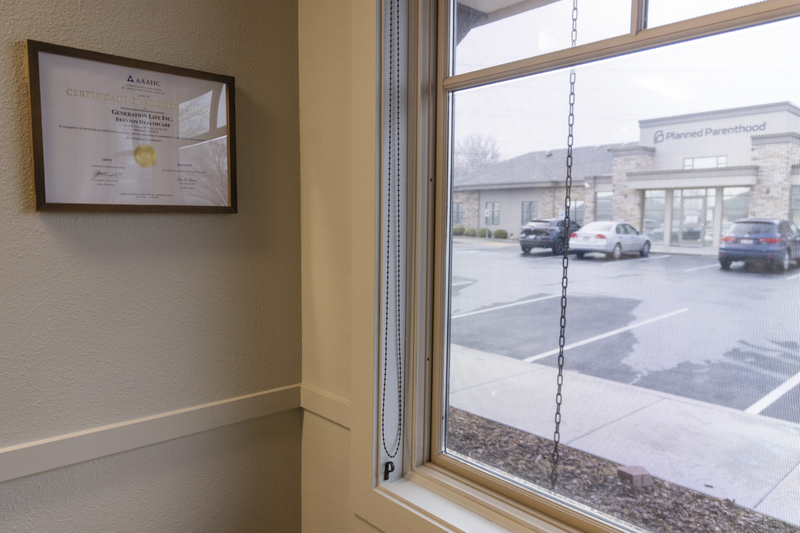
Unlike many centers, Stanton’s flagship center in Meridian, Idaho, pays for accreditation with and receives audits from the Accreditation Association for Ambulatory Health Care, and offers tests and treatment for sexually transmitted infections. The organization lists the first names of medical staff but not its medical director. Like many pregnancy centers, Stanton offers a controversial and unproven treatment known as abortion pill reversal.
While acknowledging her center’s standards are self-imposed, Swindell said the pregnancy center movement has an undeservedly negative reputation as “fake clinics” that is not representative of the majority of centers. And she defended pregnancy centers’ use of limited obstetric ultrasounds, as long as women are cautioned about potential complications.

“There’s nothing wrong with providing a limited ultrasound,” Swindell said. “There’s paperwork that the clients sign so they understand this is non-diagnostic. We are simply determining gestational age, you know how far along you are, and that it’s a viable pregnancy. That’s a very good standard of care.”
But the crisis pregnancy center movement has in recent years had to answer to high-profile stories of alleged adverse outcomes at pregnancy centers.
A Massachusetts crisis pregnancy center, Clearway Clinic, settled a malpractice lawsuit in 2023 related to a missed ectopic pregnancy. Since the suit was filed, the National Institute of Family and Life Advocates has been discouraging affiliates from diagnosing suspected ectopic pregnancies, scanning someone they expect to be ectopic or advertising that they can diagnose ectopic pregnancies.
Earlier this year a patient who went to Abundant Life Pregnancy Resource Center in Athens, Texas, said she was told her pregnancy was healthy, then days later went to the emergency room with an ectopic pregnancy. The organization did not respond to a request for comment.
Many centers continue to advertise diagnostic ultrasounds and suggest women should come in for their own safety to confirm the embryo is in the uterus. That includes half of the centers in Louisiana that received state funding in the first year of the Louisiana Pregnancy and Baby Care Initiative.
“In rare cases, a pregnancy can develop outside the uterus. This is called an ectopic pregnancy and requires immediate medical attention,” reads the website of Crossroads Pregnancy Resource Center in Thibodaux, which did not respond to a request for comment. “After a positive pregnancy test, you may qualify for a limited diagnostic ultrasound if you’re considering abortion or are uncertain about your options. This scan will confirm whether your pregnancy is progressing and if it’s in the uterus.”
In June the Campaign for Accountability sent a letter to Democratic New York Attorney General Letitia James, asking her to investigate whether centers that are making these claims in her state may be violating the unauthorized practice of medicine or deceptive advertising laws.
The New York attorney general’s office confirmed to States Newsroom that it is investigating the complaint.
This story is part of a reporting fellowship sponsored by the Association of Health Care Journalists and supported by the Commonwealth Fund.
States Newsroom’s investigation is ongoing. If you have had an experience with a crisis pregnancy center, please get in touch at [email protected]. Stateline reporter Sofia Resnick can be reached at [email protected].
- July 30, 20262:03 pmEditor's note: This story has been updated to clarify Robyn Chambers' assessment of working with local pregnancy centers for Focus on the Family's Option Ultrasound program.