Kansas AG has a history of using unreliable expert witnesses in high-profile cases
Oct 13, 2026 | 8:50 am ET
Description
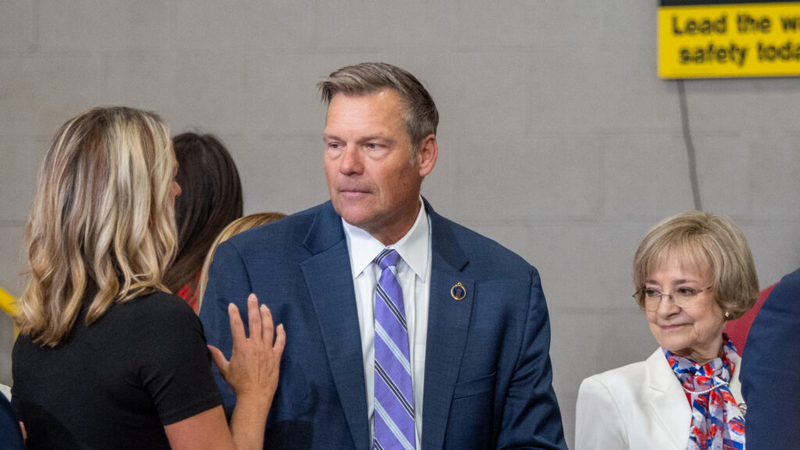
Kansas Attorney General Kris Kobach appears at a Sept. 14, 2026, rally by Vice President JD Vance at Webco Manufacturing in Olathe. (Photo by Sherman Smith/Kansas Reflector)
TOPEKA — A woman told a Lawrence court earlier this month about using a bathroom in the Kansas Statehouse when she was a 19-year-old intern for a state representative.
“As I was using the restroom, it was apparent to me that the person who was in the stall right next to me was quite clearly a man,” said the woman, who testified anonymously during an Oct. 2 hearing on a law that restricts bathroom use based on sex assigned at birth.
“I could tell this by the way that the individual was clearly standing to pee,” she said, according to court transcripts, adding that “they were facing towards the wall as opposed to facing outward, like as if you were sitting to pee.”
When the woman saw Kansas’ first transgender lawmaker, Stephanie Byers, come out of the stall, she told the court, she felt uncomfortable.
The trouble with that testimony, Byers said, is that she received gender affirmation surgery in 2019 in Thailand, roughly two years before she began serving in the Legislature. Her anatomy makes it impossible for her to stand to use the restroom, she said.
“Standing to pee is not something that is comfortable to do,” Byers said in a phone interview. “That is not something I do.”
The woman who testified anonymously is one of several witnesses Kansas Attorney General Kris Kobach has brought forward in state cases whose bias and credibility has been questioned.
Byers, a Democrat who lived in Wichita when she served in the House from 2021-2023, directly challenged the woman’s truthfulness.
But federal and state judges have deemed expert witnesses brought forth by Kobach, or on his behalf, not credible or unreliable in more than a dozen instances since 2016 across four court cases involving state laws.
A spokesperson for Kobach’s reelection campaign attributes the courts’ rejection of his witnesses to political pandering from the bench.
“Some judges are political,” said Danedri Herbert, a spokesperson for Kobach’s campaign who is also the chair of the Kansas Republican Party. “When an expert’s opinion stands in the way of a judge’s agenda, he will declare the witness not credible.”
A retired district judge found the pattern troubling.
“What’s concerning is he keeps using the same people over and over again,” said Kevin Moriarty, a retired Johnson County district judge, who was the first to permit same-sex marriage in Kansas.
“There is a pattern throughout the country,” he said, that indicates witnesses know what they’re going to say before they take the stand.
“The only thing the judges agree on is, frequently, they don’t have the experience to testify,” Moriarty said.
In a high profile 2016 case on voting rights involving then-Secretary of State Kobach, a federal judge, Julie Robinson, sanctioned Kobach and reprimanded him for “flaunting disclosure and discovery rules that are designed to prevent prejudice and surprise at trial,” she said in a 2018 ruling that also blocked a law Kobach supported that required proof of citizenship to vote.
“For most attorneys, they would be devastating comments,” Moriarty said.
Robinson also found Kobach in contempt of court before her 2018 verdict. Before that, a federal magistrate demanded he pay a $1,000 fine for presenting misleading information about voter fraud.
In a 2023 case challenging state-imposed abortion restrictions dating back to 1997, then-Johnson County District Judge Christopher Jayaram questioned the credibility of seven witnesses who testified for Kobach’s team of attorneys during a two-part trial in 2025.
Jayaram said the opinions of a retired neonatologist, Robin Pierucci, on fetal development and fetal pain were “unlikely to be accurate and are certainly outside of the medical mainstream, which is not surprising, given her lack of experience in the subspecialities that actually deal with fetal development, health, and well-being.”
He said testimony from Farr Curlin, an internal medicine and palliative care physician, was “obviously biased and ideologically based.”
He gave Curlin’s testimony “no weight whatsoever,” he wrote in a 261-page decision issued in August, hours before he was sworn in as a Kansas Supreme Court justice. But Kobach ultimately used Curlin as a witness again months later.
Jayaram also gave little weight to testimony from three abortion patients, who “appeared biased and untrustworthy to the court, when considered either independently or in totality.”
Two, he said, gave testimony that was “significantly influenced” by “obvious philosophical biases” developed in the decades since they received their abortions. Another had three abortions, none of which occurred in Kansas. Jayaram said her testimony at times “seemed unbelievable and coached, given her demeanor while on the stand.”
Herbert, Kobach’s spokesperson, said Jayaram’s findings about the women’s credibility was “based on their religious faith,” which she speculated was a violation of the First Amendment.
On the other side, Jayaram called the plaintiff’s witness testimony in the case “extremely competent,” “compelling and impressive,” “equally powerful and credible,” “compelling and persuasive,” and with “no particular ‘bent’ or agenda to pursue, other than to testify objectively to the views of the mainstream medical and scientific communities in this particular subspecialty area.”
The case is in the process of being appealed.
In a case challenging a gender-affirming care ban for minors, Douglas County District Judge Carl Folsom disputed most of the witnesses Kobach put forth in a May ruling.
Folsom said the vast majority of the state’s witnesses were “not credible” or gave their testimony little to no weight in articulating his decision to temporarily block the ban. Kobach said at the time Folsom’s decision was “a stark example of judicial activism.”
The state’s eight witnesses included a plastic surgeon, a medical ethicist, an endocrinologist who treats adults and a neuroscientist. Folsom gave little weight to three of the eight, some weight to one and little-to-no weight to another.
One of the witnesses was Curlin, the physician and medical ethicist who testified months earlier in the abortion restriction case.
Folsom said Curlin’s opinions were “inconsistent with the weight of medical research in his field, and his opinion appears motivated by his personal views as opposed to a methodology applicable in the field of medical ethics.”
He gave his testimony little to no weight.
Kobach also brought to the stand James Cantor, a neuroscientist-psychologist who has testified in favor of gender-affirming care bans in cases across the country. He has been criticized in the past for his specialized research on pedophilia.
Folsom said Cantor’s opinions were “supported only by cherry-picked information, conjecture, and research taken out of context,” and he gave his testimony little weight.
“Judge Folsom’s ruling on Dr. James Cantor was an aberration,” Herbert said. “Dr. Cantor was deemed credible and the court relied on his testimony in Missouri, North Dakota, and Kentucky. In that case, Folsom literally copied and pasted the proposed finding of fact from the ACLU, a leftwing New York advocacy group. He did no independent thinking at all.”
A judge in North Dakota used pieces of Cantor’s testimony to back up his opinion to uphold a gender affirming care ban. Gender affirming care bans were also upheld in Missouri and Kentucky, but other courts, including in Alabama and Tennessee have given Cantor’s testimony little weight. Folsom’s office did not respond to Kansas Reflector’s request for comment.
Despite Folsom’s ruling, Kobach brought Cantor to the stand again in early October.
During the four days of hearings over the anti-trans law, where the anonymous witness mentioned her experience in a Statehouse restroom with the state’s first trans lawmaker, Cantor testified before Douglas County District Judge James McCabria.
Cantor said in a deposition for the case that he reviewed Folsom’s opinion before testifying.
“I think he applied the wrong criteria for what determines the appropriate qualifications for expertise in the matter,” Cantor said.
Leah Rymer, a spokesperson for Democrat Chris Mann, who is running for attorney general against Kobach in the November election, said taxpayers are footing the bill for state witnesses.
“It’s reasonable to expect the state’s top attorney to bring credible witnesses, not ones who push a political agenda,” Rymer said.
Byers, the trans former state lawmaker, said honest assessments of trans people are necessary, especially in court.
“You can’t let someone else tell your story,” she said. “The narrative is being told by people who don’t know and are not trans, and they are writing their own narrative in such a way to cast aspersions and fear on trans people.”
Topeka, KS