Jake Johnson is collecting receipts — can he collect enough votes against Rep. Brad Finstad?
Oct 13, 2026 | 9:08 am ET

Description
Jake Johnson, DFL candidate for Minnesota's 1st Congressional District, greets an attendee at the kick-off event to his "Receipts Tour” in North Mankato, Minn. on Oct. 4. (Photo by Maya Betti/Minnesota Reformer)
Jake Johnson stood at a small park tucked within the hills of North Mankato, his dinged-up Toyota minivan parked just behind him, armed with a solid gimmick: He would collect the receipts brought to him by people across Minnesota’s 1st Congressional District to document the rising price of everyday life.
If elected in November, he said he plans to bring those receipts to Washington — in his minivan.
The event underscored Democratic hopes for a Johnson upset victory in the 1st District, which President Donald Trump carried comfortably in three straight elections and which has been represented by a Republican in Congress since 2019. But rising prices — particularly the cost of fuel after Trump launched an attack on Iran in March — are giving Democrats like Johnson an opening to make the election a referendum on the cost of living.
Johnson laid out the argument: “Costs continue to rise, and Washington doesn’t seem to care about it,” Johnson said. “Whether it’s the cost of gasoline or diesel because of the Iran war, whether it’s just the cost of doing business, building houses because of tariffs or the massive health care cuts that we’ve seen championed by our congressman — it seems to have no end in sight.”
The event also highlighted Johnson’s challenge in a district where Trump won by nearly 12 percentage points in 2024. Just six supporters managed to show up — his Republican opponent, U.S. Rep. Brad Finstad, has more children than that.
In order to win, Johnson, 43, has to prove to voters — Republicans, independents and Democrats alike — that he represents something different, rather than a typical blue state Democrat.
Finstad, who didn’t respond to interview requests, has avoided obvious mistakes and scandal and would typically be able to rely on Republicans’ numerical advantage, but this is not an ordinary year.
Home to Mayo Clinic and some of the Midwest’s richest farmland
Drive across Minnesota’s 1st District spanning the southern part of the state and the landscape changes, sometimes within a few miles.
There are fields filling the horizon, small towns with modest church houses and dusty farm roads cutting through some of the state’s richest agricultural land. Then there is Rochester, where the skyline rises around the Mayo Clinic. Minnesota’s third largest city has grown by roughly 41% since 2000.
The combination of farm country and growing cities like Rochester, Mankato and Winona has created a dynamic political mix in the 1st.
Jim Cottrill, a Winona State University political scientist, points out that over the past 100 years, the congressional seat has been held by just two Democrats — Gov. Tim Walz, from 2007 until 2019, and Tim Penny, who retired in 1995.
Rochester, a solidly Democratic outpost, is the region’s economic center, fueled in part by the expansion of the Mayo Clinic and the Destination Medical Center initiative. Around 50% of the city’s residents ages 25 and older have a bachelor’s degree or higher, and 13% are foreign-born — that’s more than twice the share in the rest of the district, and fertile territory for Democrats’ standard bearer Johnson, who is on leave from his job as a Rochester Public Schools teacher.
Outside its cities, the district is dominated by agriculture.
The district contains more than 6.6 million acres of farmland — about three-quarters of its total acreage — and accounts for roughly 36% of Minnesota’s agricultural sales. In 2022, the district ranked ninth nationally in agricultural sales, according to the U.S. Department of Agriculture.
In years past, Republicans could rely upon this rural base to turn out on Election Day. Finstad, who has a family farm and worked for the U.S. Department of Agriculture during Trump’s first term, has been well positioned to dominate among these voters.
Now, however, the farm economy is facing pressure from several directions: tariffs, inflation driven by the Iran War and cuts to federal farm programs — all under the leadership of a Republican president.
“Bill Clinton, when he ran, he talked about ‘It’s the economy, stupid,’” Cottrill said, referring to the famous motto of the 42nd president’s political advisor, James Carville. “Those kinds of economic issues — how much groceries cost, how much gasoline costs — tend to hit people in their pocketbook, and it tends to motivate them.”
With the tide of national politics turning against the president, whose approval rating is hovering just above 30%, and an energetic opponent, Finstad is confronting more of a real race than in years past.
Johnson shares working-class roots
This summer, Johnson traveled across Minnesota’s 1st Congressional District for a town hall tour that took him to all of its 21 counties. At each stop, he invited local residents to ask questions and raise their concerns.
And at each one, he started with the same story of uplift from working-class roots.
His father was a garbage collector. His mother was a meter reader for a gas company. He grew up in Stewartville with 10 siblings, relying at times on SNAP and Medicaid and, later, on Pell grants and subsidized Stafford loans to afford college.
Before his time on the campaign trail, Johnson spent 20 years as a high school math teacher. There, he worked to improve wages and working conditions for teachers through union activism.
As a teacher at John Marshall High School he helped campaign for a Rochester Public Schools funding referendum in 2024, getting his first taste of politics. The referendum passed, providing more than $19 million a year in funding for the district for the next 10 years.
Now, Johnson is trying to translate that background into a campaign built around affordability for a candidate who understands the pressures middle-class families are facing.
At the “Receipts Tour” event in North Mankato, Johnson framed the election as a fight between working families and the wealthy.
“There’s two sets of rules,” Johnson said. “There’s a set of rules for the rich, powerful, well-connected folks in D.C. and then there’s a set of rules for the rest of us… working families doing more and more and making less and less.”
Johnson has gingerly tried to separate himself from other Minnesota Democrats, including Walz, given the metro party’s association with progressive social issues and the defrauding of the state’s social safety net. The party has nonetheless embraced his campaign. Walz and U.S. Sen. Amy Klobuchar have both extended praise to him, and the Democratic Congressional Campaign Committee added him to its “Red to Blue” program that seeks to promote promising candidates in historically hostile districts.
Despite the attention from party leaders, Johnson insists he is not much different from the people he is asking to vote for him.
“I am the most real, boring person that maybe has done this for a while,” Johnson told the Reformer in an interview.
Boring or not in the classroom, he’s engendered loyalty from his former students.
Nik Marda, Johnson’s campaign manager, was once his student. Oftentimes at his town halls, young faces familiar to Johnson from his years in the classroom can be seen taking photos, recording video and handling microphones for the campaign.
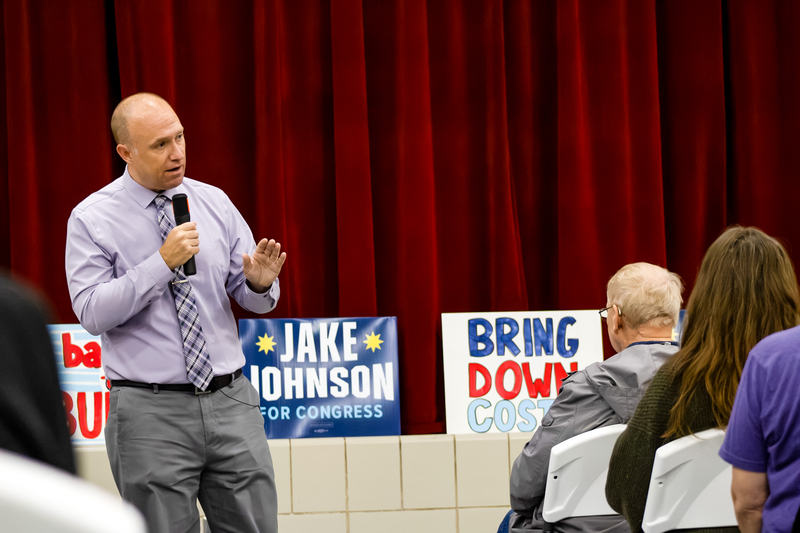
For some voters at these events, Johnson’s appeal lies in his distance from current national politics, particularly Trump.
“I think that Brad Finstad is just out of touch with this district,” said Maggie Jones, who came to Johnson’s North Mankato event. “He’s supported Trump in too many budget things, and it’s just gotten out of hand.”
Jim Davison, an elementary school principal at Fairmont Area Schools, calls himself a “proud independent” and said Johnson’s willingness to compromise is part of what drew him to the candidate.
“He’s shown up,” Davison said. “He’s not bought and sold by somebody… I believe that he will work hard to really represent both sides.”
Davison introduced Johnson at a town hall in Martin County; he stressed that he wouldn’t have done so for any other candidate.
As Johnson has traveled across southern Minnesota, logging nearly 20,000 miles on his vehicle, he has turned his conversations with residents into policy, including a call for a data center moratorium and a plan to stop what he calls “data center exploitation.”
Finstad has said that data centers can bring jobs and revenue to communities that want them.
If elected, Johnson said he plans to continue holding his town halls, in every term, in every county.
Finstad counts on his record
Finstad, like Republicans across the country, has been forced to take a different approach.
While Johnson spent the summer driving from town to town, Finstad has largely kept his head down, relying on the advantages of incumbency: name recognition, a slight cash advantage and all the favors that members of Congress can do for constituents.
Finstad, 50, who is from New Ulm, has spent much of his career inside Republican politics. He served as an agricultural policy adviser to U.S. Rep. Mark Kennedy and spent three terms in the Minnesota House. In 2017, Trump appointed him to lead USDA rural development in Minnesota, a position he held until running for Congress.
He first won the seat in a 2022 special election following the death of Rep. Jim Hagedorn. Later that year, Finstad won the general election by over 11 percentage points — the best showing for a Republican since 2004. He was reelected in 2024 with almost 60% of the vote, outperforming even Trump.
Finstad has focused his work on issues that affect Minnesota’s agricultural economy. He voted for the One Big Beautiful Bill Act, which included provisions from his FARMER Act, which increased premium subsidies and extended benefits for new farmers and ranchers, among other provisions. That bill also kept in place income tax cuts passed in 2017, while cutting taxes on tips and overtime. To pay for it, Congress cut $1 trillion from Medicaid, the state-federal program of healthcare for low-income, disabled and elderly Minnesotans in nursing homes.
Finstad has also championed a 2026 farm bill that would improve producers’ access to credit and make crop insurance more affordable. It passed the House in April, but has yet to pass the Senate.
Finstad is running a low-key incumbent’s campaign.
“It’s not strategically wise for him to open himself up to opportunities to misspeak or to say something that will be taken out of context or misheard,” said Cottrill, the Winona State political scientist. “Incumbents are going to try to be judicious about where they go and what they do and what they say.”
And Finstad has apparently been judicious with public events.
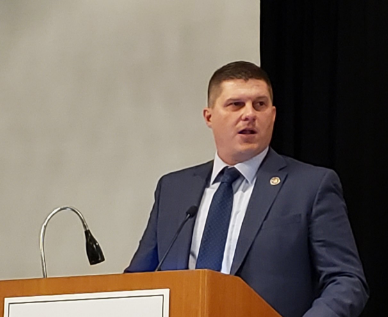
Throughout his time in Congress, Finstad has opted against in-person town halls in favor of “tele-town halls” — phone calls in which his office “randomly selects” constituents from across southern Minnesota to speak with him for about an hour.
Dial-ins are not allowed, his office says, to prevent outsiders from infiltrating the conversation. One such tele-town hall purportedly drew 7,000 participants.
He’s also been selective when it comes to press.
Over the course of reporting for this story, the Reformer contacted Finstad’s congressional offices and campaign seeking an interview. There was no response. Multiple calls to his New Ulm and Rochester offices went unanswered. The Reformer also contacted state Republican officials and local Republicans seeking a comment about Finstad. Also, no response.
Finstad hasn’t ignored his opponent entirely, however. His campaign website includes a “Jake Johnson vs. Reality Claims” section, which leads to a document devoted to Johnson’s political associations. It highlights Johnson’s past criticism of Trump, his ties to Walz and a $20 donation Johnson made to Sen. Bernie Sanders in 2020.
There is no contact form on the Finstad website, but there is an email address at the bottom. The Reformer sent an email, but received no response. The website’s “news” section has not been updated since 2023.

Saint Paul, MN