I-194 seeks to remove ‘dark money’ from politics
Oct 13, 2026 | 10:00 am ET
Description
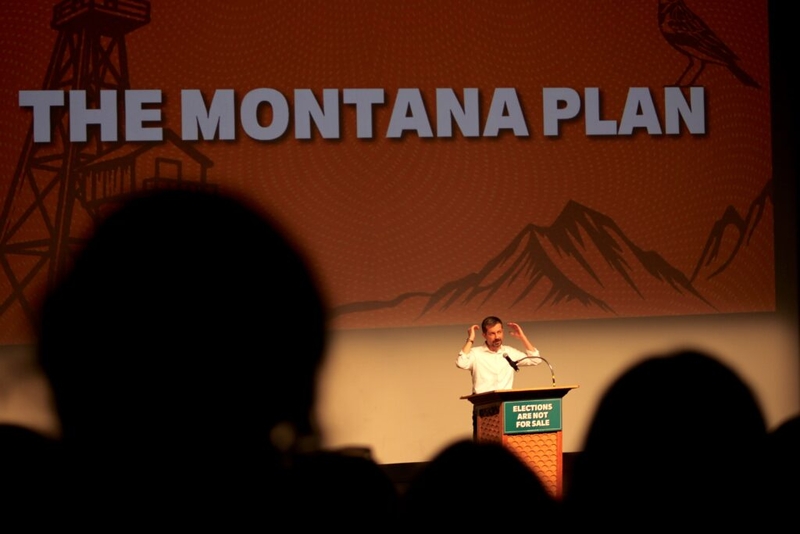
Former U.S. Secretary of Transportation Pete Buttigieg speaks at the Mother Lode Theater on Sunday, May 17, 2026 in Butte, Montana during an event highlighting the Montana Plan, an effort to create a state law to remove corporate spending from elections. (Jordan Hansen / Daily Montanan)
An initiative seeking to limit spending by corporations, nonprofits and other organizations in elections, I-194, will be on the ballot this November.
The initiative, which is being spearheaded by the Transparent Election Initiative, is using Montana’s ability for citizens to propose state laws to ask the question: Whether “artificial persons” can contribute to elections to voters statewide.
In Montana law, “artificial persons” include groups such as nonprofits, trusts, partnerships, corporations, trade associations, or unincorporated associations.
Since corporations are regulated by states, the idea behind the initiative is: Montana could limit corporate powers when it comes to contributing to elections, candidates and political parties. The plan grew out of frustrations about the huge amount of money flowing into political campaigns, as well as dissatisfaction with the “Citizens United” decision which equates campaign donations with political speech, afforded the highest protection by the First Amendment of the U.S. Constitution.
“We’ve never given up the authority as a state to determine what powers corporations have,” said Jeff Mangan, a former Montana Commissioner of Political Practices who has been pushing the effort for years. “So, what I-194 does simply is basically redefine those powers.”
Mangan is the president and founder of Transparent Election Initiative, an organization seeking to address the issue both in Montana and nationally.
If passed, I-194 would mean that anyone who wants to contribute to a political campaign has to do so with their name attached. Advocates for I-194 have said that shell corporations have washed Montana in political cash and this pushes back against it. There’s nothing in the initiative that prevents businesses from advocating for candidates, but that they can’t contribute money. Businesses that fail to abide by that law would lose their right to do business in Montana.
There has been some opposition to the plan, including the Montana Chamber of Commerce and industrial interests such as the Montana Mining Association. The state Republican party has also added opposition to it to its platform.
Todd O’Hair, President and CEO of the Montana Chamber of Commerce worries that it could make it difficult for businesses to band together and fight regulations or candidates they don’t like. One worry, O’Hair said, is that it would not prevent a wealthy person from individually bankrolling a specific candidate.
“If I-194 passes, I think you can rest assured that there will be some of those folks coming in here to attack the things that are important to us and attack the values and our way of life because the business community will not be able to defend itself,” O’Hair said.
He also said the state has a relatively cheap media market, and there’s also a similar worry that someone with an axe to grind against a specific policy could theoretically blanket the state in ads regardless. And O’Hair worries businesses in the state wouldn’t be able to push back under I-194.
“It’s not hard to imagine someone coming in and saying, ‘This is a cheap media market. We can move the needle. We can ban a certain practice or a certain sector in the state of Montana, and we can do so in a way knowing that the opposition, the business community, is not going to be able to fight back and try to provide a different educational sort of narrative on this,’” O’Hair said. “So they would be free to make all sorts of misstatements, misconstrue facts, and completely lie about activities going on.”
Russell Cleveland, who is the Executive Director of Partnerships for TEI, says this levels the playing field between small businesses and large corporations. Cleveland finished third in the Democratic primary for Montana’s First Congressional district in June and made dark money a major facet of his campaign.
“One of the three pillars for me was getting ahold of this corruption issue that we have in politics and in government,” Cleveland said. “I really preach: You have to start at the source, which typically starts with campaigning and campaign finance.”
If passed, Montana would be the second state to introduce such a law, following Hawai’i. The idea has picked up steam nationally, as frustrations with spending in political races continue to mount — more than $1.7 billion has been spent on the 2026 midterm elections, according to Mother Jones.
“There’s an overwhelming need for reform and to get some regulation around it,” Cleveland said. “And this Montana Plan allows a different method to do that.”
Helena, MT