Pa. lawmakers urged to preserve SNAP benefits, assist farming industry at committee hearing
Jul 31, 2026 | 4:09 pm ET
Description
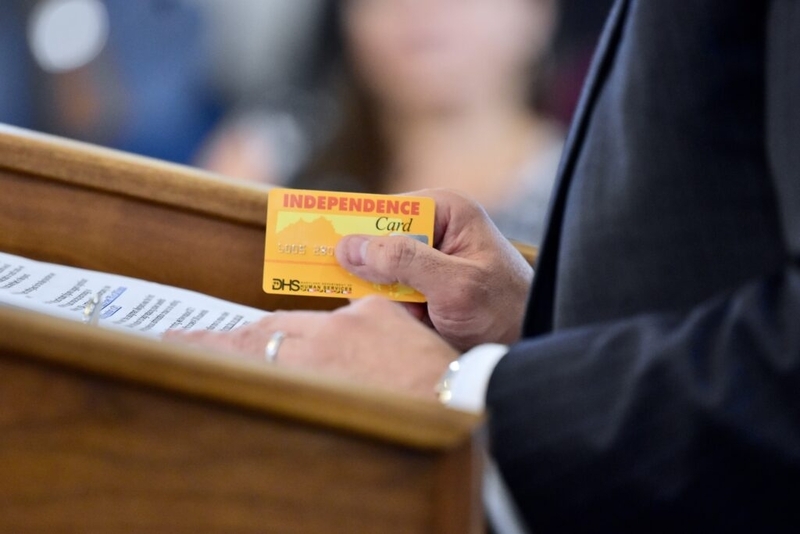
Chip-enabled cards for Pennsylvania's SNAP beneficiaries, like the Maryland version pictured above, could soon be a reality in the commonwealth. (Photo by Bryan P. Sears/Maryland Matters)
Emily Scolnick is a 2026 Dow Jones News Fund intern at the Pennsylvania Capital-Star.
Food bank executives and a union leader urged Democratic lawmakers to “protect SNAP at all costs” and help support Pennsylvania’s farming and agriculture industries amid rising costs at a committee hearing Friday.
The state Senate Democratic Policy Committee meeting, led by Sen. Nick Miller (D-Lehigh) and Senate Minority Leader Jay Costa (D-Allegheny), focused on the need to lower grocery costs and the impact of federal policies on Pennsylvania’s food and farming industries.
State Secretary of Agriculture Russell Redding said that even as the federal government’s values and priorities have changed, Pennsylvania’s commitment to affordability has not.
“The strong farms and strong businesses and strong communities are not competing priorities. They’re inseparable,” he said. “Affordability doesn’t begin at the checkout lane. It begins with building food systems that are resilient, competitive, and work for everyone.”
Allegheny County Executive Sarah Innamorato emphasized that as grocery prices have sharply risen since 2020, outpacing wage increases across the state, families are struggling to accept a “new normal.”
“We’re not asking ourselves, ‘What do we want to buy?’ but rather, ‘What can we afford this week?’” she said. “We’re stretching every dollar, weighing price against nutrition, quantity against quality.”
Pennsylvania has experienced some of the highest grocery price hikes in the country, according to data from Consumer Affairs. Wendell Young, the president of United Food & Commercial Workers Local 1776, said the uncertain state of the food and agriculture industry has made things increasingly difficult for employers, workers, and family-owned businesses.
“The cost of the Trump administration makes it impossible for employers in this chaotic environment that this president’s caused,” he said. “The constant carousel of what is subject to tariffs and what isn’t, the lack of guidance from the Department of Homeland Security on what class of immigrant workers are allowed to stay in our country or not, and the modeling on how the Big Beautiful Bill will impact SNAP benefits for Pennsylvania consumers all contribute to this uncertainty.”
Young said he believes the Trump administration’s tariffs have caused plant closures, stagnant wages, and hiring freezes. His union, which represents over 35,000 members, has lost over 6,000 jobs since Trump’s election.
He added that a slaughterhouse in Montgomery County is slated to close on Aug. 14, eliminating another 1,400 jobs.
The tariffs “make it more difficult to be able to run a plant in Pennsylvania where we don’t have a lot of cattle ranches nearby,” Young said. “So it’s an industry-wide problem right now, but it’s been exasperated by the tariffs and the immigration policies of this administration.”
Sen. Judy Schwank (D-Berks), the minority chair of the Senate Agriculture and Rural Affairs Committee, said the price of meat is a continuous issue for consumers.
“It’s become almost unaffordable,” she said, urging support for local farmers. “We’re all looking for lower prices, but we have to remember that people need to make a living as well.”
“In the wealthiest country in the world, we have people who can’t buy chicken,” added Sen. Nick Pisciottano (D-Allegheny). “This is a complete failure and a big, big problem that we need to address.”
Redding said that international conflicts like the Russia-Ukraine war and the limited use of the Strait of Hormuz after the U.S. and Israel launched attacks against Iran have caused issues with the fertilizer supply among the nation’s farmers.
“We have placed in others’ hands, really, the basic ingredients in growing our crops,” he said. He urged the state to provide economic development assistance to further innovative efforts to increase the domestic fertilizer supply.
Leaders of several food banks in the Pittsburgh area told lawmakers they are seeing an increasing number of people turning to their organizations for assistance.
“More than 1.7 million Pennsylvanians don’t have enough food to meet their nourishment needs. More than half a million children are food insecure,” said Julie Bancroft, the CEO of Feeding Pennsylvania. “Almost 20% of Pennsylvania’s children don’t have enough food to eat, and that obviously impacts their ability to learn and to grow.”
Bancroft added that 10% of older adults in Pennsylvania experience food insecurity, while nearly half of the food insecure live above the SNAP eligibility threshold — earning too much to qualify for benefits, but not enough to adequately provide for their families.
Over 98,000 Pennsylvanians have lost access to SNAP benefits since President Donald Trump signed the One Big Beautiful Bill Act into law last year, according to estimates from the state Department of Human Services.
“Grocery prices have increased 33% between 2019 and 2026 … that’s the largest jump in 50 years,” Bancroft said, citing data from the Bureau of Labor Statistics. “They’re all being priced out of the grocery stores and being forced to make impossible choices about rent, medicine, utilities, transportation, and food.”
Colleen Young, the Greater Pittsburgh Community Food Bank’s director of government affairs, said her organization distributed 830,000 more pounds of food in the 2026 fiscal year as it did the year prior. She added that their on-site food pantry in Duquesne is averaging 200 visitors per day.
“Government assistance is ensuring that agencies without a food budget can source more food and keep up with rising demand,” she said.
Bancroft said their biggest need is for lawmakers to “protect SNAP at all costs.”
“If we don’t have the support of SNAP and our state food programs, we can’t, we simply can’t meet the need that will result from folks not having access to SNAP benefits,” she said.
Harrisburg, PA