Political notes: An AI adviser, a new hand on racing panel reins, lawmakers talk shop
Jun 10, 2026 | 5:00 am ET

Description
The state in May brought on a special adviser to the governor on artificial intelligence. About 45,000 state employees had access to Google's Gemini AI assistant last fall, and a third were considered active users in one report. (Photo by Cpl. Dalton S. Swanbeck/U.S. Marine Corps)
Gov. Wes Moore’s (D) newest senior adviser will aim to improve Maryland’s use of AI technology.
Michael Boyce, who started as Moore’s senior adviser for responsible artificial intelligence in late May, is the second person ever to hold the title in state government. He comes from U.S. Digital Response, a nonprofit that helps local and state governments improve their services, including by using AI tools.
Before that, Boyce was leading the Department of Homeland Security’s AI Corps, an initiative to bring 50 AI experts into the agency to implement the technology to improve its work on immigration, law enforcement and disaster response. He also helped shape AI policy as part of President Joe Biden’s White House Office of Management and Budget.
Boyce’s career began as a refugee officer for Homeland Security, who helped determine refugees’ eligibility to relocate to the United States. His early government service prompted him to focus more on technological improvements, he said.

“At the federal government level, I really saw that a lot of the challenges that needed to be addressed were oftentimes in our technology systems,” Boyce said in an interview Tuesday.
Moore has been outspoken about deploying AI systems in state government. His administration entered into a partnership in November with AI companies Anthropic and Percepta focused on addressing child poverty, expanding housing access and modernizing government services, according to his administration.
As of October 2025, about 43,000 state employees had access to Google’s AI assistant Gemini, and about one-third were considered active users, according to a news release from the company. The state has a published policy governing its employees’ use of AI, at ai.maryland.gov.
“We have done the zero-to-one building,” Boyce said. “We’re really looking to go from the one to 10.”
Marylanders may notice some state use of AI. There’s an AI chatbot, for instance on the website for SUN Bucks, the state’s summer food stamps program for schoolchildren who receive free and reduced-price lunches.
But Boyce believes many of the improvements spurred by AI will be behind the scenes.
“Previously, maybe the application would have taken three weeks, and then somebody would get a response in two days. Previously, you would have called, and someone would have maybe needed to get back to you with information, but because they have an internal tool that can help them, they can give you an answer right away,” Boyce said.
Preaching to the (legislative) choir
At least two Maryland lawmakers are scheduled to take their smarts on the road and present at a national conference of fellow legislators next month.
Sen. Cheryl Kagan (D-Montgomery) and Del. Aletheia McCaskill (D-Baltimore County) are listed as presenters for the National Conference of State Legislatures annual summit July 27-29 in Chicago. Both are scheduled to speak July 27.
Kagan will be a presenter alongside Diane Yentel, president and CEO of the National Council of Nonprofits, on “how lawmakers can work together to ensure nonprofit stability.” She’s set to speak .
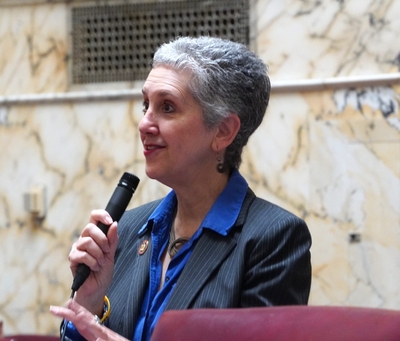
Kagan this year Senate Bill 23, which would have created the Green and Renewable Energy Efficiency for Nonprofits (GREEN) loan program, to provide no-interest loans to help nonprofits pay for energy efficiency projects. The legislation passed in the Senate but didn’t advance beyond a House committee before being incorporated into the massive Utility RELIEF Act that Gov. Wes Moore (D) signed into law last month. As part of that measure, the governor may include $5 million in the fiscal 2028 budget for the project.
“I think that the nonprofit sector is often overlooked,” Kagan said Tuesday. “I think other state legislatures would benefit from knowing about my initiative.”
McCaskill is scheduled to speak on “Child Care at a Crossroads.” She serves on an NCSL bipartisan child care work group that plans to unveil a report on policy options that recommends “affordability, accessibility, quality and financial sustainability.”
McCaskill, who has managed a family child care program and been a licensed provider since 1998, joined Del. Julie Palakovich Carr (D-Montgomery) this year on House Bill 561. It was passed and signed into law, to take effect July 1. The bill requires the governor to extend the state’s child care credential program by almost $5.7 million, reflecting the fiscal 2024 appropriation. Funding for the program would start in fiscal 2028 though fiscal 2030.
The program helps child care workers participate in professional development activities, educational training and tuition assistance at a college or university.
The bill was one of several passed on early childhood this year, including $20 million for the state’s popular child care scholarship program, which has been frozen since last year. The funds are expected to cut into a 5,000-family waiting list for the program.
A new — and historic — hand on the reins
Nicole Earle becomes the first woman and the first Black candidate to chair the Maryland Racing Commission when she assumes the job Wednesday, the governor’s office said.
Gov. Wes Moore (D) announced Friday that Earle will take over for outgoing commission Chair George Mahoney, who will step down from the leadership position but remain on the commission. Earle has served on the commission for the last year.
“Nicole Earle is the right leader at the right time and I am proud to appoint her as Chair of the Maryland Racing Commission,” Moore said in a statement Friday. “This appointment is a historic milestone for Maryland and I am confident her expertise and experience will guide her while leading our horse racing industry.”
Earle is president and CEO of Dominion Real Estate and Dominion Community Development Corp., with more than two decades of real estate experience. She has financed and managed over $1 billion in real estate projects focusing on economic growth, affordable housing, and community revitalization, according to the governor’s office, which called her a leader in the Park Heights community.
She called it an honor to be named chair “during this important period for Maryland racing.”
“I look forward to working with my fellow Commissioners and industry stakeholders to uphold the integrity of racing, support a safe and vibrant racing environment, and contribute to the success of Maryland racing as investments in Pimlico and Laurel shape a sustainable future for this longstanding Maryland tradition,” Earle said in the statement from the governor’s office.
The nine-member commission regulates thoroughbred, standardbred and parimutuel wagering in Maryland. the chair presides over the commission during meetings, oversees hearings on appeals and participates in decisions involving licensing, disciplinary actions, racing dates, purse structures and regulatory approvals. The commission is appointed by the governor.
Annapolis, MD