Judge rules WV National Guard’s deployment in D.C. is lawful; dismisses case without prejudice
Nov 10, 2025 | 6:20 pm ET
Description
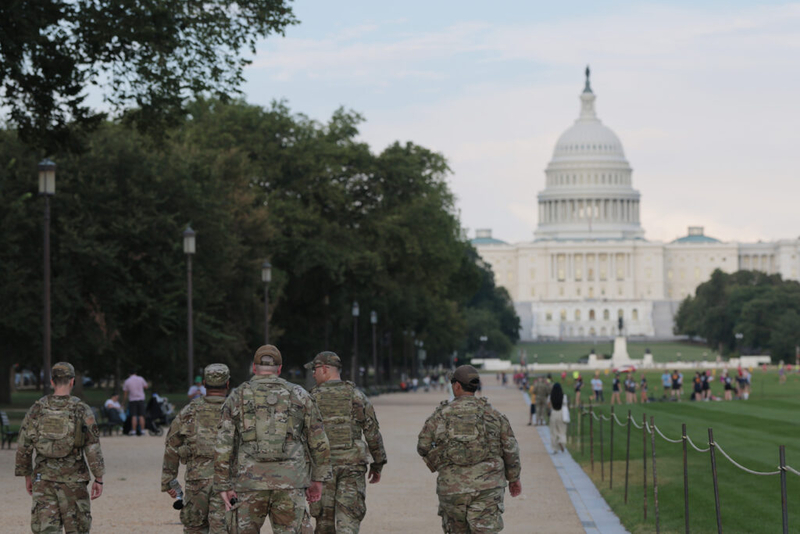
Members of the National Guard walk on the National Mall in Washington, D.C. on. Thursday, Aug. 14, 2025. President Donald Trump announced plans to deploy federal officers and the National Guard to the District in order to place the D.C. Metropolitan Police Department under federal control and assist in crime prevention in the nation's capital. (Photo by Anna Moneymaker | Getty Images)
Kanawha County Circuit Court Judge Richard Lindsay dismissed a lawsuit Monday that questioned whether Gov. Patrick Morrisey acted lawfully when he sent members of the West Virginia National Guard to Washington, D.C. earlier this year at the request of President Donald Trump.
The case was brought against the state by the West Virginia arm of the American Civil Liberties Union on behalf of the state Citizen Action Group. On Monday, Lindsay dismissed the case without prejudice, meaning it could be refiled if circumstances change.
The ACLU and CAG were requesting Lindsay to issue a preliminary injunction that would have brought the West Virginia National Guard out of D.C. and sent back home. Since the court found that the deployment was lawful, no preliminary injunction was issued.
Moreover, Lindsay said he was “persuaded” by arguments from Chris Etheredge, a lawyer with the Attorney General’s Office representing the state, to dismiss the case.
In general, Lindsay ruled that because Trump did request states to send their National Guard members to D.C., standards were met that made the deployment legal. The situation would have likely been different, he said, if the troops were sent to another state without the request and consent of that state’s governor.
“If the matter before this court was the deployment of our National Guard to another state over the objection of a state governor, then this court would have a problem with it,” Lindsay said. “[But] this case truly is different than every other National Guard deployment that’s been in the news over the last year. It’s an important fact to the extent that the president was acting within his authority according to local law [and federal law].”
Morrisey announced in August that he would be sending 300-400 members of the West Virginia National Guard to Washington D.C. after Trump declared a “public safety emergency” in the nation’s capital. That declaration ended in September, but troops have remained in the district.
In late September, a spokesperson for the state’s National Guard said members could remain in D.C. through November.
Monday was the third hearing held in the now-dismissed case. Lindsay said that, since the court found that the governor’s actions were legal, there was no further litigation necessary to prove alleged harm against CAG.
In their lawsuit, the ACLU argued that CAG was suffering real harm due to the National Guard deployment because staff were forced to use more time and resources to both educate the public about it and ensure the government acted properly.
Etheredge argued in an earlier hearing that these alleged harms against CAG were not real and were not clear. He previously argued that the only parties who could claim to be “directly harmed” by the ongoing deployment are residents of D.C. or members of the Guard themselves.
Billy Wolfe, communications director for the ACLU, said in a statement Monday that the organization was “disappointed” in Lindsay’s ruling but was also “thankful that the court treated the issue with the attention it deserved.”
“The court was clear that [CAG] had a right to hold the government accountable, and that the governor’s authority to deploy the Guard is not absolute,” Wolfe wrote. “We’re going to keep an eye on this important issue.”
Charleston, WV