Online prediction markets rile up state lawmakers
Jul 31, 2026 | 5:00 am ET
Description
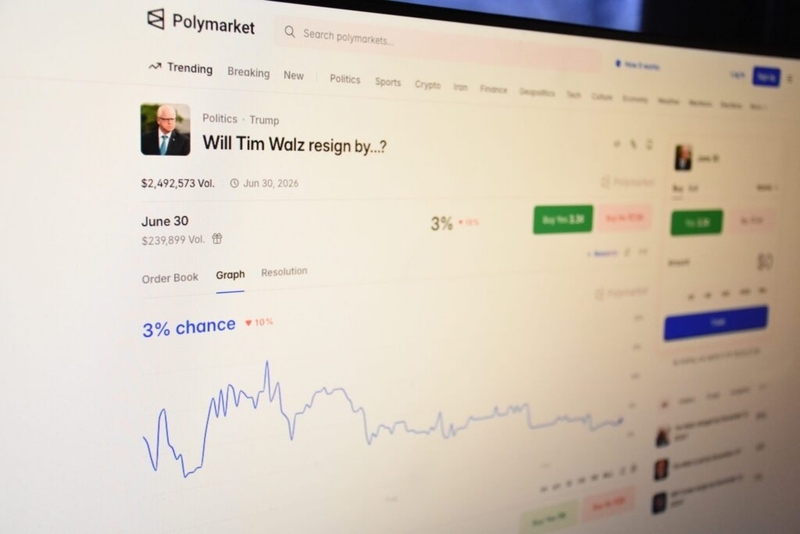
Online prediction markets such as Kalshi and Polymarket are attracting scrutiny from state lawmakers, who argue the platforms are undermining state gambling regulations. (Photo by Alyssa Chen/Minnesota Reformer)
CHICAGO — The escalating feud between states and online prediction markets was on full display at a summit of state lawmakers this week as legislators publicly scolded Kalshi and Polymarket, the two most prominent platforms.
Prediction market platforms say they are like commodity markets that offer contracts to speculate on the future price of corn or oil — not sportsbooks that allow gamblers to place bets. But many states reject those justifications, arguing the platforms are a backdoor to skirt state gambling regulations, particularly on sports.
The issue has sparked action from state regulators, new legislation, and a flurry of lawsuits from states, prediction markets, and the Trump administration, which has sought to sideline state oversight.
During a sometimes-heated panel discussion at the annual gathering of the National Conference of State Legislatures in Chicago, Iowa Republican state Sen. Dan Dawson told the audience that a group of students at his son’s high school recently enrolled in Kalshi to bet on World Cup matches. In Iowa, people must be at least 21 to participate in legal online sports betting.
“States are the ones that pick up the pieces,” Dawson said as a Kalshi executive looked on.
Dawson has previously raised concerns about the public health consequences of prediction markets. While an industry representative pledged to work with states, Dawson said a legislative subcommittee that recently studied the issue could not get even basic information from the prediction markets about their reach in Iowa.
“We couldn’t get one answer,” he said.
Kalshi and Polymarket are skirting laws on sports betting, states say
In March, Kalshi preemptively sued to block Iowa Attorney General Brenna Bird, a Republican, from taking civil or criminal enforcement action against it. In its suit, Kalshi claimed there was “a substantial risk that the attorney general of Iowa will bring an enforcement action.”
Regulation of prediction markets
Sara Slane, Head of Corporate Development at Kalshi, told lawmakers in Chicago that the company was committed to building relationships with the states. But she said the prediction markets are not subject to state oversight, as they are regulated by the Commodity Futures Trading Commission, which regulates derivatives such as futures contracts on stocks.
She said prediction markets require a national standard rather than a “state-by-state regulatory patchwork.”
“This was exactly what the commodity exchange was set up for,” she said.
The five-member, presidentially appointed CFTC currently has four vacancies. But it has aggressively sought to exclude states from overseeing prediction markets, suing red and blue states alike to maintain its jurisdiction over the markets.
Earlier this week, a coalition of 44 state attorneys general wrote to the agency, arguing it does not have the power to regulate sports-related event contracts, which they say are subject to state gambling regulations.
In addition to encroaching on state-regulated and state-taxed sports gambling, states argue that prediction markets are subject to potential insider trading, lack consumer oversight and can fuel problem gambling.
Slane said her firm works to prevent money laundering and allows people who have problems with gaming to block themselves from the site. She said Kalshi also works with major sports leagues to prevent athletes and referees from trading on sports events.
“We take this very seriously,” she said. “We want to promote integrity around our exchange.”
But prediction markets continue to gain national attention for allowing people to unfairly bet on the outcome of events by leveraging nonpublic information.
This week, the White House announced the president’s teleprompter operator was no longer on staff after he was accused of using inside knowledge to make bets about presidential speeches on Kalshi.
Minnesota Democratic Gov. Tim Walz on Tuesday signed an executive order prohibiting state employees from using inside information to bet on prediction markets. At least eight states, including Arizona, California, Maryland and Wisconsin, have implemented similar restrictions.
Mick Mulvaney, executive director of the Gambling is Not Investing Coalition, said he was sympathetic to the argument that prediction markets want to avoid a regulatory patchwork across the states.
“That being said, there’ve been two areas where the states have almost always been entirely sovereign: That’s on booze and gambling,” he said.
Mulvaney, a Republican, represented South Carolina in the U.S. House and served as acting White House chief of staff during President Donald Trump’s first term. His organization argues that prediction markets should be subject to the same state and tribal regulations as other forms of gambling.
With litigation flying, he said there’s no question the debate is heading toward the U.S. Supreme Court. Mulvaney said it’s unclear how the conservative court will rule, given its recent decisions. Some of those rulings have allowed the expansion of federal executive power, while others have tilted toward the states.
“So that will be fascinating to see how it shakes out at the Supreme Court,” he told Stateline. “But I have every expectation that this is going all the way up.”
Threat to tribal casinos
Casino gambling has been the sole economic engine for many Native American tribes for years, said Michael Hoenig, vice president and associate general counsel for gaming at the Yuhaaviatam of San Manuel Nation in Southern California.
He said tribes have built up the gambling industry over the last 40 years — sometimes in cooperation with states, other times “in friction with the states.”
“This is just a profound affront to tribal sovereignty, tribal self-government,” he said. “Tribes are supposed to have the sovereign right to decide who gets to operate gaming on their lands and who doesn’t.”
Aside from regulatory concerns, state leaders worry about how the rise of prediction markets may impact the financial and mental health of their residents. Since a 2018 U.S. Supreme Court ruling opened the door for states to legalize sports gambling, 39 states and the District of Columbia have done so.
Advocates, researchers and lawmakers are already raising alarms about how the burgeoning market could fuel gambling addiction and hurt household finances.
Growth of sports betting may be linked to financial woes, new studies find
Aside from regulation, there is little difference between the potential impacts of prediction markets and online sports betting, said Rachel Volberg, a professor emerita of epidemiology at the University of Massachusetts Amherst.
Volberg, who has studied gambling addiction for 40 years, told lawmakers in a separate presentation that the research is clear about how over involvement in gambling can hurt individuals and families. However, she told Stateline that legal sports gambling is too new for researchers to fully measure how much the high-speed and accessible world of online gaming has changed the dynamics.
In North Carolina, a new poll found that most people generally approve of sports betting, but a majority wants the state to ban prediction markets.
In the Meredith College poll released Tuesday, 51% of registered voters said they were satisfied with state regulation of sports gambling. Only 11% said they were dissatisfied, while 38% said they didn’t know.
In that poll, two-thirds of registered voters said they would support state legislation banning prediction markets, while 24% said they should be legal.
Though sports fans, policymakers and the researchers continue to grapple with the quickly evolving landscape, experts gathered in Chicago were clear that this industry is here to stay.
“It’s not going anywhere,” said Anthony D’Angelo, who leads responsible gaming efforts at Fanatics Betting & Gaming.
D’Angelo said his company’s sportsbook invests heavily in providing assistance for problem gamblers, flags potentially problematic transactions and incentivizes customers to set and stick to betting limits.
He said lawmakers can help keep people away from illegal and offshore betting platforms that have no oversight or consumer protections.
“We all want the same things to happen,” he said. “I think we want a sustainable, long-term industry where customers are protected.”
Stateline reporter Kevin Hardy can be reached at [email protected].