John E. Sununu is running for Senate in a nation that no longer exists
Jul 15, 2026 | 2:09 pm ET
Description
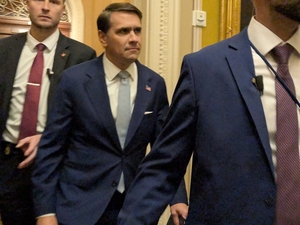
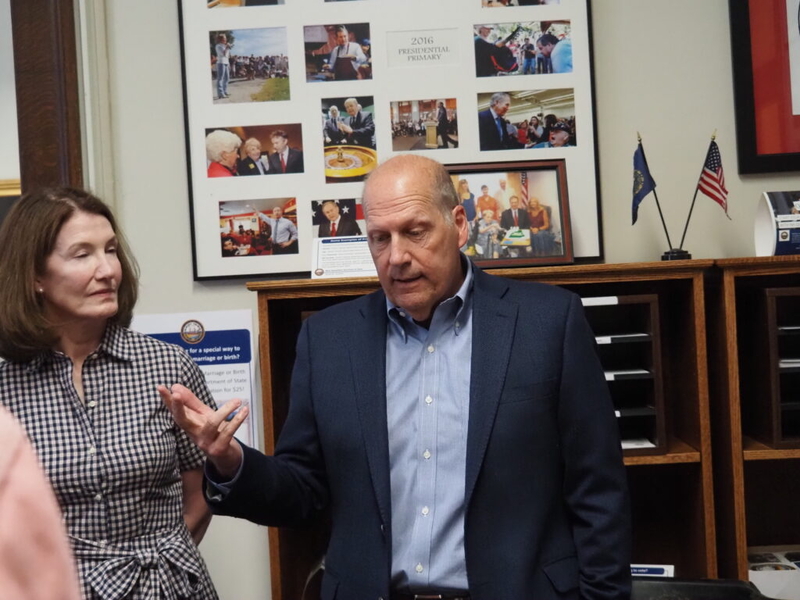
John E. Sununu speaks to reporters in the New Hampshire Secretary of State's Office on June 10, 2026, after filing paperwork to run for U.S. Senate. Sununu previously served in the U.S. Senate from 2003 to 2009. At left is his wife, Kitty. (Photo by William Skipworth/New Hampshire Bulletin)
Less than two months out from the state primary, the return of John E. Sununu has been … well, it’s been something.
Sununu, who served as a congressman in the late 1990s and early 2000s and one term as a U.S. senator from 2003-2009, is now chasing the Republican nomination to replace the retiring Sen. Jeanne Shaheen. So far he has shown himself to be much less interested in his main primary challenger, Scott Brown, another former U.S. senator (albeit from Massachusetts), than in the Democratic primary between U.S. Rep. Chris Pappas and progressive Karishma Manzur. When not obsessing over what Pappas does and does not say about a disgraced former U.S. Senate candidate in another state, Maine’s Graham Platner, Sununu has been trolling Pappas about Manzur closing the gap.
I get that it’s just the way the game is played these days, but it’s still a curious strategy. The latest St. Anselm polls show Pappas leading Manzur 62% to 20%, and Sununu’s lead over Brown is slightly smaller, 59% to 21%.
The bigger issue for Sununu is that he seems to be running for a Senate seat in 1976, or possibly an alternate dimension.
In discussing his energy vision on The Granite Discourse podcast in March, for example, Sununu touted just the kind of backward three-pronged approach that’s likely to get us all incinerated: more drilling, more pipelines, and more nuclear power. I listened to his pitch this week, as an apocalyptic sun painted the New Hampshire landscape an eerie yellow-green due to the wildfires raging in Canada. Fires of this scope and intensity are not cyclical nor are they random; they are one of the many documented effects of climate change. As the Canadian Climate Institute noted in a fact sheet this month, “the last three fire seasons have been among the 10 worst on record.” And that’s just one chapter of our collective nightmare. Stanford’s Doerr School of Sustainability estimates that “U.S. emissions since 1990 have caused more than $10 trillion in global economic damages, with roughly a third of the damage hitting the country’s own GDP.”
So much for “fiscally conservative.”
I know it’s still fashionable for Republican politicians to carry on as though the jury is still out on the reality of climate change, and to brush aside the already-staggering financial costs of mitigating and cleaning up after its effects, but any energy plan that doesn’t include clean, renewable energy is policy regression. It’s also nihilism. We know too many hard truths now to pretend that fossil fuels are our future.
I’m sure that’s why Sununu jumped on the nuclear bandwagon at the end of the podcast’s energy segment, because Republicans (and too many Democrats) advertise nuclear reactors as a more palatable kind of “green” energy — I suppose because the constant threat of radiation makes it more manly than “woke” solar and wind? Never mind that we still don’t know what to do with the nuclear waste (shoot it into space? bury it in the wilds of New Hampshire?) so we don’t further poison the planet and its inhabitants. And forget about the fact that the technology for heralded small-scale reactors doesn’t actually exist. Maybe that’s why Sununu also proposes expanding Seabrook Station, which he reassuringly said “has been safe.” Sununu’s an engineer so I guess he would have some special insight there, or maybe he’s just more sanguine about concrete degradation than most.
Energy policy, however, isn’t the only issue that has Sununu pining for a time machine.
When asked on the same podcast episode what he thought of Elon Musk’s efforts on behalf of President Donald Trump’s Department of Government Efficiency, Sununu said DOGE “wasn’t the most elegant operation, but it needed to be done.”
“Wasn’t the most elegant” is absolutely the kindest thing you can say about Musk’s rampage, but I wonder which part “needed to be done.” Maybe Sununu’s referring to the 700,000 global deaths linked to the dismantling of USAID? Or the thousands of illegally fired federal workers? Or was it the generational devastation of U.S. scientific research?
Like every think-tank Republican who operates by rote, Sununu adheres to two mantras above all others: Smaller government is better government, and an unfettered private sector is the best way to serve the public good.
The problem for Sununu is that he acts as though he’s a candidate for a better future when the America he ultimately desires is the one we’re already enduring. Smaller government, which Republicans always execute thoughtlessly, has ushered in an era where we can’t even adequately track a national cyclosporiasis outbreak let alone work to advance medical research. It has gutted the IRS, making it even more unlikely that the U.S. government will ever meaningfully close a more than $600 billion annual tax gap. And it has destroyed American soft power overseas, which is meant to prevent costly hot wars and boost U.S. security through increased global stability.
As for the public good delivered by an unfettered private sector? The nation’s leading public servant, President Trump, made $2 billion in income during the first year of his second term; his DOGE sidekick has become the world’s first trillionaire; the wealth of other billionaires grew three times faster than the past five-year average; and the overall wealth inequality gap in America is wider than it’s been in decades.
That didn’t happen because these guys are exceptional businessmen; it happened because they got a human cheat code elected president in 2024.
What does all of this mean for the candidacy of John Sununu, the throwback Republican holding up a “D.C. or Bust” sign? It means he shouldn’t be talking about Chris Pappas or Karishma Manzur, even a little bit, until after the state primary in September. Instead, he and Scott Brown should be debating, at length, which one of them is less likely to be just another cartoonishly acquiescent Republican yes man amid the most corrupt and destructive presidential administration in American history.
And then, if Sununu wins the nomination, maybe he can explain to the people of New Hampshire why he’s so high on carbon emissions. Who knows, maybe by then we’ll be able to see his wheels turning through the wildfire haze.
Concord, NH