It doesn’t have to be like this, Montana
Aug 04, 2026 | 8:11 pm ET
Description
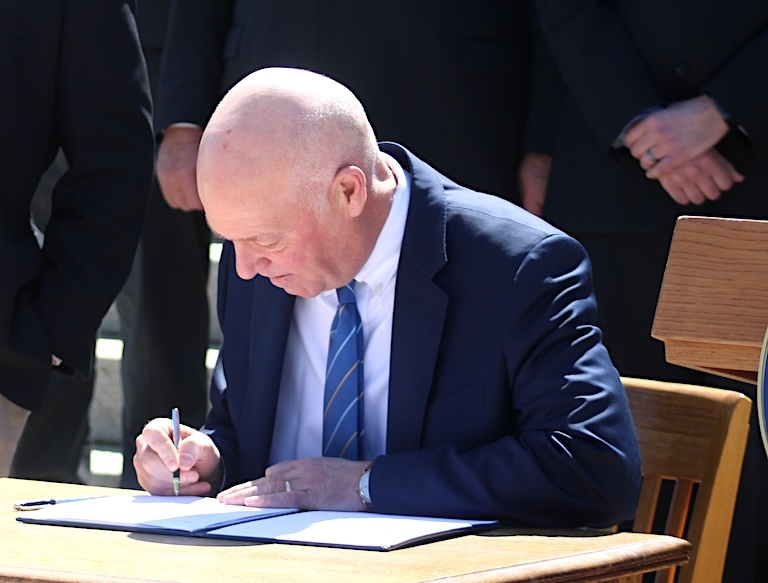
Gov. Greg Gianforte signs a bill from the 69th Legislature. (Micah Drew/Daily Montanan)
It doesn’t have to be like this.
We can have it all:
- A benevolent society that supports each one of us as we pursue the dreams of our lifetimes;
- A thoughtful society that recognizes our inviolable right to a life of dignity;
- A compassionate society that provides quality medical care, child care, educational opportunities, effective aging services, agreeable housing, and decent workforce opportunities that pay a livable wage;
- An opportunity society in which each person has “a fair chance to make of himself all that in him lies,” as Teddy Roosevelt proclaimed in 1910.
We can’t begin to approach these goals while wealth and power is concentrated in the tiniest portion of our population. The present tax structure facilitates this concentration of power.
Thomas Jefferson set a high bar high with his famous words in the Declaration of Independence, and President Abraham Lincoln reaffirmed them 87 years later at Gettysburg. We are “all created equal” and we are all entitled to an equal opportunity in the game of life.
Yet anyone with eyes can see how far short we have fallen. Everywhere, people struggle to get by, while a few amass fabulous riches and spend it on mansions, yachts and extravagances that are almost beyond comprehension.
Franklin Delano Roosevelt warned us that “the test of our progress is not whether we add to the abundance of those who have much; it is whether we provide enough for those who have too little.”
With that in mind, since the Great Depression, the tax code has required the wealthiest to pay a higher share of their income to the government to support programs that advance the common good. This tax structure funded our public programs through the post-war era until the mid-’70s, yielding a period of unprecedented prosperity.
Then came a new theory — trickle-down economics. It proposed cutting the taxes on the wealthy in the hope that they would create new jobs and revenue, lifting the living standards of the rest of us. Beginning with the Reagan presidency, this theory was put to the test.
But it was too good to be true. The government cut taxes for the richest but the wealth did not trickle down. Instead it concentrated at the top 1% and the social safety net shrank.
You would think that the trickle-down theory would be firmly buried by the facts. But you would be wrong. Gov. Greg Gianforte is preparing a new version called the “flat tax.” This proposal lowers the state income tax on those at the top while doing nothing for working people and families. Taxpayers who earn more than $575,000 a year already pay the lowest effective state and local tax rate of any category of taxpayers. Yet the flat tax would lower it even more.
The governor’s tax cuts would decrease state revenue by $130 million a year, at a time when Montana sorely needs those revenues. That tax revenue protects Medicaid and rural healthcare, funds our public schools, addresses the affordable housing crisis, provides residential property tax relief, and cares effectively for our aging population.
It’s easy to fall into the trap of hopelessness. But it doesn’t have to be like this, and there’s something we can do about it.
It’s simple. We can vote. The elections this November can change the direction of our state and our country. We have the power to choose a new set of officeholders, folks who are committed to the belief that government should be used to provide for the general welfare of all and not just for the few.
The campaign for the midterms will begin in earnest after Labor Day. Find out where each candidate stands on the governor’s flat tax.
It doesn’t have to be like this. And we can do something about it.
Jon Ellingson serves as Vice Chair of the Board of Big Sky 55+. He is a former state legislator and was Senate Majority Leader during the 2005 session. His career includes work with former Attorneys General Mike McGrath and Steve Bullock and as the legal director of the Montana ACLU.
Helena, MT