Ranked choice voting makes sense for Oregon
Aug 04, 2026 | 6:14 pm ET
Description
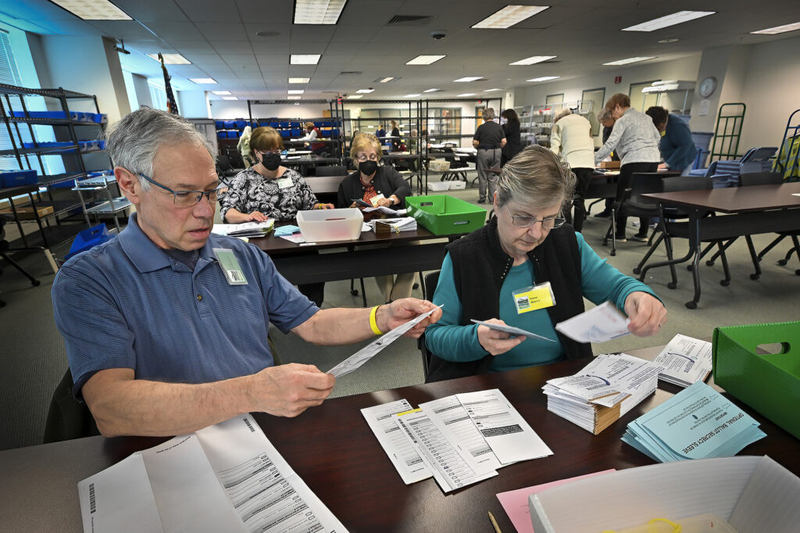
Election workers John Jorgensen and Irene Morris inspect ballots on May 16, 2022 at the Marion County Clerk's Office in Salem. In future elections, Oregon might opt for ranked choice voting. (Photo by Ron Cooper/Oregon Capital Chronicle)
It’s hard to imagine a scenario where ranked choice voting — or, more to the point, the lack of ranked choice voting — won’t have an impact on this year’s race for governor.
Ranked choice voting eliminates concerns about “spoiler” candidates and ensures that the winner has broad support among voters. Right now, we’re teeing up a close gubernatorial election with at least one minor party candidate in the mix — with the potential for more to join the fray. Any time you have an election with more than two candidates in our current winner-take-all, first-past-the post system, you run the risk of the winning candidate being elected with far less than a majority of the vote.
Although ranked choice voting is used in Corvallis, Portland, Benton County, and Multnomah County, it has yet to be used at the statewide level where winner-take-all reigns supreme.
Under the current statewide system, a candidate only needs to secure a plurality of the vote—meaning more votes than anyone else. At first blush, this sounds both sensible and fair, until you consider what elections look like with multiple candidates in the race. If, for example, you have a three-way election, a plurality of the vote could translate to a candidate winning with just 34%. That means that 66% of the voters would have preferred that someone else won.
We don’t have to look far back in Oregon’s history to see examples of this. In the recent May primary, the Republican candidate for U.S. Senate won that election with less than 30% of the vote. On the Democratic side of the equation, Chris Beck emerged victoriously from the 2nd Congressional District race with a mere 34% of the vote.
One of the many beautiful things about ranked choice voting is how it eliminates the need for needless runoff elections. Ranked choice voting—which is also known as “instant runoff voting” — essentially combines two rounds of elections into one.
As voters in a number of Oregon jurisdictions have discovered, voters get to rank candidates in order of preference — 1, 2, 3, and so on — and if their preferred candidate can’t initially muster enough support to win a majority, the voters’ back-up choices come into play. Votes are counted in rounds until a candidate secures a majority and is declared the winner.
Both Washington and Clackamas County will have runoff elections in November between the top two candidates for two seats on their Boards of Commissioners because no candidate secured a majority of the vote in the May primary.
That means eight candidates will have to campaign in two separate elections, just months apart. That seems like an incredible waste of time, money, and resources when a ranked choice/instant runoff election can produce a winner with candidates only having to run once.
So, while using ranked choice voting has many benefits — more choices for voters and elections which produce winners with broader public support among them — adopting its use might just come down to a matter of dollars and sense. Combining two elections into one, and the savings that would generate, could provide local jurisdictions with sufficient motivation to make the switch.
Oregon’s use of ranked choice voting, for now, is limited to a handful of cities and counties. 2024’s Measure 117, which would have established ranked choice voting for all federal and statewide offices, proved to be a bridge too far for Oregon voters, garnering just 42% of the vote.
Rolling out ranked choice voting at the local level, where voters will have more opportunities to get familiar with it, is a likely path for its continued adoption. Another route could be adopting it in bite-sized pieces and using it for specific elections—such as the governor’s race—where multi-candidate races are common and the risk of electing a candidate without the support of a majority of voters is high.
There are many threats to the democratic process; some more overt than others. Winner-take-all elections may not seem nefarious, but elections which thwart the will of the majority are incompatible with the basic principles of democracy. Ranked choice voting is a simple and elegant solution to this problem.
Salem, OR