Iowa State University researchers, global partners create pest identification model
Apr 03, 2026 | 5:06 pm ET
Description
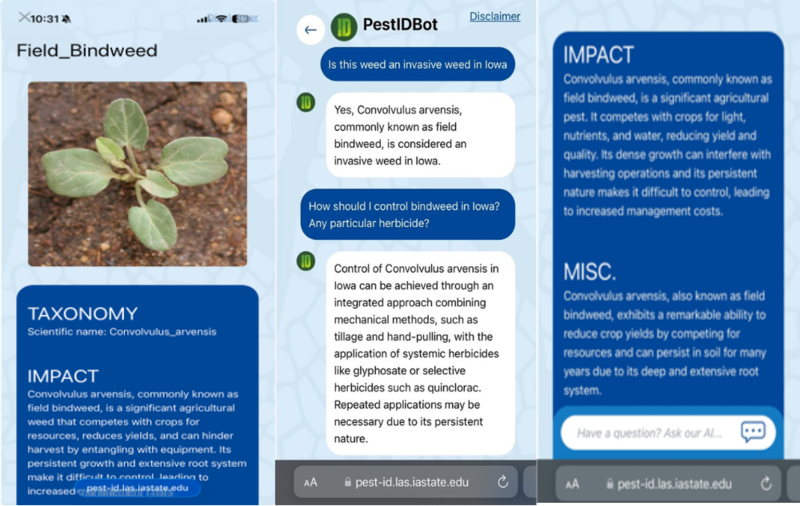
The Pest-ID program allows users to upload a photo and receive information on the weed or insect featured in it, as well as ask a chat bot about management. (Pest-ID model screenshots courtesy of Arti Singh/Iowa State University)
As machine learning and artificial intelligence programs have advanced over the past decade, Iowa State University researchers — alongside national and international colleagues — have likewise expanded efforts to use those tools in aiding farmers with finding solutions to their pest problems and in teaching the next generation how to go even further.
Pest-ID, an AI-driven tool for use in identifying insects and weeds and managing their presence, is the result of more than 10 years of work from ISU and other academics. The team is currently working to grow its basis of knowledge in these areas and branch it out to plant diseases as well, a lift that will take even more data and access to computing power.
Arti Singh, leader of the project developing Pest-ID, and Baskar Ganapathysubramanian, director of the ISU AI Institute for Resilient Agriculture, said this work is being done with the goal of giving farmers more access to the information they need to make real-time decisions in problem solving and managing their crop.
Around 80% of Iowa farmers fall into the small- to mid-size range, Ganapathysubramanian said, and Singh pointed out that they don’t always have resources or expert advice immediately available to them when they find a pest among their crops.
“Sometimes they want to make a decision right away, right then and there, and they need an expert tool,” Singh said. “And this is where we thought that we can bring expert knowledge.”
The Pest-ID program, currently a webpage being tested by farmers with hopes from researchers of creating a phone app in the future, allows users to upload photos of insects or plants to be identified by the application, providing scientific and local names and other identifying information.
From there, users with additional questions can ask an attached chat bot about how they should manage the pest once they know what it is. The insect and weed identification models have been trained on 16 million and 15 million images, respectively, Singh said, with identification capabilities of 4,000 insect species and 1,500 weed species. INaturalist, an online social network and database where users can upload images of what they find in nature, was utilized in finding images to train the models.
Work to develop the app is being supported with a two-year, $400,000 grant from the National Science Foundation, building on other federal grants and partnerships with the project over the more than 10 years of efforts.
Global work for global use
The AI Institute for Resilient Agriculture, launched in 2021 with $20 million in federal funding and currently in its last year, had a hand in expanding the work that could be completed on Pest-ID and its network, Ganapathysubramanian said. In addition to the researchers across the U.S. involved with the institute, he said the Iowa Soybean Association has been a “core partner” that helped the program develop “moonshot” problems to try and solve for farmers.
One of those moonshots was how AI tools could impact the work of pest and disease identification. In order to create a pest and disease identification system and do it “well at scale” required three things, Ganapathysubramanian said — huge amounts of data, computer resources and AI expertise to train the models, and experts in various fields to ensure the answers provided by the tool are the right ones.
“I think it takes a village, and we have been fortunate enough to have an excellent nucleus of people across agronomy, engineering, computer science, data science, and then pathology, entomology and so on, who have come together, who are working together to answer this important question,” Ganapathysubramanian said.
All of these connections, both in and outside of the U.S., have led to current efforts in creating a “global-to-local” strategy in which Pest-ID users around the world can tailor the application to their specific geographic area and the body of pests within it, Singh said.
Outside partnerships are also helpful in accessing more data for pest detection, Singh said, in order to collect millions of images of different crop diseases which can be put in the global model then used to train local iterations.
“Even if we go with different universities, we cannot gather millions of images, but we know that in other countries, there are scientists who have databases,” Singh said. “So how can we collaborate among ourselves to pool that disease data to create a model like we have created for insects and weeds?”
Global models for insect and weed identification have already been created and fine-tuned for use in Iowa, Ganapathysubramanian said, and the team is working with collaborators across the U.S. and globe to tailor models for their own ecosystems. This doesn’t mean the work is done, he said, as they will continue to collect more data and hopefully keep training their models to get better and better.
AI here to stay
Beyond applications for those in agriculture, Singh said an important aspect of this work is the educational opportunities it provides for Iowa students. Singh has “gamified” the data used to create Pest-ID in order to have students guess which insects are real or not real and make other connections.
Ganapathysubramanian described artificial intelligence as a “force multiplier” with the power to transform areas like manufacturing, technology, education and agriculture — one that must be maintained with computing power and other technology and equipment.
ISU has been ahead of the game with its high-performance computing center, he said, and the Pest-ID project has been sustained with Nvidia and Amazon Web Services partnerships throughout its creation and expansion, but it’s critical that this work continues to be supported by both the institution and the state.
Especially in agriculture, where AI could help with precision agriculture, pest identification management, sustainability practices and more, Ganapathysubramanian said there is a “clear value proposition for AI” in agriculture, where farmers who see an impact to their bottom line become early adopters of the technology.
“From a scouting perspective, from an automation perspective, from an additional supports perspective, I think AI is here to stay and to make a significant impact,” Ganapathysubramanian said.
Des Moines, IA