Iowa House votes to restrict abortion medication, requiring in-person prescriptions
May 01, 2026 | 7:48 pm ET
Description
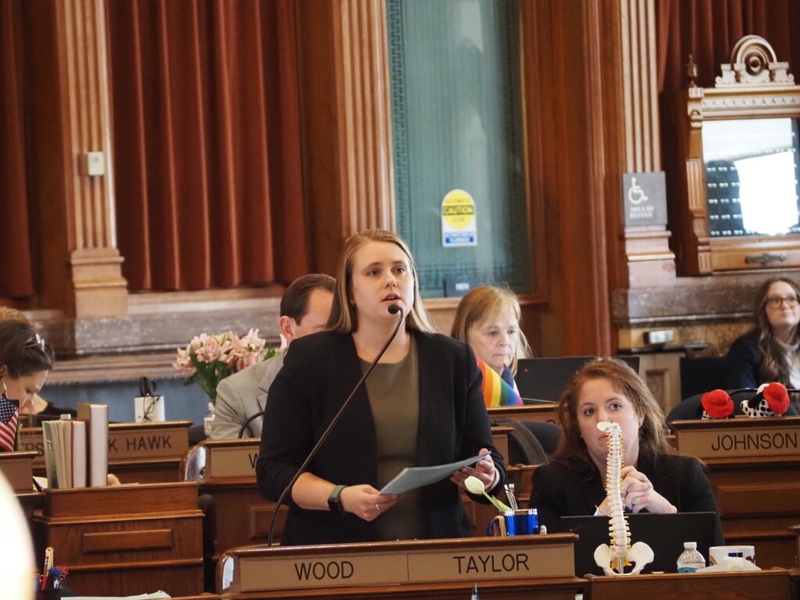
Rep. Devon Wood, R-New Market, spoke on legislation restricting access to abortion-inducing medication via telehealth and mail-order prescriptions May 1, 2026. (Photo by Robin Opsahl/Iowa Capital Dispatch)
The Iowa House passed a bill Friday restricting access to abortion medication, even as nationwide restrictions on mifepristone are taking effect due to a court order.
House File 2788, passed 57-29, would require abortion-inducing medication to be prescribed in person and dispensed in a medical setting, restricting Iowans’ ability to receive these medications through telehealth and mail-order providers, many of which are located outside the state.
The measure has been amended both during earlier meetings as well as when it was brought to the House floor to reflect feedback from medical professionals, Rep. Devon Wood, R-New Market, said. This included changes like striking an earlier requirement for doctors dispensing these medications to share information about the possibility of “reversing the intended effects of a chemical abortion,” which multiple medical organizations have said does not reflect factual, scientific information.
The bill was also changed to clarify the definition of an “abortion” to ensure treatment related to miscarriages and ectopic pregnancy could not be construed as an abortion procedure. Additionally, the amended proposal does not include reporting requirements present in earlier bills about drugs that can be used to induce abortions.
Democrats supported the amendment, saying that it improved the bill — but voiced their opposition to the legislation overall. Rep. Beth Wessel-Kroeschell, D-Ames, said the bill adds additional state-level barriers in accessing abortion-inducing medication that exceed federal standards “not because science demands it, but because ideology does.”
Iowa House lawmakers moved forward the bill as similar restrictions are coming into effect nationwide. A U.S. appeals court Friday temporary blocked a Food and Drug Administration rule allowing the prescription of mifepristone, a common abortion-inducing drug, through telehealth appointments — which includes providers outside of states where abortions have been banned.
Republicans in Iowa House said the state-level measure is needed to help keep Iowa women safe from potential negative health outcomes caused by taking abortion medications, and to prevent “black market” abortion medications from coming into the state. Wood said she believed the bill would ensure these medications are being used safely.
“I’m frustrated, I’m disgusted and I’m disappointed,” Wood said. “I thought we would have a bipartisan discussion today. How could I think a bill about abortion pills might be a bipartisan discussion? Because I thought we all agreed one thing: women deserve safe access to health care.”
Wood argued the bill will also help women in abusive or violent relationships, saying “by requiring in-person screenings, we are giving these women a lifeline,” as research has found many women seeking abortions are pursuing this medical intervention because they are in an abusive or otherwise unsafe relationship.
“We are providing a private clinical sanctuary where an expert can look them in the eye and ask, ‘Are you safe?'” Wood said. “That opportunity for intervention is lost the moment that we move this process to a computer screen, a phone or a mailbox.”
But Democrats said the bill was not about women’s safety in health care — it was about further restricting abortion access.
“If our goal is safety, then we should be investing in maternal health infrastructure, expanding postpartum coverage, recruiting providers to rural communities and addressing our workforce shortages,” Wessel-Kroeschell said. “Those are the real challenges facing Iowa families. The millions of federal dollars we are pouring into the Rural Health Transformation Initiative will fall short if legislation like this continues to discourage providers from practicing here. This bill continues the pattern of government intrusion into deeply personal medical decisions.”
Rep. Megan Srinivas, D-Des Moines, a physician, said the bill will also not have an impact on “black market” abortion medication, because these drugs are already illegal. What the measure will impact, she said, is reproductive health care access for a many Iowans in rural areas who are already struggling with significant health care shortages.
“All this bill does is take away options for people in rural Iowa who have no other ability to get care,” Srinivas said. “One-third of our communities in rural Iowa — actually, throughout the state of Iowa, one-third of our counties — have no access to OB-GYN care. None. They rely on telehealth. And I know. because I am a telehealth provider for many issues — internal medicine, infectious disease and women’s health. … Let’s tell the truth here. This doesn’t touch the problem of black market abortions. It creates a problem of creating a void in care for so many Iowans, for too many Iowans.”
Rep. Jon Dunwell, R-Newton, brought up the need to pass the bill because of situations where pregnant women could face adverse health effects — but he also brought up how the legislation was needed to ensure Iowa’s six-week abortion ban is being enforced as intended. He said he believed life “begins at conception,” and said he wants to work “for the day where the Iowa law fully reflects that conviction.”
“But I also know, and every member here knows that we govern within the law,” Dunwell said. “As it stands today, the heartbeat law is the law of Iowa, and every day that out-of-state, mail-order operations dispense abortion drugs to Iowans with no exam, no doctor and no oversight, the heartbeat law this chamber passed is being eroded.”
A previous version of the bill included a larger proposal from Rep. Zach Dieken, R-Granville, that would classify abortion as homicide and put in place criminal charges for the termination of a pregnancy, with exceptions for miscarriages and when an abortion is needed to save the life of the mother. This proposal was not brought up during floor debate Friday.
The bill moves to the Senate for further consideration. While Senate Majority Leader Mike Klimesh said in April that conversations were continuing on the bill, he did not know if the majority caucus had reached a consensus on moving the measure forward.

Des Moines, IA