Iowa State University lab examines muscle and bone deterioration in space and on Earth
Jul 17, 2026 | 3:23 pm ET
Description
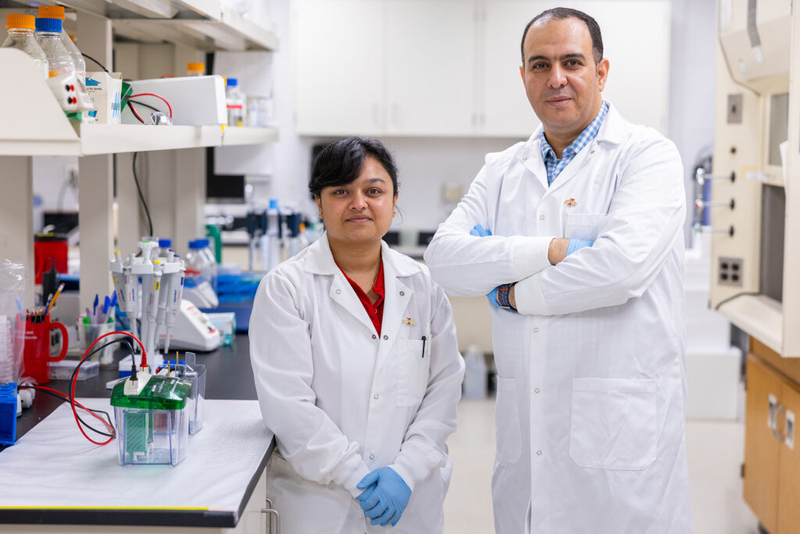
Iowa State University Ph.D. student Namitha Bannimath is working with kinesiology and health professor Khaled Kamal inside the Musculoskeletal Redox and Therapeutics Laboratory. (Photo courtesy of Christopher Gannon/Iowa State University)
Researchers at Iowa State University have earned national recognition for their work connecting the impact of space on astronauts to potential treatments for muscle loss here on Earth.
Khaled Kamal, assistant professor of kinesiology and health at ISU, leads the university’s Musculoskeletal Redox & Therapeutics Laboratory where, along with graduate and undergraduate researchers, he works on different projects to identify biological markers for exercise and create countermeasures to mitigate muscle deterioration.
While he doesn’t want to stretch the lab’s mission, Kamal said the basic science they’re doing will hopefully translate to other fields to help make people’s lives better.
“We try to understand some new mechanisms in space to protect our astronauts, but also we try on the back door to learn from this knowledge and try to provide some new countermeasures for some diseases on Earth,” Kamal said.
Kamal, as well as Ph.D. student Namitha Bannimath and other student researchers, are growing muscle cells and analyzing the DNA of astronauts in order to better understand the processes that lead to astronauts losing muscle much more quickly in space than here on Earth, and whether treatments to tap into those processes can help mitigate muscle loss.
According to the European Space Agency, bone loss during spaceflight occurs at a rate of 1-2% per month, and six months of microgravity can cause as much as a 20% decrease in bone mass, leading astronauts to exhibit osteoporosis symptoms similar to those in older women with the condition on Earth. Short missions have also caused astronauts to lose up to 20% of muscle with countermeasures, and even 50% if no countermeasures are applied.
The lab is focusing on three main projects currently, Kamal said, supported by funding from NASA, nonprofit organizations and ISU. Through his work leading a NASA GeneLab Analysis Working Group and funded by Iowa NASA Established Program to Stimulate Competitive Research, or EPSCoR, the lab is trying “to understand and develop a new biomarker” for astronauts to predict how their muscles and bones could deteriorate in space.
Using 20 years’ worth of blood sample data from more than 42 astronauts, Kamal said they’re trying to track nanoparticles released from tissue that they believe carry important information about immune and other kinds of stress.
Fight Duchenne Muscular Dystrophy, a nonprofit supporting research for a cure to the progressive neuromuscular disorder caused by DMD gene mutation, also provided Kamal’s lab with $100,000 to develop a new treatment to “inject exercise” into children with the disorder. The treatment would provide tissues with vesicles created from healthy, mechanically stretched muscle cells, giving correct signals to the body and improving communication.
“We have a chamber where we can have the muscle cell, we can actually mimic how when the exercise happens, what happens to the muscle cell itself, so we can understand the core biology inside the cell,” Bannimath said. “So that’s what I’m analyzing right now in the lab.”
They’re trying to grow the cells and convert them into actual muscle fibers, Bannimath said, in order to test blocking muscles’ mechanical unloading and potential countermeasures that could be used for astronauts going on missions as far away as Mars.
Kamal said this drug, which the team is registered to patent, earned the team national recognition from the American Physiological Society, having won first place in this year’s Hot Topics in Muscle Biology Award Competition at the society’s June summit.
As for the future of the lab’s work, Kamal said the team has been invited by the European Space Agency to send the muscle cells they’re working with on a suborbital flight, providing the cells with “around 20 seconds of real microgravity,” rather than the simulated conditions made on Earth. There are also other grants they plan to apply for, and they will continue to establish an infrastructure at ISU for this kind of research.
Iowans would especially benefit from the kinds of solutions Kamal’s lab is working on, he and Bannimath said, as the state’s population is older and has high cancer rates that could create problems with muscle disuse and atrophy.
When asked about how it feels to have reached this point in the research Kamal has been conducting in different forms for more than a decade, he said they’ve “just started to open the door for a new field to advance our knowledge,” but they haven’t really done anything yet. Bannimath agreed, saying they’re at the start of a long road she plans to keep forging a path on.
“I think this project is still in the baby steps, we are still walking with the small steps. We have a whole big journey to take ahead,” Bannimath said. “Yeah, it’s going to be wonderful.”

Des Moines, IA