Inside the modern Delaware classroom, teachers balance tech with traditional lessons
Nov 06, 2026 | 5:00 am ET
Description
Photo courtesy of Spotlight Delaware
Why Should Delaware Care?
Elementary school education helps kids build foundational skills for more difficult subjects and for national tests. Spotlight Delaware observed two classes this past fall to see how that education has changed.
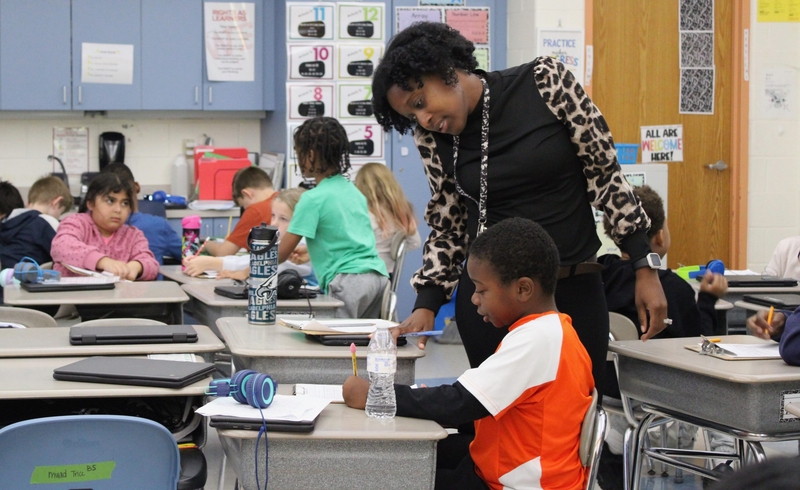
On a sunny Thursday afternoon in October, students in Chadia Garyeazon’s third grade class gather on a blue carpet. Their only instructions are to sit quietly at the front of the classroom and watch a three-minute Disney short film. The lesson of the day is about making inferences.
But sitting quietly and thinking about inferences proves to be difficult for the kids at Southern Elementary School, near Delaware City.
“Ew! Look at them, they’re bald!” multiple students yell as they watch blue birds in the film lose their feathers.
Garyeazon quickly redirects the students back to their task. Describe how the birds seem to feel, she asks the students.
Some students answer the question with just a few words, prompting the teacher to reminds them that as third graders they need to be able to speak in full sentences.
“We’re not just answering the questions,” she tells the students, “we’re gonna restate the question. That way if someone that we don’t know puts up our paper, they know what we’re answering.”
The students may not have realized it during their English Language Arts lesson, but the stranger who could be reading their answers in the future could be a test proctor.
The third grade is an important year for students nationwide, as it comes one year before students participate in national tests, such as the National Assessment on Educational Progress, better known as the Nation’s Report Card.
The lessons in Garyeazon’s class are happening as Delaware debates how to improve student achievement. To that end, Delaware Secretary of Education Cindy Marten in September announced a draft of a plan that could see the state take over low-performing schools, or even hold back third-graders who are far behind grade-level reading and writing.
Holding back third-graders is a tactic that Mississippi educators have used to dramatically increase proficiency scores over the past decade. While the gains have transformed the state into a national model for improving student learning, the tactic has also come under criticism from some as a manipulation of test scores.
Marten said that holding back students in Delaware would be a last-resort option.
For students, the stakes may be high, but Garyeazon’s class does not have to worry today about the possibility of repeating a grade.
Instead, they must simply continue working through and understanding inferences.
“I can infer that [the birds are] all blue,” one of Garyeazon’s students says to his classmates.
Changing education practices
To see what teaching looks like in 2026 amid debates over school funding, test schools and tech in schools, Spotlight Delaware sat in with two classrooms this fall — one in New Castle County and one in Sussex County.
What became clear is that lessons and classroom projects today are similar to those from past generations, but include a digital twist.
For generations, elementary-age students have completed projects about animals and their various habitats.
Garyeazon’s class is no different, as her students have spent days researching mammals. They have learned about the kind of food they eat, where they live, and other basic facts — all to help strengthen their reading, writing, and research skills.
But instead of submitting a final, handwritten report, the third graders are plugging the information into the digital illustration program, Canva, to create a presentation.
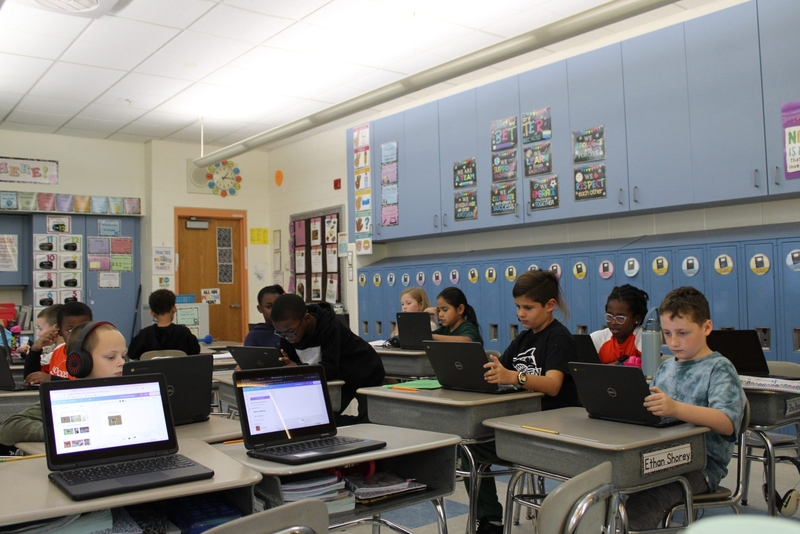
Still, Garyeazon reminds her students that creating a digital presentation is a privilege.
If her students become too distracted with computers or get too rowdy, they will switch back to handwriting the projects.
Still other lessons that were once common in classrooms have been completely changed, or even eliminated, in recent years.
In the past, it was common for students to receive multiplication worksheets with upwards of 30 problems. Students would usually have one minute to complete as many problems as possible.
Those sheets do not exist in Brent Evans’ fourth grade classroom at Seaford Central Elementary School. Evans said his students focus more on conceptual knowledge than on memorization.
He noted when he was a student, he knew “three times three was nine because my teacher told me it was nine on my flashcard.”
“Now the kids realize that it’s three groups of three,” he said.
Building student confidence
Last spring, results from the 2026 Education Scorecard — a large-scale academic study of federal and state testing data by researchers from Harvard and Stanford universities – placed Delaware fourth out of 38 states in math recovery and in the top half of states in reading recovery between 2022 and 2025.
Additionally, a handful of school districts in the state, including Seaford, were reported to be among the top 500 in the country for math gains during those three years.
Seaford Director of Instruction Kirsten Jennette credited the increase in part to the district’s efforts to use “illustrative math,” which helps students understand concepts rather than just step-by-step math processes.
The illustrative math that begins when Seaford students are in kindergarten is carried into Evans’ classroom.
By the time students are in fourth grade, they are focusing on breaking numbers apart to create fractions. They are also using more advanced math vocabulary, like equivalent and non-equivalent fractions.
The vocabulary and illustrative math translate into students’ work as they sit in pairs and draw what fractions look like on whiteboards.
Much of the work in Evans’ class is split between individual and group work, where students work together in pairs to solve answers before coming together as a class.
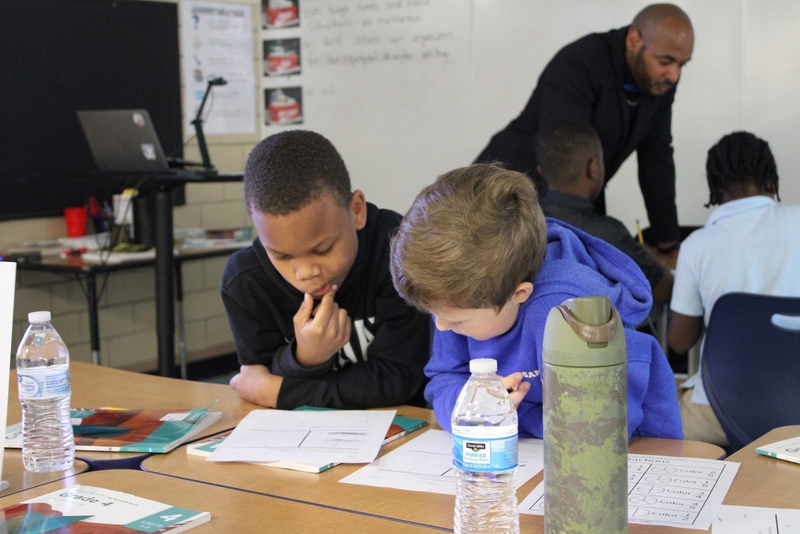
Having students work together in small groups helps teachers, who listen in on their conversations, gain a better idea of how many kids understand the lesson, according to Seaford’s Curriculum and Instruction Specialist Amber Hastings.
And teachers in Seaford classrooms do not randomly call on students.
Instead, they allow students to work with tablemates before the class comes together to answer questions.
Hasting says the technique gives educators a better understanding of where the whole class is, rather than just hearing from one or two students who raised their hands to answer a question.
Evans also sees it as a way for students, who may not speak up in front of the full class, to build confidence.
“If you had had the opportunity before answering a question out loud individually to think by yourself and then talk to somebody about your answer, would you have felt more confident saying it?” Evans said.
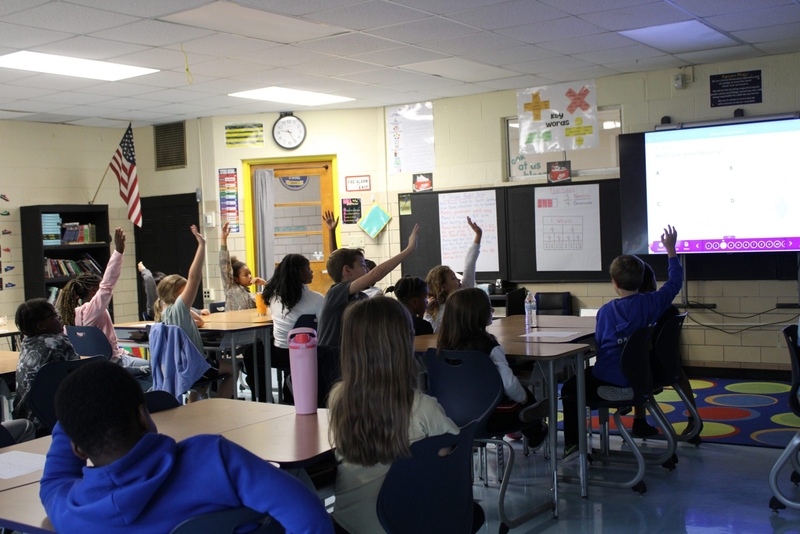
In Evans class last month, nearly half of the students raised their hands to answer a question about how to demonstrate one-fourth. None appeared afraid to possibly answer questions incorrectly.
One student tells Evans to draw a rectangle and draw three lines, but “not too close” to one another.
The class erupts as their teacher draws lines inside the rectangle, claiming he did not draw them correctly. In turn, Evans tells his students that their classmate may not have been clear enough in her explanation.
Like Garyeazon does with her third graders in the Colonial School District, Evans subtly reminds his students that they must be “very specific” when explaining their answers.
“If you remember when we did our word problems, remember we said our answers always have to be precise,” Evans tells the students. “We have to use our math vocabulary.”
Another student raises her hand and gives Evans an answer he is satisfied with.
After working with their whiteboards, the fourth graders continue to drill down their new math skills with practice worksheets.
Another buzz fills the classroom as students turn to one another to work through their practice sheet.
“Which diagram matched up with two-thirds?” Evans asks his class.
Multiple hands shoot into the air — highlighting Evans’ philosophy that students need to feel confident to participate, and should not be afraid to get questions wrong.
“Letter B,” a student says to Evans,
“Letter B, that has two shaded in out of three parts, I like that,” Evans tells his students.

Dover